
InsightsHealthcare
AI Clinical Documentation Software: The Complete 2026 Guide
The complete 2026 guide to AI clinical documentation software: real evidence, legal risks, EHR integration, and build-vs-buy costs.
The average physician spends roughly two hours on documentation for every hour of direct patient care. That ratio has barely moved in a decade despite the widespread adoption of electronic health records that were supposed to make documentation easier.
AI clinical documentation software is changing this in a way that previous tools did not. Not by asking physicians to change how they document, but by listening to how they already work, capturing the clinical encounter as it happens, and generating structured clinical notes automatically so that documentation happens alongside patient care rather than instead of it.
In 2026 this is no longer an emerging category. It is one of the most widely adopted healthcare technologies in the United States, with ambient tools running in major health systems, independent practices and specialty clinics across the country. It is also one of the most legally exposed, with active class-action litigation over patient consent and a documented gap between what vendors claim and what controlled studies measure.
This guide covers what healthcare organisations and healthtech companies actually need to know: how the technology works, what the evidence really shows, the two separate legal regimes that govern it, what it costs to build, and how to decide whether building is the right move at all.
Key Takeaways
The measured evidence is more modest than the marketing. Controlled multisite research reports time savings in the range of 13 to 16 minutes, while clinician self-report and vendor case studies routinely claim 30 to 70%. Plan against the measured numbers.
Burnout reduction is the better-supported benefit. Peer-reviewed data shows burnout falling from 51.9% to 38.8% of clinicians after 30 days of use, which is a stronger and more consistent finding than raw time savings.
Two legal regimes apply, not one. HIPAA governs what happens to the audio after it exists. State wiretapping and all-party consent statutes govern whether recording it was lawful at all. A fully HIPAA-compliant deployment can still create criminal exposure in some states.
Hallucination in the transcription layer is documented, not theoretical. Published research found fabricated text in a measurable share of transcriptions from a widely used open ASR model, with roughly 40% of those fabrications classified as harmful or concerning.
EHR integration decides adoption. A tool that produces excellent notes but requires manual transfer into the EHR reintroduces the exact time cost it was meant to remove.
Building a general-purpose ambient scribe in 2026 is usually the wrong call. Epic ships native AI charting, and the independent market is consolidated and well funded. Build when you have a specialty, workflow, language or market that incumbents do not serve.
Custom build cost runs $80,000 for a focused single-specialty MVP to $400,000+ for a multi-specialty platform. Annual maintenance runs $30,000 to $80,000.
What Is AI Clinical Documentation Software?
AI clinical documentation software is a category of healthcare technology that uses speech recognition, natural language processing, and large language models to capture, structure, and generate clinical documentation from healthcare encounters, producing a draft note the clinician reviews and approves rather than writes from scratch.
Traditional clinical documentation requires physicians and clinical staff to manually type or dictate their observations, assessments, and plans into the electronic health record. This is time-consuming, happens after the encounter rather than during it, and is a primary contributor to physician burnout in the United States.
AI clinical documentation software automates that process. It listens to or analyses clinical encounters, extracts clinically relevant information, structures it according to clinical documentation standards, and generates draft notes for clinician review.
The result is a fundamentally different documentation workflow, one that produces clinical records as a byproduct of clinical care rather than as a separate task that follows it.
Why are health systems adopting AI clinical documentation in 2026?
Health systems are adopting AI clinical documentation in 2026 primarily as a clinician retention and burnout intervention, secondarily for documentation completeness that supports value-based reimbursement, and increasingly because it has become a recruiting expectation rather than a differentiator.
Burnout is the primary driver. Medscape's 2025 physician burnout reporting put burnout symptoms at roughly 49% of US physicians, with documentation load consistently among the top contributors. The peer-reviewed burnout reduction associated with ambient documentation is the most defensible outcome in the category.
Recruiting and retention pressure. Once a critical mass of local competitors offer ambient documentation, not offering it becomes a recruiting liability. Several health systems now describe deployment as a retention necessity rather than an efficiency project.
Documentation completeness affects revenue. Under value-based care arrangements, richer and more accurate documentation supports more complete and accurate coding, which flows directly to reimbursement. This has made documentation quality a CFO-level metric rather than purely a clinician satisfaction question.
EHR vendors have removed the friction. Epic launched native AI charting in limited availability in early 2026 and added additional ambient vendors to its Toolbox programme. When the capability appears inside the EHR's own interface, the adoption barrier largely disappears.
The market has scaled accordingly. Ambient scribe revenue grew from under $200M in 2022 to an estimated $5B or more by end-2026 on combined analyst estimates, and over 70% of large integrated delivery networks had deployed or were piloting at least one solution as of KLAS Research's 2025 reporting.
How AI Clinical Documentation Software Works
AI clinical documentation software works in six stages: audio capture, medical speech recognition, clinical NLP extraction, note generation, EHR integration with clinician review, and continuous learning from clinician edits.
Step 1: Audio Capture
The clinical encounter is captured through a microphone, either a dedicated ambient device in the examination room, a smartphone running the documentation app, or a wearable microphone worn by the clinician.
Audio quality matters significantly for downstream NLP accuracy. Background noise, accents, medical terminology, overlapping speech, and variable recording distances all create challenges for speech recognition systems in clinical environments.
Step 2: Speech Recognition and Transcription
The captured audio is processed by a speech recognition model that converts spoken language to text. Medical speech recognition requires specialized models trained on clinical vocabulary; standard consumer speech recognition performs poorly on the technical language of clinical encounters.
Clinical speech recognition must handle:
Medical terminology, drug names, and anatomical terms
Clinical abbreviations and acronyms
Multiple speakers: physician, patient, family members
Non-English words and phrases common in clinical settings
Variable audio quality and background noise
Step 3: Clinical NLP and Information Extraction
The transcript is processed by NLP models that identify and extract clinically relevant information: chief complaint, history of present illness, review of systems, physical examination findings, assessment, and plan.
This extraction must distinguish between clinically relevant content and conversational content, identifying that "the pain started three weeks ago" is a relevant clinical detail while "I know that appointment took a while, I'm sorry about that" is not.
Step 4: Note Generation and Structuring
The extracted clinical information is formatted into a structured clinical note according to the appropriate template: SOAP note, H&P, progress note, procedure note, discharge summary, and the documentation requirements of the target EHR.
Generative AI models increasingly handle this step, taking extracted clinical information and generating natural, well-written clinical prose that reads like a note a physician would write rather than a robotic transcript of the encounter.
Step 5: EHR Integration and Physician Review
The generated draft note is pushed to the physician's review interface either within the EHR, in a companion application, or as a structured draft in the documentation workflow. The physician reviews, edits as needed, and approves.
The approved note is written to the appropriate location in the EHR through an HL7 FHIR integration, becoming part of the permanent clinical record.
Step 6: Continuous Learning
The physician's edits to draft notes are captured as feedback signals, allowing the system to learn the physician's documentation preferences, specialty-specific terminology, and documentation style over time. Systems that support physician-level personalization consistently achieve higher adoption and higher documentation quality than those with one-size-fits-all note generation.
Types of AI Clinical Documentation Software
1. Ambient Clinical Intelligence
Ambient clinical intelligence tools listen passively to the clinical encounter; the physician does not need to activate recording, use a specific verbal trigger, or change their behavior in any way. The system is always on, always listening, and generates a draft note at the end of the encounter.
This is the highest-value form of AI clinical documentation because it requires zero workflow change from the physician. It is also the most technically demanding, requiring robust speaker separation, noise cancellation, and clinical NLP that can handle the full range of clinical encounter types.
Top ambient tools: Abridge, Nuance DAX Copilot, Nabla Copilot, Suki AI
2. Dictation-Based AI Documentation
Dictation-based tools require the physician to actively dictate their clinical observations and plans into a recording interface that the AI then structures into a formatted note.
This category builds on traditional medical dictation, replacing the transcription step with AI-powered structuring and formatting. It is less seamless than ambient documentation but more predictable in its input quality.
3. Post-Encounter Documentation AI
Post-encounter tools process a recording of the clinical encounter captured by the physician or automatically from a room device after the patient has left. The AI generates the draft note from the encounter recording for physician review.
This approach is simpler than true real-time ambient documentation but introduces a slight lag between encounter and note generation.
4. Structured Data Capture AI
Rather than generating free-text notes, structured data capture tools use NLP to populate specific EHR fields, diagnosis codes, medication lists, vital signs, and problem lists from clinical encounter content. These tools are particularly valuable in high-volume documentation environments where specific data elements need to be captured consistently.
What features does an AI clinical documentation platform need?
High-Accuracy Medical Speech Recognition
The foundation of any AI clinical documentation system is speech recognition that performs reliably in clinical environments with clinical vocabulary, variable audio quality, and the range of accents and communication styles present in US healthcare settings.
Accuracy requirements for clinical documentation are higher than for general speech recognition because errors in clinical notes can affect patient care. Medical speech recognition systems should be validated for clinical accuracy before production deployment.
Clinical NLP and Information Extraction
The NLP layer that extracts clinically relevant information from conversation transcripts must be trained on clinical data, not general conversational data. Clinical encounters have specific structures, vocabularies, and information patterns that require specialized models.
Fabrication detection and grounding verification
Every generated clinical statement must be traceable to something actually said in the encounter. This is a discrete engineering component, not a property that emerges from using a good model. It is covered in detail in the hallucination section below.
Specialty-Specific Note Templates
Different clinical specialties have different documentation requirements, different vocabularies, and different note structures. An internal medicine H&P looks very different from an orthopedic surgical note, a psychiatry intake assessment, or an emergency medicine fast track note.
AI clinical documentation systems that support specialty-specific templates and ideally, physician-level customization of those templates achieve significantly higher adoption than those with generic note formats.
EHR Integration
EHR integration is the single most important technical requirement for AI clinical documentation adoption. A documentation tool that generates high-quality notes but requires physicians to manually copy them into the EHR will not be used consistently.
Our EHR and EMR integration practice builds HL7 FHIR-based integrations that write AI-generated documentation directly to the appropriate locations in the EHR, making the documentation workflow genuinely seamless rather than just faster than traditional dictation.
Physician Review and Edit Interface
The interface through which physicians review and approve AI-generated notes needs to be fast, intuitive, and available on the devices physicians actually use: workstation, tablet, or smartphone.
Key design requirements:
Draft note displayed in the physician's preferred format immediately at encounter end
Clear indication of AI-generated versus physician-confirmed content
Efficient editing tools that support rapid modification
One-click approval for notes that require minimal editing
Audit trail showing what was AI-generated versus physician-written
Our healthcare UI/UX design team designs documentation review interfaces tested with real physicians from the target specialty because interface friction at the review stage is the point where physician adoption most commonly breaks down.
HIPAA-Compliant Audio Handling
Audio recordings of clinical encounters are protected health information. The recording, transmission, storage, and processing of encounter audio must comply with HIPAA, including encryption at every step, access controls restricting audio access to authorized users, and audit logging of all audio data interactions.
This compliance requirement extends to the NLP processing infrastructure; audio and transcripts processed by cloud-based AI services must be handled through HIPAA-eligible service configurations with Business Associate Agreements in place.
Performance Monitoring and Feedback Capture
A documentation system that cannot measure its own performance cannot improve. Monitoring should capture:
Documentation time per encounter (before and after AI)
Physician edit rate: the percentage of AI-generated content modified
Note completion time after encounter
Physician satisfaction scores
EHR write success rates
Physician edit data is particularly valuable; it reveals what the AI is getting wrong systematically and drives model improvement over time.
How do you build AI clinical documentation software? A 10-step process
Step 1: Define the Clinical Documentation Workflow and Target Specialty
AI clinical documentation software development begins with a precise definition of the documentation workflow, which clinical encounter types the system will document, which EHR it will integrate with, which note templates it will generate, and which clinical specialties it will serve.
Different specialties have dramatically different documentation requirements. Building a general-purpose documentation system that tries to serve all specialties equally is significantly more complex and typically less successful than building a focused system for a specific specialty or encounter type.
Step 2: Determine Regulatory Classification
Pure AI clinical documentation tools those that capture and structure clinical information without making clinical recommendations are generally not regulated as Software as a Medical Device. However, if the documentation system includes clinical decision support elements suggesting diagnoses, flagging documentation gaps with clinical implications, or providing coding recommendations, the regulatory status may be more complex.
Our MVP and product strategy process addresses regulatory classification before development begins because the intended use statement for a clinical documentation tool significantly affects both the development requirements and the compliance architecture.
Step 3: Build the Audio Capture and Processing Infrastructure
The audio capture and processing pipeline is the technical foundation of any AI clinical documentation system. This includes:
Microphone selection and integration: dedicated room devices, smartphone microphones, or wearables
Audio capture and streaming infrastructure
Speaker diarization: identifying who is speaking at each moment
Noise cancellation and audio enhancement
Audio storage with HIPAA-compliant encryption
Audio quality at this stage directly determines the accuracy of everything downstream. Investment in audio processing infrastructure pays dividends throughout the system.
Step 4: Develop and Fine-Tune the Speech Recognition Model
Build or fine-tune a speech recognition model for clinical vocabulary. Options include fine-tuning existing large ASR models Whisper, Wav2Vec, or commercial medical ASR APIs on clinical encounter data, or building custom models for specific specialty vocabularies.
The training data for clinical ASR should include examples of the specific encounter types the system will document, including the accents, vocabularies, and communication styles present in the target clinical environment.
Step 5: Build the Clinical NLP Pipeline
The NLP pipeline processes the transcript and extracts clinically relevant information structured according to the target note format.
This pipeline includes:
Named entity recognition for clinical entities: symptoms, diagnoses, medications, procedures, anatomical terms
Section classification identifying whether content belongs in HPI, ROS, physical exam, assessment, or plan
Relevance filtering distinguishing clinically relevant content from conversational content
Relationship extraction identifying relationships between clinical entities (medication dose, symptom duration, diagnosis rationale)
Our AI and ML solutions team has experience building clinical NLP pipelines that handle the vocabulary, structure, and information density of clinical encounters in specific healthcare specialties.
Step 6: Implement Note Generation
The note generation component takes structured clinical information from the NLP pipeline and generates natural clinical prose in the appropriate template format.
Large language models fine-tuned on clinical documentation examples are increasingly used for this step, generating note text that reads naturally and follows the documentation conventions of the target specialty. Guardrails must be implemented to prevent hallucinated AI generation of clinical content that was not present in the encounter, which is a patient safety concern in clinical documentation.
Step 7: Build the EHR Integration Layer
The EHR integration layer connects the documentation system to the target EHR, reading relevant patient context to improve note generation and writing completed documentation to the appropriate EHR record locations.
HL7 FHIR is the current standard for EHR integration in the United States. The specific FHIR resources used depend on the documentation being written: DocumentReference for clinical notes, Composition for structured documents, and DiagnosticReport where relevant.
Our API integration services team builds these EHR integrations with the healthcare interoperability expertise that makes them reliable in production, including the authentication patterns and data format requirements of specific EHR platforms.
Step 8: Implement HIPAA Compliance Architecture
Implement full HIPAA compliance architecture before any patient encounter audio is processed:
AES-256 encryption for all audio recordings and transcripts at rest
TLS 1.2+ for all data in transit
Role-based access controls restricting audio and transcript access
Comprehensive audit logging of all interactions with encounter data
Business Associate Agreements with cloud providers, NLP APIs, and all third-party services
Our HIPAA-compliant software development practice builds these requirements into the documentation architecture from the beginning the only approach that avoids the expensive remediation that compliance-as-afterthought creates.
Step 9: Build the Physician Review Interface
Design and build the interface through which physicians review, edit, and approve AI-generated notes. This interface must be:
Available on the devices physicians use at the point-of-care workstation, tablet, or smartphone
Fast and responsive; physicians will not use a slow documentation review interface
Integrated with the EHR workflow, ideally accessible from within the EHR itself
Designed to minimize edit friction, making quick corrections easy
Test this interface with real physicians from the target specialty in realistic clinical conditions before production deployment.
Step 10: Pilot, Monitor, and Improve
Deploy with a structured pilot in a defined clinical environment with specific success metrics: documentation time per encounter, physician edit rate, note quality scores, adoption rate. Monitor continuously after deployment and use physician feedback and edit data to drive ongoing model improvement.
Our DevOps and cloud solutions team builds the monitoring and continuous learning infrastructure that keeps an AI clinical documentation system improving over time.
Technology Stack for AI Clinical Documentation Software
Audio and Speech Processing
Component: Speech Recognition
Technology: OpenAI Whisper/custom fine-tuned ASR
Why: Medical ASR accuracy, open ecosystem
Component: Speaker Diarization
Technology: pyannote.audio
Why: Multi-speaker identification
Component: Audio Enhancement
Technology: WebRTC Audio Processing / RNNoise
Why: Noise reduction for clinical environments
Component: Medical ASR APIs
Technology: Nuance / Google Medical ASR
Why: Pre-built medical vocabulary
Clinical NLP
Component: Clinical NER
Technology: scispaCy / custom transformer models
Why: Medical entity recognition
Component: Section Classification
Technology: Fine-tuned BERT / clinical BERT
Why: Clinical document structure understanding
Component: Note Generation
Technology: GPT-4o / Claude / fine-tuned LLaMA
Why: Natural clinical prose generation
Component: Hallucination Detection
Technology: Custom verification models
Why: Patient safety, preventing false clinical content
Backend Infrastructure
Component: Backend API
Technology: Python / FastAPI
Why: AI ecosystem, high-performance async
Component: Audio Storage
Technology: AWS S3 (HIPAA-eligible)
Why: Encrypted, scalable audio storage
Component: Processing Queue
Technology: AWS SQS / Apache Kafka
Why: Async audio processing pipeline
Component: Database
Technology: PostgreSQL
Why: Structured clinical and encounter data
Cloud and Compliance Infrastructure
Component: Primary Cloud
Technology: AWS or Azure
Why: HIPAA-eligible service catalogs
Component: Encryption
Technology: AWS KMS / Azure Key Vault
Why: HIPAA-compliant key management
Component: Audit Logging
Technology: AWS CloudTrail
Why: Comprehensive HIPAA audit trail
Component: Model Serving
Technology: Amazon SageMaker
Why: Managed model deployment and scaling
Component: Monitoring
Technology: Datadog / CloudWatch
Why: System and model performance monitoring
EHR Integration
HL7 FHIR R4 Document Reference, Composition, and Observation resources for clinical note integration. Epic SMART on FHIR for Epic-specific integrations. HL7 v2 for legacy EHR connections where FHIR is not supported.
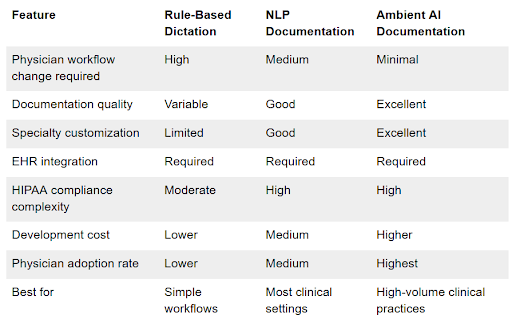
AI Clinical Documentation Software: Feature Comparison Table
What are the HIPAA requirements for AI clinical documentation?
Encounter audio, transcripts, and draft notes are all protected health information, so an AI clinical documentation system must encrypt them in transit and at rest, restrict access by role, log every interaction, execute a Business Associate Agreement with every vendor in the pipeline, and enforce a defined retention and deletion policy.
Why clinical encounter audio is especially sensitive
Audio recordings of clinical encounters are among the most sensitive forms of protected health information; they capture not just structured health data but the patient's voice, the content of deeply personal conversations with their physician, and information that patients may not have disclosed elsewhere.
This sensitivity creates specific compliance obligations that go beyond standard PHI handling requirements.
Key HIPAA Requirements
Consent and notice. Patients must be notified that encounters are being recorded for AI documentation purposes. While HIPAA does not require explicit consent for recording in most clinical contexts, organizational policy and state law may impose additional requirements.
Minimum necessary. The audio and transcripts generated by an AI documentation system should be retained only as long as necessary for their documentation purpose. Clear retention policies and technical implementation of those policies are required.
Business Associate Agreements. Every service that processes audio or transcripts, cloud storage, speech recognition APIs, NLP services, and model training infrastructure requires a signed BAA. Verify BAA availability for every third-party service before including it in the documentation architecture.
Encryption at every step. Audio must be encrypted during capture, in transit from the capture device to the processing infrastructure, during processing, and at rest in storage. Transcripts must be encrypted at rest and in transit. Generated notes must be handled as PHI until they are written to the EHR.
De-identification for model training. If encounter audio or transcripts are used to train or fine-tune AI models, they must be properly de-identified under HIPAA standards before use for that purpose or covered by appropriate patient authorization.
Does AI clinical documentation software need FDA clearance?
Pure clinical documentation tools that capture and structure information without making clinical recommendations are generally not regulated as Software as a Medical Device and do not require FDA clearance. Adding decision support, diagnostic suggestion or coding recommendation changes that analysis.
Generally outside FDA jurisdiction:
Transcription and note generation from encounter content
Structuring information into standard note templates
Populating EHR fields with information stated in the encounter
May require regulatory review:
Real-time clinical prompts delivered to the clinician during the encounter
Diagnostic suggestion or differential generation
Documentation gap flagging with clinical implications
Coding recommendations that influence clinical characterisation
Risk scoring derived from encounter content
The distinction turns on intended use and clinical claims, not on the underlying technology. Some ambient tools now ship transcript-adjacent clinical prompts as premium features, and those features can carry a different regulatory posture than the documentation function they sit alongside. Review feature roadmaps for this specifically, and make the determination with regulatory counsel before development begins.
What is the designated record set problem?
If encounter audio or raw transcripts are retained and used for anything beyond generating the draft note, they can become part of the designated record set, which makes them subject to patient access rights and discoverable in litigation.
This is a governance question that engineering decisions quietly determine, and it catches organisations by surprise.
The signed note is the medical record. The audio and the raw transcript are the working material that produced it. But if the transcript is retained indefinitely, referenced in care, or used to resolve questions about what happened in a visit, the argument that it is merely working material weakens.
Practical implications:
Define retention duration for audio and transcripts explicitly, and enforce it technically with storage lifecycle policies rather than a written procedure
Keep the signed note as the authoritative artefact and make sure clinicians finalise notes promptly, so the transcript never functions as the de facto record by default
Decide deliberately whether transcripts are patient-accessible, and be able to defend the decision
Understand that anything you retain is discoverable, including audio of everything else said in the room
Build reminders that prevent notes sitting unsigned, because an unsigned note plus a retained transcript is the worst combination
AI Clinical Documentation Development Checklist
Clinical Foundation
Target specialty and encounter types defined
Documentation templates for target specialties developed
Clinical reviewers identified for NLP validation
Hallucination prevention strategy defined
Audio and Speech Processing
Microphone and audio capture approach selected
Speaker diarization implemented
Audio quality testing completed in representative clinical environments
Medical vocabulary coverage validated
Clinical NLP and Note Generation
Clinical NER models trained and validated on target specialty content
Section classification validated against real clinical encounter transcripts
Note generation guardrails implemented to prevent hallucination
Specialty-specific note templates implemented and tested
EHR Integration
Target EHR integration designed using HL7 FHIR
Authentication and authorization with EHR implemented
Note write integration tested with production EHR instance
Physician review interface integrated with EHR workflow
HIPAA Compliance
Patient consent and notice process documented
Encryption implemented for audio, transcripts, and notes
Role-based access controls implemented
Audit logging configured for all PHI interactions
BAAs in place with all third-party services
Data retention and deletion policies implemented
Deployment and Monitoring
Clinical pilot defined with specific success metrics
Documentation time measurement implemented
Physician edit rate monitoring configured
Continuous learning pipeline built for model improvement
Common Mistakes to Avoid
1. Using General Speech Recognition Instead of Medical ASR
General speech recognition models, including many consumer-grade ASR services, perform poorly on clinical vocabulary, medication names, and the overlapping speech common in clinical encounters. Medical speech recognition requires models specifically trained or fine-tuned on clinical data.
2. Not Building Hallucination Prevention
AI note generation that produces clinical content not present in the encounter is a patient safety issue. Documentation systems that do not implement hallucination prevention, verifying that generated clinical content is grounded in the encounter transcript, should not be used in clinical settings.
3. Treating EHR Integration as Optional
A documentation tool that requires physicians to manually copy AI-generated notes into the EHR will not be adopted consistently. EHR integration is not an enhancement it is the feature that determines whether the tool delivers value or creates new administrative steps.
4. Ignoring Audio Quality at the Capture Stage
Poor audio quality at the capture stage cascades through every subsequent processing step. Investment in high-quality audio capture infrastructure, appropriate microphones, room acoustic considerations, and noise cancellation delivers returns at every downstream stage of the documentation pipeline.
5. One-Size-Fits-All Note Templates
Physicians in different specialties document differently. A primary care progress note, an orthopedic surgical note, and a psychiatry intake all have different structures, vocabularies, and information priorities. Documentation systems that impose a single template format on all specialties achieve lower adoption and lower documentation quality than those with specialty-specific and physician-customizable templates.
6. Skipping the Physician Pilot
AI documentation systems that look impressive in controlled demonstrations often reveal significant gaps when used by real physicians in real clinical conditions. A structured pilot with physician feedback collection is the investment that reveals these gaps before they affect broad deployment.
How Codieshub Builds AI Clinical Documentation Software
At Codieshub, we build AI clinical documentation software for healthcare organizations that need solutions designed for the specific specialties, workflows, and EHR environments they operate in, not generic documentation tools that require clinical workflows to adapt to the software.
Every AI clinical documentation engagement begins with our MVP and product strategy process, which addresses clinical workflow design, specialty-specific documentation requirements, EHR integration architecture, and HIPAA compliance requirements before production code is written. Our AI and ML solutions team builds medical speech recognition, clinical NLP, and note generation models with hallucination prevention built in because documentation that introduces clinical content not present in the encounter is not just poor quality; it is a patient safety issue.
Our healthcare UI/UX design team designs physician review interfaces tested with real physicians from the target specialty in realistic clinical conditions. Our EHR and EMR integration team builds HL7 FHIR-based integrations that write completed documentation directly to the EHR. Our HIPAA-compliant software development practice builds encryption, access controls, audit logging, and BAA management into the architecture from day one. And our DevOps and cloud solutions team builds the monitoring and continuous learning infrastructure that keeps the documentation system improving as it accumulates physician feedback and encounter data.
Get a Free Project Estimate: Tell us about your AI clinical documentation project, and we will send you a tailored development and compliance game plan within 48 hours.
Conclusion
AI clinical documentation software is addressing one of the most persistent and consequential problems in US healthcare: the documentation burden that consumes physician time, contributes to burnout, and reduces the time available for actual patient care.
The tools that are delivering real impact in 2026 are not just faster documentation systems. They are ambient systems that listen to clinical encounters and generate structured clinical records automatically, making documentation happen as a byproduct of care rather than instead of it.
Building a documentation system that actually works in clinical environments requires medical speech recognition that performs reliably on clinical vocabulary, clinical NLP that extracts structured information accurately, note generation with hallucination prevention built in, EHR integration that makes the workflow genuinely seamless, and HIPAA compliance architecture that protects the audio of deeply personal clinical conversations.
At Codieshub, we bring all of these capabilities to AI clinical documentation projects from the initial clinical workflow design and compliance architecture through NLP development, EHR integration, and the continuous learning infrastructure that keeps the system improving with every clinical encounter.
Book a Free Consultation: Let's discuss your AI clinical documentation goals and map out a development and compliance strategy tailored to your needs.
Frequently Asked Questions
1. What is AI clinical documentation software?
AI clinical documentation software uses speech recognition, NLP, and generative AI to capture and generate clinical notes from healthcare encounters. Advanced tools include ambient listening, passively listening to conversations and creating draft notes automatically, which physicians review and approve, replacing manual dictation or typing after patient visits.
2. How does ambient clinical documentation AI work?
It captures encounter audio via microphone, room device, or wearable, processes it through medical speech recognition for a transcript, then clinical NLP structures the information into templates. Generative AI creates clinical prose, physicians review the draft, and it's written to the EHR via HL7 FHIR integration.
3. Does AI clinical documentation software need to be HIPAA compliant?
Yes. Encounter audio is protected health information under HIPAA. Systems must encrypt audio and transcripts in transit and at rest, enforce role-based access, maintain audit logs, and sign Business Associate Agreements with third parties. Compliance architecture must be built in from the start, not retrofitted.
4. Does AI clinical documentation software need FDA clearance?
Pure documentation tools that capture and structure information without clinical recommendations generally aren't regulated as Software as a Medical Device and don't require FDA clearance. If the system adds decision support, diagnosis suggestions, or coding recommendations, regulatory classification should be reviewed by FDA digital health counsel.
5. What is the most important technical requirement for adoption?
EHR integration. Tools generating quality notes but requiring manual transfer to the EHR won't see consistent adoption, since that reintroduces the time cost the AI was meant to eliminate. HL7 FHIR-based integration writing notes directly to the correct record location drives real-world clinical adoption.
6. What is hallucination in AI clinical documentation and why does it matter?
Hallucination refers to AI-generated content absent from the actual encounter fabricated symptoms, diagnoses, medications, or findings. This is a patient safety concern since inaccurate records affect future care decisions. Systems must verify generated content is grounded in the transcript before clinical deployment.
7. How long does it take to build AI clinical documentation software?
A focused MVP for one specialty and EHR environment takes 6 to 12 months. A full multi-specialty platform with multiple EHR integrations and advanced AI takes 12 to 24 months. Key timeline drivers are clinical NLP development, EHR integration complexity, and HIPAA compliance architecture.
8. How much does it cost to build AI clinical documentation software?
A single-specialty MVP typically costs $80,000–$180,000, while a full multi-specialty platform with advanced AI and multiple EHR integrations costs $200,000–$400,000+. Main cost drivers are NLP development, medical speech recognition fine-tuning, and EHR integration scope. Annual maintenance runs $30,000–$80,000.