
InsightsHealthcare
How to Choose an AI Healthcare Development Partner: The Complete 2026 Guide
Learn how to choose the right AI healthcare software development company in 2026—what to verify, what to ask, and red flags to avoid.

Choosing the wrong AI healthcare software development company is one of the most expensive mistakes a healthcare startup, health system, or clinic can make.
It is not just the wasted budget. It is the months of lost time. The compliance gaps discovered after launch. The EHR integration that breaks in production. The clinical workflow that physicians abandon within a week because nobody bothered to watch them actually use the product before shipping it.
The right partner does not just write code. It understands clinical environments, navigates HIPAA from the architecture up, builds AI that clinicians trust, and stays invested long after the delivery milestone.
In 2026, the number of firms claiming AI healthcare capability has grown fast. The number that can deliver in live clinical environments, with evidence, has not. Around 78% of health systems now have AI projects underway. That volume of demand has pulled in a lot of vendors whose healthcare experience is a wellness app and a landing page.
This guide tells you exactly how to tell the difference.
Key Takeaways
The right AI healthcare software development company has shipped live HIPAA-compliant AI products into real clinical environments, not healthcare mockups, not wellness apps.
HIPAA compliance is an architecture decision, not a checklist. It is made before production code, or it is paid for twice.
EHR integration experience must be verifiable at the level of named platform, named FHIR release, and named certification pathway.
AI explainability is an adoption requirement, not a feature. Clinicians who cannot interrogate a recommendation will not act on it.
Clinical validation is not benchmark accuracy, ask for sensitivity, specificity, PPV at real prevalence, calibration, and external validation on a site the model never saw.
Discovery quality is the single strongest predictor of outcome. The right company resolves regulatory classification, compliance architecture, and workflow fit before the engineering meter starts.
Red flags are more reliable than green flags. Evaluate what a vendor cannot explain, not what it claims.
Budget $80K–$200K for a focused clinical AI MVP and $200K–$600K+ for a full platform with EHR integration, and separately budget inference costs, which most buyers miss entirely.
What Is an AI Healthcare Software Development Company?
An AI healthcare software development company is a development partner with demonstrable expertise at the intersection of applied machine learning, clinical workflow design, healthcare data standards, and US healthcare regulation, as distinct from a general software agency that has delivered a few healthcare projects.
General software agencies build products that are technically functional but clinically problematic, missing HIPAA requirements, unable to integrate with EHR systems, designed for users the development team imagined rather than clinicians they observed.
The right AI healthcare software development company brings four specific capabilities that general agencies do not have.
Clinical domain knowledge. Understanding how a radiologist reads a worklist, how a nurse triages an alert, how an elderly patient navigates a health app under cognitive stress, and using this understanding to build products that fit real clinical environments rather than ideal ones.
HIPAA compliance architecture. Building encryption, access controls, audit logging, and Business Associate Agreement management into the foundation of every system, not as a retrofit at the end.
Healthcare data standards experience. HL7, FHIR, DICOM: the standards that govern how healthcare data moves between clinical systems. Real experience means having built these integrations before, learned where they fail, and knowing how to make them reliable in production.
AI built for clinical trust. Explainability, confidence scoring, and uncertainty quantification the features that determine whether clinicians actually use AI recommendations or dismiss them. Companies without this understanding build impressive demos that generate poor adoption.
Regulatory literacy beyond HIPAA. FDA SaMD classification, ONC HTI-1 decision-support transparency obligations, 42 CFR Part 2 for substance use records, and the emerging state AI statutes. Most vendor content stops at HIPAA. Most 2026 risk does not.
How to Choose an AI Healthcare Software Development Company: The Right Framework
Choose by defining your project's two or three highest-risk challenges first, then evaluating every vendor specifically against those challenges, not against their general capability, team size, logo wall, or hourly rate.
Here is how to get to that answer.
What Should You Define Before You Start Evaluating Vendors?
Before you contact a single vendor, write down the two or three technical and compliance challenges that will determine whether your project succeeds or fails, because those become your entire evaluation rubric.
Typically one of:
HIPAA architecture for an AI system processing PHI at scale
Integration with a specific EHR at a specific health system
Clinical accuracy sufficient for a diagnostic or triage claim
FDA classification uncertainty
A patient-facing interface for users who are elderly, anxious, or low-literacy
Model performance that must hold across demographic subgroups
Score every vendor against those. Ignore the rest of their service list.
How Do You Verify a Vendor Has Real Clinical Deployment Experience?
Verify clinical deployment by asking for products that are in active clinical use today, at named organisations, with a measured clinical or operational outcome, because a product that shipped and was abandoned tells a completely different story from one that has grown since launch.
Ask for the clinical context, the AI capability delivered, the compliance obligations addressed, and the outcome achieved. Then ask the question most buyers skip: is it still running?
Match complexity honestly. A patient booking app is not evidence for a diagnostic tool with EHR write-back and FDA clearance.
What HIPAA Questions Separate Real Expertise From Claims?
Real HIPAA expertise shows up as specific architectural answers about when compliance decisions are made and how PHI moves, vague, high-level compliance language that cannot be pressed into implementation detail is the single most reliable disqualifier in healthcare vendor selection.
Ask:
At what point in your process is compliance architecture decided, before development, or during?
How do you implement encryption for PHI at rest and in transit? Which key management service?
What is your approach to Business Associate Agreements with subprocessors, including model providers?
How does your audit log capture AI system interactions with PHI, inputs, outputs, and who saw what?
What does your risk assessment documentation look like for a new healthcare AI project?
How do you de-identify data for model training, and under which method, Safe Harbor or Expert Determination?
Do you hold SOC 2 Type II? HITRUST? Who audited it and when?
The BAA question competitors skip: if your AI calls a third-party model API, that provider is handling PHI. Ask which model providers the vendor has an executed BAA with, and whether the deployment is configured for zero data retention. A vendor that has not thought about this has not shipped clinical AI.
Why Does AI Explainability Determine Clinical Adoption?
Explainability determines adoption because clinicians carry personal and legal accountability for their decisions and will not act on a recommendation they cannot interrogate, which is why confidence scoring, feature attribution, and uncertainty quantification must be design requirements, not post-hoc additions.
Ask: how do you build explainability into models for clinical use? What does the clinician see alongside the prediction? How do you communicate low confidence? What happens when the model is out of distribution?
There is also a regulatory dimension now. Under ONC HTI-1, certified health IT that includes predictive decision support interventions must make a defined set of source attributes available to users, funding, training data description, validation, fairness approach, and more. If your product will live inside certified health IT, your vendor should already know this. Ask them. Most cannot answer.
How Do You Confirm Real HL7 and FHIR Integration Experience?
Confirm real integration experience by asking for named EHR platforms, the specific FHIR release used, the vendor certification pathway they went through, and one concrete production failure they hit, genuine integrators describe specific problems, because those problems only appear against real clinical data volumes.
Ask:
Which EHR systems have you integrated with, Epic, Oracle Health, MEDITECH, athenahealth?
Which FHIR release, and did you conform to US Core profiles?
Did you go through the vendor's app certification and listing process? How long did that take?
Read-only or write-back? Write-back is a materially harder problem.
Did you use SMART on FHIR launch, CDS Hooks, or a bulk data export?
What broke in production, and how did you resolve it?
Good answers sound like: token refresh behaviour under long-running sessions, rate limits that only bite at real volume, sandbox data that does not resemble production data, an organisation that models a field differently from every other site. Those are the war stories of someone who has actually done it.
Ask about the timeline explicitly. EHR vendor review and certification can add months to your schedule and is rarely in a vendor's proposal. If a company gives you a delivery date without mentioning it, they have not integrated before.
How Do You Evaluate Whether the AI Is Clinically Valid?
Evaluate clinical validity by asking for performance metrics that matter at the bedside: sensitivity, specificity, and positive predictive value at your population's actual prevalence, plus calibration and external validation at a site the model never trained on, because benchmark accuracy on a curated dataset predicts almost nothing about clinical performance.
Ask:
What is the PPV at our expected prevalence, not at the dataset's prevalence?
Is the model calibrated, and how do you monitor calibration drift?
Has it been externally validated at a site outside the training data?
How did you evaluate subgroup performance across age, sex, race, ethnicity, language, and payer class?
What is your alert burden estimate, and how did you set the operating threshold?
What is your model drift monitoring plan, and what triggers retraining?
Alert fatigue kills more clinical AI than poor accuracy does. A vendor who has deployed clinically will bring up threshold selection and alert burden without being asked.
What Should You Ask About Data Rights and Ownership?
Ask explicitly whether the vendor retains any right to use your clinical data, derived features, or trained model weights — because ambiguous data and IP terms are the most common source of expensive disputes in healthcare AI contracts, and they are rarely raised during the sales process.
Get written answers on:
Who owns the trained model weights and any fine-tuned artefacts?
Can our de-identified data be used to improve models for other clients?
Where is data stored and processed, and in which region?
Who at the vendor has access to production PHI, and how is that logged?
Who owns the source code, the IaC, and the CI/CD configuration?
What does offboarding look like — what do we receive, in what format, on what timeline?
This is the gap in nearly every competing guide on this topic. Innovaccer raises data governance for buying an AI product; almost nobody raises it for commissioning custom AI development, where the terms are negotiable and therefore matter more.
What Should You Look For in an AI Healthcare Software Development Company?
Look for twelve things: live clinical products, compliance-first discovery, genuine HIPAA architecture, named EHR integration experience, explainability by design, bias evaluation, clinically-tested UX, in-house full-stack delivery, named engineers, regulatory literacy beyond HIPAA, transparent cost modelling including inference, and a post-launch model built for model drift.
1. Live AI healthcare products in clinical use. Actively used by clinicians or patients in US clinical environments today. Not prototypes, not wellness apps, not a 2019 project.
2. Discovery that resolves compliance before code. Regulatory classification, compliance architecture, data flow design, AI strategy, and workflow fit settled before sprint one. Ask what the deliverable of discovery actually is: a document you own, or a verbal summary?
3. Genuine HIPAA compliance architecture. Decisions about how PHI flows, is protected, and is accessed, built in, not retrofitted.
4. EHR integration with named platforms and FHIR releases. Plus honest description of what went wrong.
5. Explainability designed into the model. Confidence scoring, feature attribution, uncertainty quantification.
6. Documented bias and subgroup evaluation. Performance broken out by demographic subgroup, with a stated remediation approach. This is both a clinical safety issue and, increasingly, a regulatory one.
7. Clinical UX tested with real target users. Including patients who are elderly, anxious, or managing complex conditions.
8. Full-stack delivery without subcontractors. Backend, frontend, mobile, cloud, integrations, and models in one team. Coordination failures across fragmented teams are where healthcare AI projects most reliably break.
9. Named engineers, available before you sign. The team that wins the deal should be the team that ships it.
10. Regulatory literacy beyond HIPAA. FDA SaMD classification, PCCP, HTI-1, 42 CFR Part 2, state AI statutes.
11. Transparent cost modelling — including inference. A clinical LLM feature has a per-encounter cost that scales with usage. Ask any vendor proposing generative AI to model your monthly inference spend at projected volume. Most cannot, and this is a genuinely underdiscussed line item.
12. A post-launch model built for drift. Monitoring, retraining triggers, EHR API change management, and compliance updates. Healthcare AI degrades quietly; delivery is a beginning.
What Questions Should You Ask an AI Healthcare Software Development Company?
Ask questions that require specific answers, named systems, named versions, named failures, named people, because generic questions get generic answers and tell you nothing about capability.
About Their AI and Clinical Experience
Can you walk me through a specific healthcare AI project you shipped, what clinical problem it solved, what AI capability you built, and what the clinical outcome was?
How do you build explainability into AI models for clinical environments?
What is your experience with FDA regulatory classification for healthcare AI?
How do you validate AI model performance for clinical use beyond standard benchmark metrics?
About Their HIPAA Compliance Process
When in your development process do you address HIPAA compliance architecture before or during development?
How do you handle Business Associate Agreements with third-party services?
What does your audit logging architecture look like for healthcare AI systems?
How do you conduct risk assessments for new healthcare AI projects?
About Their EHR Integration Experience
Which EHR systems have you integrated with using HL7 FHIR?
What were the most significant technical challenges you encountered in those integrations?
Is all integration work done in-house or do you use subcontractors?
What happens when the EHR vendor updates their API after your integration is in production?
About Their Process and Team
Who specifically will work on our project, and what is their direct healthcare AI experience?
What does the output of your discovery process look like for a healthcare AI project?
How do you handle scope changes that have compliance implications mid-project?
Can you introduce us to two healthcare clients we can speak with directly?
About Post-Launch
What does your post-launch support model include for AI model monitoring and retraining?
How do you handle compliance updates when HIPAA guidance or regulatory requirements change?
What does code ownership and handoff look like if we end the engagement?
What Are the Red Flags in an AI Healthcare Software Development Company?
The reliable red flags are all forms of the same thing: an inability to move from claim to implementation detail under direct questioning.
They cannot describe their HIPAA implementation in specific architectural terms. High-level claims about compliance that cannot be pressed into implementation detail are not evidence of genuine compliance expertise.
Their AI portfolio does not include explainability features. If the AI products they have built do not include confidence scoring, heatmap visualization, or uncertainty quantification, they are building for demos, not clinical adoption.
They give you a price without asking about your compliance requirements. An agency that provides an estimate after a brief call without asking detailed questions about HIPAA obligations, EHR integration requirements, and AI validation requirements has not scoped your project. That number will change, and not in your favor.
They claim EHR integration experience but cannot describe a specific challenge they encountered. Real integration experience produces specific knowledge of specific problems. Vague claims about healthcare interoperability experience are not the same thing.
Post-launch support is undefined or vague. For healthcare AI specifically — where models require ongoing monitoring, retraining, and regulatory compliance maintenance — an undefined post-launch support model is a significant risk.
They agree with everything you say. The best AI healthcare software development companies push back when your approach has problems. Agreeing with everything in the sales process is almost certainly not a sign that they will bring the clinical and technical judgment your project needs.
Their entire healthcare portfolio is wellness apps. There is nothing wrong with building wellness apps. But presenting them as relevant experience for a clinical AI product with EHR integration and HIPAA compliance requirements is a misrepresentation.
How to Compare AI Healthcare Software Development Companies Side by Side
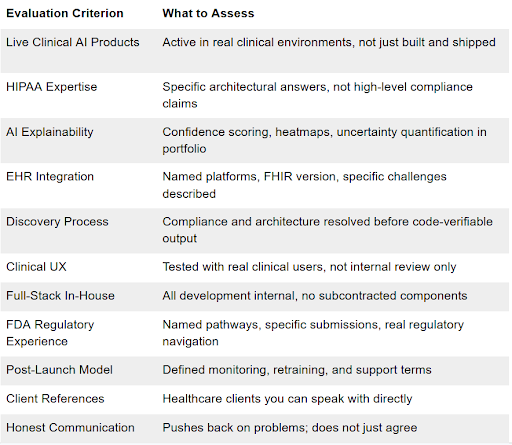
How Long Does AI Healthcare Software Development Take?
A focused clinical AI MVP takes four to eight months from discovery through pilot, and a full platform with EHR integration and FDA clearance takes twelve to twenty-four months or more, with the variance driven mostly by compliance complexity, EHR certification queues, and whether an FDA submission is required.
Expect these phases in sequence, each with defined exit criteria before the next begins:
Discovery and regulatory classification — 2–4 weeks
Compliance and data architecture — 2–4 weeks
Data curation, de-identification, annotation — 4–12 weeks (routinely underestimated)
Model development and validation — 6–16 weeks
EHR integration and vendor certification — 4–16 weeks (vendor queue is outside your control)
Clinical pilot — 6–12 weeks
Production rollout and monitoring — continuous
What Regulations Apply to Healthcare AI in the US in 2026?
HIPAA and HITECH govern healthcare AI in the US for PHI, FDA regulation where the software meets the Software as a Medical Device threshold, ONC HTI-1 transparency requirements for decision support inside certified health IT, 42 CFR Part 2 for substance use disorder records, and a growing set of state AI statutes, and your vendor should be able to classify your product against all five in the first conversation.
HIPAA / HITECH — the baseline. Security Rule technical safeguards, BAAs, breach notification.
FDA / SaMD — triggered by diagnostic, triage, image-finding, or clinical risk claims. Determine classification before development. A Predetermined Change Control Plan is what lets you retrain a cleared model without a new submission; ask whether your vendor has structured one.
ONC HTI-1 / DSI — predictive decision support in certified health IT must expose defined source attributes covering training data, validation, and fairness.
42 CFR Part 2 — substance use disorder records carry obligations stricter than HIPAA.
State AI law — Colorado's AI Act and comparable statutes elsewhere impose duties around consequential decisions and impact assessments.
Voluntary frameworks worth adopting — NIST AI Risk Management Framework and CHAI assurance guidance are increasingly what enterprise health system procurement asks about.
When Should You Not Hire a Specialist AI Healthcare Development Company?
You should not hire a specialist when your product does not touch PHI, does not integrate with clinical systems, and makes no clinical claim, because in that case you are paying a compliance premium for risk you do not carry.
A wellness tracker with no PHI, an internal scheduling tool, a marketing site, a payer-side analytics dashboard on de-identified data: a strong general agency is the right call and the cheaper one. Be honest about which side of the line you are on. Vendors who tell you every healthcare project needs a specialist are selling, not advising.
Real-World Case Studies: Codieshub Healthcare AI Projects
TeamBuilder Predictive Healthcare Platform MVP in Under 6 Months
TeamBuilder needed a predictive scheduling platform for physician ambulatory care and had a hard deadline. A major New York healthcare system was waiting for a live pilot.
Codieshub embedded as a full product and engineering team, delivering role-based authentication, a predictive scheduling engine with demand forecasting, and admin reporting tools in structured two-week sprints. The architecture was designed from day one to support future data science integrations. The MVP launched in under six months, enabling the live clinical pilot with a leading New York healthcare provider, with 100% of core functionality delivered on time.
Why US Healthcare Companies Choose Codieshub
At Codieshub, we have shipped healthcare AI products for funded startups and enterprise health systems across the United States, live products that are in active clinical use, have survived compliance reviews, and have grown after launch.
Here is specifically what makes us different as an AI healthcare software development company.
1. We start with compliance architecture, not a feature list. Every engagement begins with our MVP and product strategy process, which explicitly addresses regulatory classification, HIPAA compliance architecture, AI strategy, and EHR integration design before production code is written.
2. We build AI that clinicians trust. Our AI and ML solutions team builds healthcare AI models with explainability built in because we have learned from clinical deployments that models without it do not achieve adoption regardless of their technical performance.
3. We design for real clinical users. Our healthcare UI/UX design team designs and tests interfaces with real users from the target clinical population, including patients who are elderly, anxious, or managing complex conditions, and clinicians who need precision and speed.
4. We handle the full technical stack in-house. Our healthcare software development team manages backend, frontend, cloud infrastructure, EHR integrations, and AI model deployment without subcontractors. Our API integration services team builds production-reliable EHR connections using HL7 FHIR. Our HIPAA-compliant software development practice builds compliance into the foundation of every system.
5. We stay after launch. Our DevOps and cloud solutions team builds the monitoring, model management, and continuous improvement infrastructure that keeps healthcare AI performing reliably in production long after the delivery milestone.
Get a Free Project Estimate: Tell us about your healthcare AI project, and we will send you a tailored development and compliance game plan within 48 hours.
Conclusion
Choosing the right AI healthcare software development company is not a procurement decision; it is a product strategy decision. The company you choose will make hundreds of technical, clinical, and compliance decisions on your behalf. Their understanding of healthcare AI, HIPAA compliance, EHR integration, and clinical workflow design will determine whether your product achieves clinical adoption or creates expensive problems you spend years trying to fix.
The framework is straightforward. Evaluate companies specifically against the challenges your project will face. Verify their clinical AI experience with live products, not marketing claims. Test their HIPAA and EHR knowledge with specific questions that require specific answers. Look for a discovery process that resolves compliance and architecture before code begins. And insist on a post-launch model that treats delivery as a beginning, not an end.
At Codieshub, we meet all of these criteria with live healthcare AI products serving tens of thousands of patients in the United States, compliance architecture expertise built into every engagement from day one, and a long-term partnership model that stays invested in your product's clinical success.
Book Your Free Compliance & Architecture Consultation: share your healthcare AI idea and our team will map out a compliance-ready development plan within 48 hours, at no cost.
Frequently Asked Questions
1. What should I look for in an AI healthcare software development company?
Look for live HIPAA-compliant AI products in active clinical use, not just wellness apps or mockups. Verify their HIPAA architecture, EHR integration experience with named platforms using HL7 FHIR, and how they build AI explainability for clinical trust. Confirm their discovery process resolves compliance and workflow decisions early, and ask for direct client references.
2. How do I know if a company truly understands HIPAA compliance?
Ask them to explain HIPAA technical safeguards, specifically encryption at rest and in transit, role-based access controls, audit logging, and Business Associate Agreement management. Also ask when compliance architecture decisions happen in their process. Genuine experts answer with precision; others give vague, high-level responses that fall apart under detail.
3. Does AI healthcare software need FDA clearance?
It depends on functionality. AI tools making diagnostic or triage claims, detecting image findings, assessing clinical risk, or supporting clinical decisions are typically regulated as Software as a Medical Device and require FDA clearance. Tools offering general health information may fall outside FDA scope. Determine classification before development to avoid costly surprises later.
4. What is the most important technical requirement for healthcare AI software?
EHR integration. AI that surfaces findings and alerts directly within the EHR without requiring clinicians to switch systems achieves far higher sustained clinical adoption than standalone interfaces. Before hiring a development company, confirm they have proven, production-level EHR integration experience with the specific platforms your clinical environment actually uses.
5. How long does AI healthcare software development typically take?
A focused clinical AI MVP usually takes four to eight months, from discovery through pilot testing. A full platform with EHR integration, FDA clearance, and monitoring infrastructure typically takes twelve to twenty-four months or more. Timeline mainly depends on compliance complexity, integration scope, AI validation needs, and whether FDA submission is required.
6. How much does it cost to build a healthcare AI product?
Costs vary based on scope and complexity. A focused MVP typically runs $80,000 to $200,000, while a full clinical AI platform with EHR integration and advanced compliance ranges from $200,000 to $600,000. FDA support, training dataset assembly, and post-launch maintenance are additional costs often underestimated during initial planning stages.
7. What questions should I ask before signing a contract?
Ask for live clinical AI products, not mockups. Ask for specific HIPAA architecture details, EHR platforms and FHIR versions used, and who will actually work on your project. Confirm what their discovery process delivers before coding starts, request client references, and clarify their post-launch AI monitoring and retraining support model.
8. Should I choose a specialist or a general software agency?
For simple, low-compliance patient-facing apps, a general agency with some healthcare exposure may work. But for clinical AI products involving HIPAA, EHR integration, and workflow design, specialist expertise almost always outweighs the cost premium; generalist mistakes in healthcare AI are expensive to catch and even harder to fix.