
InsightsSaaS
Monolith vs Microservices Architecture: Complete Guide (2026)
Compare monolith vs microservices architecture to find the best fit for your project — covering performance, costs, and when to choose each.

In modern software development, choosing the right system architecture is very important for building scalable and efficient applications. Many businesses compare monolith vs microservices architecture to decide which approach best fits their project needs. The right architecture can improve development speed, simplify system management, and support long-term business growth.
A monolithic application keeps all features in one system, which makes development simple and often more cost-effective for small teams. On the other hand, microservices architecture divides an application into individual services, allowing better flexibility, independent updates, and easier deployment and scaling.
Today, many companies also use DevOps & Cloud technologies to manage infrastructure, automate deployment, and improve system performance.
This guide will help you understand the differences between monolithic and microservices architecture, their benefits, challenges, and how to choose the best option for
What You Will Learn in This Guide
Quick Decision Framework
What is Monolithic Architecture?
What is Microservices Architecture?
Monolith vs Microservices: Key Differences
Performance: The Numbers Nobody Talks About
Operational Costs and SRE Ratios
Decision Criteria for Selection
When a Monolith Is the Better Choice
When Microservices Make Sense
Challenges of Monolithic Architecture
Challenges of Microservices Architecture
Final Thought
Frequently Asked Questions (FAQs)
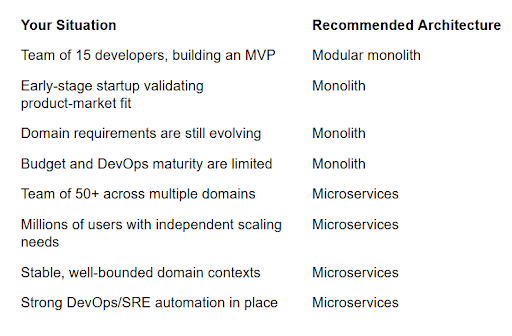
Quick Decision Framework
Before diving into details, here is a simple framework to help you decide.
What is Monolithic Architecture?
A monolithic application is a traditional software architecture where all features are built into a single codebase. The entire system works as one unit.
In a monolithic system, components such as the user interface, business logic, and database are tightly coupled. This means they are connected closely and depend on each other.
Advantages of monolithic architecture include:
Simpler development deployment
Easier testing and debugging
Faster development for small teams
Lower infrastructure costs
Disadvantages of Monolithic Architecture include:
A complex deployment process as the application grows
Difficult testing and debugging in large codebases
Slower development for large teams due to shared codebase conflicts
Higher infrastructure and maintenance costs when scaling the entire system
Many startups begin with a monolithic system because it helps them launch products quickly. Companies often combine this approach with MVP & Product Strategy to build and test new products before investing in complex architectures.
What is Microservices Architecture?
Microservices architecture is a modern approach where an application is divided into multiple services. Each service performs a specific service or function.
These services are loosely coupled, meaning they work independently and communicate through APIs.
Advantages of microservices include:
Independent development of individual components
Flexible deployment and scaling
Better performance for large systems
Easier updates without affecting the entire application
Disadvantages of Microservices Architecture include:
Complex system management because the application is divided into multiple services
Higher infrastructure and operational costs due to managing many services and servers
Difficult debugging and monitoring across distributed systems
Time-consuming deployment and coordination between multiple services
More complex development processes compared to a simple monolithic system
Modern technologies such as AI & ML Solutions are often integrated into microservices because they allow different services to process and analyze data independently.
Microservices are especially useful for large platforms that require distributed systems and high scalability.
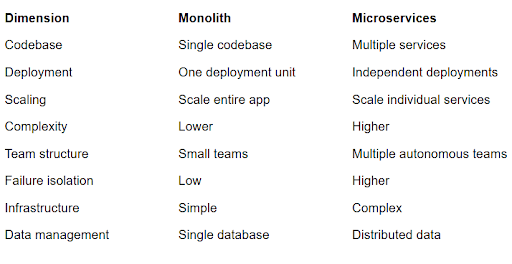
Monolith vs Microservices: Key Differences
The biggest difference between these architectures is how the system is structured.
In a monolithic application, everything is built into one system. In microservices, the system is split into individual services.
Some business applications, like Custom CRM platforms, may start as monolithic systems and later move to microservices as they grow.
Performance: The Numbers Nobody Talks About
Performance is often misunderstood when comparing architectures.
A monolithic application may perform faster initially because all components run in the same system without network communication.
However, as systems grow larger, microservices can improve performance because individual services can be scaled separately.
Many Top Custom Software Development teams design hybrid architectures that combine monolithic simplicity with microservices flexibility.
The best choice depends on system complexity and traffic requirements.
Operational Costs and SRE Ratios
Operational cost is a major factor when choosing architecture.
Monolithic systems are often more cost-effective because they require fewer servers and simpler infrastructure.
Microservices require more resources because they involve:
Multiple services
Container orchestration
Monitoring tools
Distributed communication
These additional requirements can increase Software Development Cost, especially when managing large distributed systems.
Companies must balance scalability benefits with operational expenses.
Decision Criteria for Selection
Choosing the right architecture depends on several factors:
Team size
System complexity
Scalability requirements
Budget
Development timeline
Businesses also evaluate whether they need custom software vs. off-the-shelf solutions before deciding on architecture. If your application requires flexibility and frequent updates, microservices may be the right choice. If simplicity and speed are priorities, monolithic architecture may work better.
When a Monolith Is the Better Choice
Monolithic architecture works best when:
The team is small
The application is new
Development must move quickly
Infrastructure budgets are limited
Many industries still rely on monolithic systems because they are easier to manage and maintain.
Businesses often evaluate Industries We Serve to determine whether a simple or complex architecture fits their industry requirements. For startups, monolithic systems help achieve faster time to market.
When Microservices Make Sense
Microservices are ideal when systems grow large and complex.
This architecture works best when:
Multiple teams work on individual services
Applications require high scalability
Continuous updates are necessary
Systems must support distributed systems
Many of the best software development companies use microservices to build scalable enterprise platforms and cloud-based applications. Microservices also allow companies to update services independently without affecting the entire system.
Challenges of Monolithic Architecture
Although monolithic systems are simple, they have limitations.
Common challenges include:
Difficult deployment and scaling
A large codebase becomes time-consuming to maintain
Updating one feature may affect the entire system
Harder to adopt modern technologies
Businesses often rely on Custom Web Development services to gradually modernize older monolithic applications.
Challenges of Microservices Architecture
Microservices offer flexibility but introduce new complexities.
Challenges include:
Managing multiple services
Network communication between services
Monitoring and debugging distributed systems
Higher operational costs
For smaller businesses, microservices can sometimes slow development rather than speed it up. Choosing the right architecture is essential for maintaining efficient development processes.
Final Thought
Choosing between monolith vs microservices architecture depends on your application requirements, team size, and long-term business goals. A monolithic application can be a great choice for small teams and startups because it allows faster development, simpler development and deployment, and a quicker time to market.
On the other hand, microservices architecture is better suited for large and complex distributed systems that require flexible deployment and scaling, independent individual services, and continuous updates.
Understanding the strengths and challenges of monolithic and microservice architectures helps businesses choose the right approach for building scalable and efficient applications. Selecting the right architecture early can improve performance, reduce costs, and support long-term software growth.
If you are unsure which architecture fits your project, book a call with our experts to get guidance on the best technology strategy for your business.
Frequently Asked Questions (FAQs)
1. What is the difference between monolithic and microservice architectures?
Monolithic architecture combines all features in a single codebase, while microservices divide the system into independent services. Microservices provide faster development cycles, easier scaling, and flexibility, whereas monoliths are simpler for small teams and cost-effective for early-stage applications.
2. When should I use a monolithic application?
Monolithic applications are ideal for small teams or startups. They allow simpler development and deployment, lower infrastructure costs, and faster delivery. Monoliths work best when the system is not highly complex, has limited features, and doesn’t require frequent independent scaling of individual components.
3. When should I choose microservices architecture?
Microservices are best for large and complex applications requiring distributed systems. They allow independent development, deployment, and scaling of individual services. This architecture supports large teams, continuous updates, and integration with modern technologies like AI & ML Solutions.
4. What are the main advantages of monolithic architecture?
Monolithic systems offer simpler testing, easier debugging, and faster initial development. They are cost-effective, especially for small teams, and have fewer operational challenges compared to microservices. Monoliths provide a single, unified system that’s easier to manage during the early stages of development.
5. What are the disadvantages of monolithic architecture?
Monolithic applications can become time-consuming to scale and update. Tight coupling of modules makes refactoring difficult, and large teams face coordination challenges. Deployments are slower as the entire system must be updated, and performance may degrade as the codebase grows.
6. What are the disadvantages of microservices architecture?
Microservices increase operational complexity because of multiple services and servers. Debugging, monitoring, and deployment coordination are more difficult. Managing distributed systems requires additional tools, and infrastructure costs are higher than in a monolithic application.
7. Can a monolithic system be converted to microservices?
Yes, many companies start with a monolithic system and later break it into microservices as applications grow. This allows independent scaling, faster development cycles, and flexible deployment, supporting complex operations while maintaining reliability and efficiency.