In 2026, asking how much custom software costs is like asking how much a car costs. You can get a compact, a premium SUV, or a full fleet. The only useful answer is a realistic range tied to what you actually need.AI-assisted development, stricter security, and cloud native architectures have changed how software is built and priced. If you understand the main cost drivers, you can predict a sensible budget before you talk to vendors.
What Does Custom Software Development Cost Actually Mean
When you ask for a quote, you are not just paying for developers. In 2026, true cost covers the full lifecycle of getting a working product into users’ hands.At a minimum, that includes:
Discovery and product strategy
UX and UI design
Engineering, testing, and DevOps
Integrations, data migration, and security
Hosting, monitoring, and support after launch
Think of it as paying for a working business system, not just for code.
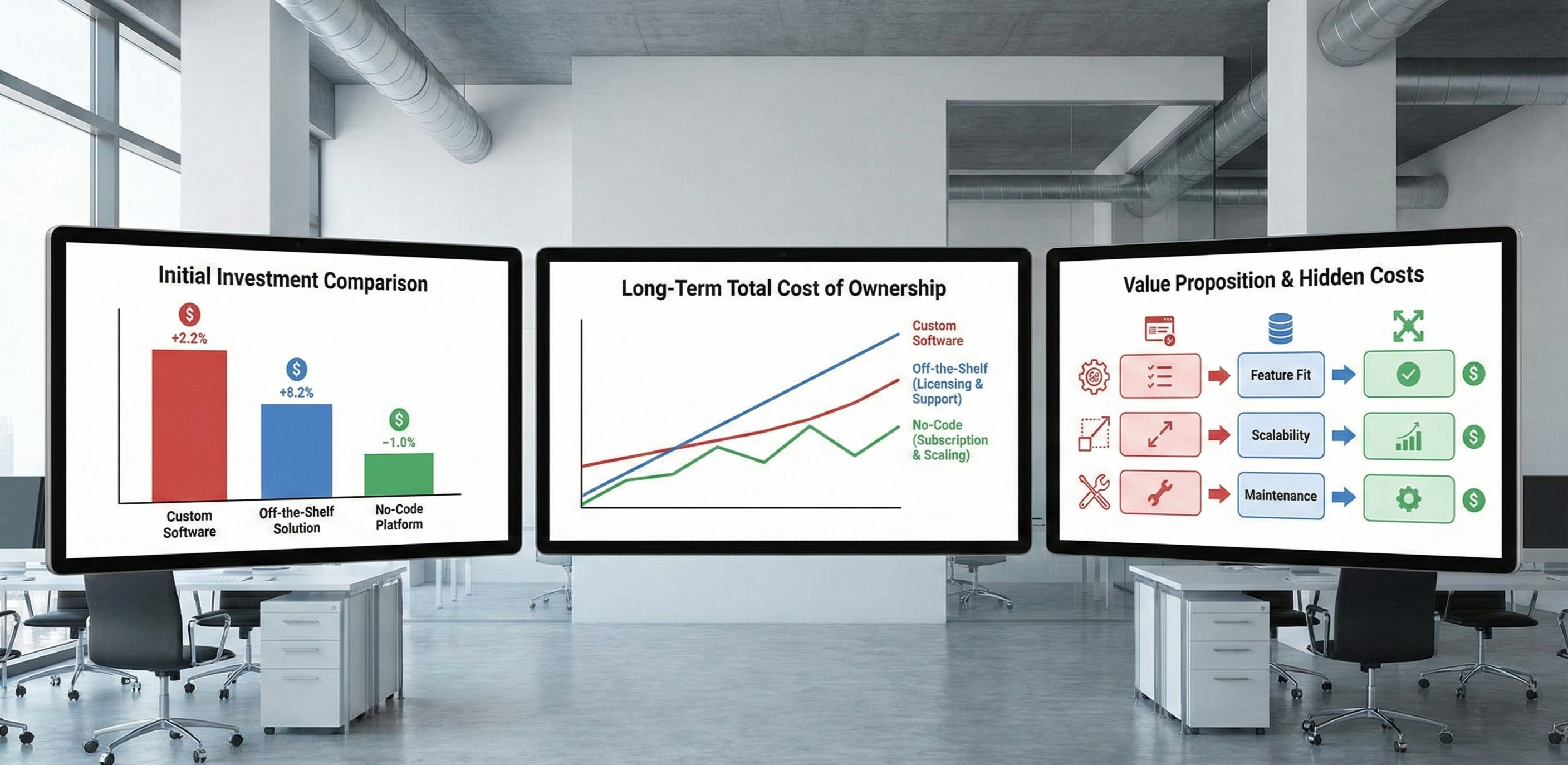
Why Cost Clarity Matters in 2026
Custom software is now central to how companies sell, serve, and operate. Poor cost planning does not just hurt budgets, it delays launches and weakens competitiveness.Cost clarity helps you:
Avoid under-budgeting and mid-project scope cuts
Prevent over-engineered builds that never pay back
Give executives and investors a budget they can trust
In a market where AI, compliance, and integrations add new layers of complexity, you cannot rely on back-of-the-envelope estimates anymore.
Typical Price Ranges in 2026
Every project is different, but most modern business applications fall into three bands.
Small internal tool or focused MVP
Examples: workflow automation, basic internal dashboard, first version of a niche SaaS.
Budget range: 40,000 to 120,000 USD
Timeline: 2 to 4 months
Mid-sized business-critical application
Examples: custom CRM, customer or patient portal, field service app, core B2B SaaS.
Budget range: 120,000 to 400,000 USD
Timeline: 4 to 9 months
Large enterprise platform or ecosystem
Examples: logistics or ERP-like platform, multi-module SaaS, product with advanced AI and analytics.
Budget range: 400,000 to 2,000,000+ USD
Timeline: 9 to 24 months in phases
Typical blended hourly rates in 2026:
North America and Western Europe: 90 to 180 USD per hour
Eastern Europe and Latin America: 50 to 110 USD per hour
Asia and other offshore regions reputable firms: 35 to 90 USD per hour
Your total spend depends on both the rate and the efficiency, not just the rate.
Key Factors That Influence Your Budget
Two projects that look similar on paper can differ by hundreds of thousands of dollars once you factor in complexity.The biggest drivers are:
Scope and feature depth: How many user roles, workflows, and modules do you need in version one?
Integrations and data: Number of third-party systems, legacy platforms, and data migrations.
Security and compliance: Requirements like SSO, audit trails, GDPR, HIPAA, or SOC 2.
AI and automation: Simple AI API calls are affordable; custom AI agents, RAG, or heavy analytics add more work.
Decide deliberately on each of these, and the budget becomes much more predictable.
Common Cost Pitfalls to Avoid
Most overruns are not bad luck. They come from a few avoidable patterns.Common pitfalls include:
Skipping discovery: Starting development without a clear scope leads to rework and scope creep.
Trying to build “version three” as version one: Packing every idea into the first release inflates cost and delays feedback.
Choosing the cheapest quote that cuts corners: Low bids often under scope UX, QA, and architecture, which you later pay for in fixes.
If you avoid these three, you are already ahead of most failed projects.

A Simple 2026 Roadmap for Scoping and Budgeting
A staged approach lets you get to a realistic number without committing to a huge build on day one.Phases include:
Phase 1: Discovery and Feasibility: Clarify goals, users, and core workflows. Outcome: high-level scope and rough budget range.
Phase 2: UX and Architecture Blueprint: Map journeys, key screens, and technical design. Outcome: backlog and a more precise estimate.
Phase 3: Core Build or MVP: Implement must-have features first and launch to real users. Outcome: usable product generating value.
Phase 4: Iteration and Scale: Add non-critical features, AI, and optimizations based on real usage. Outcome: mature platform over time.
This roadmap turns one big bet into a series of controlled, measurable investments.
Best Practices to Control Cost
You cannot control market rates, but you can control how you scope and deliver.Key practices include:
Prioritize ruthlessly: Focus version one on the 20 percent of features that deliver 80 percent of value.
Prototype before coding: Use clickable prototypes to align stakeholders and avoid rework.
Phase advanced features and integrations: Launch with essential systems and add extras once the core is stable.
Plan for maintenance: Expect 15 to 25 percent of the original build cost per year for support and improvements.
These habits protect your budget without forcing you to compromise on quality.
Conclusion
Custom software development cost in 2026 sits on a spectrum. Small focused tools often land between 40,000 and 120,000 USD. Mid-sized business-critical systems range from 120,000 to 400,000 USD. Large strategic platforms usually require 400,000 to 2,000,000+ USD across phases.Your exact number depends on scope, complexity, integrations, security, and how you phase the work. The real advantage comes from clarity, not guesswork.If you want to sanity check your budget before you commit, schedule a complimentary Cost and Architecture Clarity Session with our Principal Architect. In one focused call, we will map your vision to a realistic 2026 cost range and outline a phased roadmap that your leadership team can support with confidence.











 AI & ML


