
InsightsHealthcare
AI-Powered Intensive Care Unit (ICU) Monitor: Complete Guide 2026
Discover how AI-powered ICU monitors detect patient deterioration hours earlier, reduce mortality, and transform critical care in 2026.
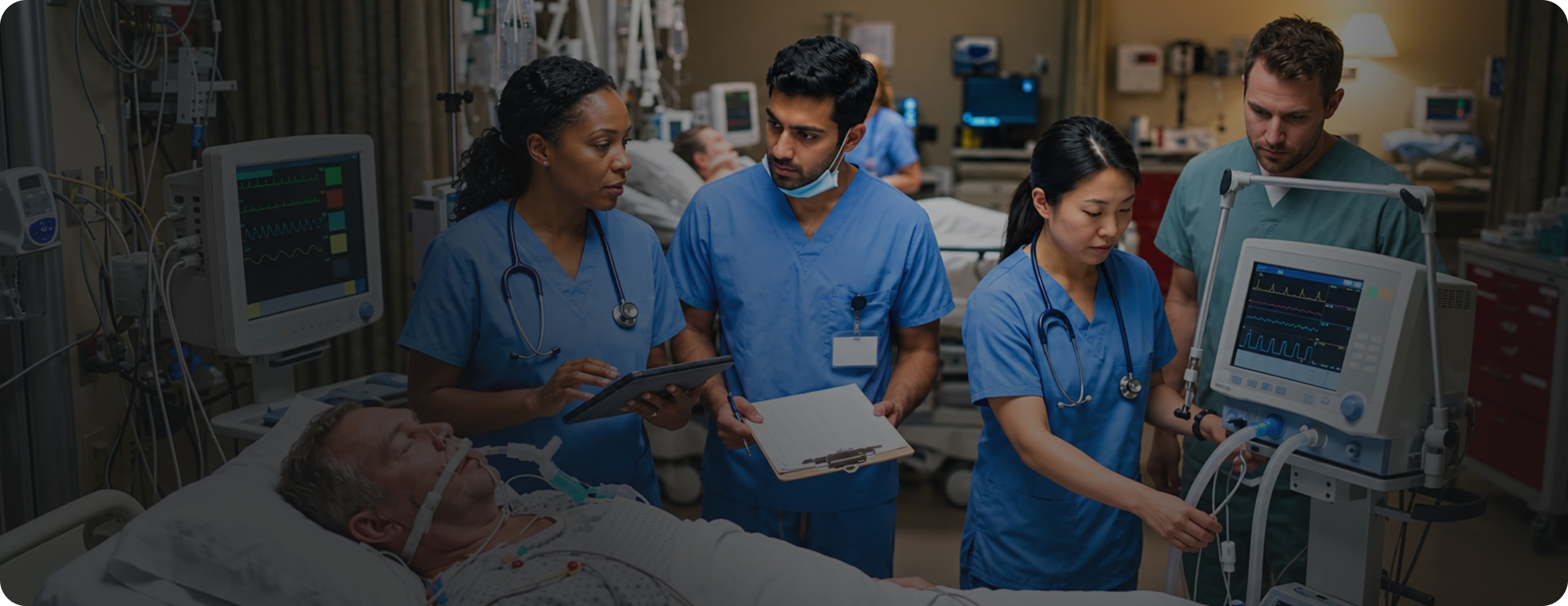
A patient in the ICU is connected to more monitoring equipment than almost anywhere else in medicine. Continuous ECG. Arterial blood pressure. Pulse oximetry. Capnography. Temperature. Ventilator parameters. Intracranial pressure. Each of these generates a continuous stream of data hundreds of data points per second across a single patient, thousands across an ICU unit.
The nurses and intensivists responsible for these patients are exceptionally trained clinicians. But they are human. They cannot watch twelve data streams simultaneously across eight patients without filtering out some of what they see. They cannot detect subtle trends that develop over hours before manifesting as acute deterioration. And they cannot be at the bedside of every patient at every moment when a concerning pattern emerges.
AI-powered intensive care unit ICU monitors change this. They do not replace the ICU nurse or the intensivist; they give them capabilities that human attention alone cannot provide. Continuous analysis of every data stream simultaneously. Pattern recognition across thousands of prior patient trajectories. Early warning of deterioration hours before clinical signs become obvious. And intelligent alerting that surfaces the right information to the right clinician at the right moment without the alert fatigue that makes current monitoring systems less effective than they should be.
In 2026, AI-powered ICU monitoring platforms are in active clinical use in academic medical centers, community hospitals, and specialized critical care units across the United States. The clinical evidence for their impact on sepsis detection, deterioration prediction, mortality reduction, and ICU length of stay is substantial and growing.
This guide covers everything healthcare organizations and health tech companies need to know about AI-powered ICU monitoring, from the clinical use cases delivering the most value to the technical architecture, FDA regulatory requirements, HIPAA compliance obligations, and step-by-step development process.
Key Takeaways
An AI-powered intensive care unit ICU monitor continuously analyzes all patient monitoring data streams vital signs, laboratory values, ventilator parameters, and medication data to detect deterioration patterns hours before they become clinically obvious
Sepsis detection, hemodynamic instability prediction, ventilator management support, and acute kidney injury prediction are the AI ICU monitoring use cases with the strongest clinical evidence in 2026
Alert fatigue is the most critical design challenge: AI ICU monitors must surface clinically meaningful alerts without overwhelming nurses with false positives that erode clinical trust
FDA regulatory classification is a core development decision. AI ICU monitoring tools that make clinical claims about patient risk or therapeutic recommendations are regulated as Software as a Medical Device
HIPAA compliance with the highest technical safeguards is required. ICU patient data is among the most sensitive PHI in healthcare, combining continuous vital sign streams with critical illness clinical information
Integration with the ICU information system, EHR, ventilator systems, and laboratory systems is what makes AI ICU monitoring clinically useful, not just technically capable
Total development cost for a custom AI ICU monitoring platform ranges from $150,000 for a focused single-use-case MVP to $800,000 or more for a full enterprise platform
What Is an AI-Powered Intensive Care Unit ICU Monitor?
An AI-powered intensive care unit ICU monitor is a clinical software platform that continuously ingests, analyzes, and synthesizes all available patient monitoring data in the ICU vital signs, laboratory values, ventilator parameters, medication administration records, fluid balances, and clinical documentation and uses machine learning models to detect early warning patterns, generate risk scores, support clinical decision-making, and deliver actionable alerts to ICU clinical staff.
Traditional ICU monitoring presents data it displays values, trends, and alarm states for individual parameters. When a heart rate exceeds the alarm threshold, an alarm fires. When an oxygen saturation drops below the set limit, an alarm fires. The clinical interpretation of what these alarms mean individually and in combination, in the context of this patient's clinical trajectory, remains entirely the responsibility of the clinical staff.
AI-powered ICU monitoring goes beyond displaying data. It interprets combinations of parameters that together indicate a developing clinical problem before any individual parameter has crossed an alarm threshold. It compares the current patient's trajectory to thousands of prior ICU patient trajectories to identify patients whose pattern of evolution matches prior cases of specific adverse outcomes. It generates risk scores that quantify the probability of specific adverse events sepsis, hemodynamic instability, acute kidney injury, respiratory failure in the next several hours. And it surfaces these insights to clinicians through intelligent alerting that is designed to be clinically meaningful rather than merely technically triggered.
The defining clinical value is time. Sepsis caught six hours earlier changes outcomes dramatically. Hemodynamic instability predicted before it manifests allows preemptive intervention rather than rescue treatment. Extubation failure predicted before the extubation attempt prevents the complications of failed extubation. AI ICU monitoring buys time and in critical care, time is the most important clinical resource.
Why Is AI Transforming ICU Monitoring in 2026?
ICU Data Volume Exceeds Human Processing Capacity
A single ICU patient generates approximately 1,440 vital sign data points per day from continuous monitoring, and that is before factoring in laboratory results, ventilator waveforms, medication administration records, and nursing assessment documentation. An ICU nurse managing multiple patients simultaneously cannot process this data volume comprehensively. Important patterns in the data are inevitably missed not because the nurse is inattentive, but because the information density exceeds what human attention can continuously process.
AI systems do not have this limitation. They process every data point, continuously, for every patient simultaneously.
Alert Fatigue Is Undermining Current Monitoring
Studies of ICU alarm systems have consistently found that 80 to 99% of physiological alarms in ICU environments are false alarms that fire because a parameter threshold was crossed, but that do not represent a genuine clinical emergency requiring immediate action. This alarm burden creates alert fatigue; nurses and physicians who learn, through experience, that most alarms are not actionable begin responding to them more slowly and less consistently.
Alert fatigue in the ICU is a patient safety problem. AI monitoring systems that significantly reduce false alarm rates by generating alerts based on clinical pattern recognition rather than single-parameter threshold violations restore the clinical response urgency that alarm systems are intended to create.
Clinical Evidence Is Accumulating Rapidly
The clinical evidence base for AI ICU monitoring has expanded significantly in the past five years. Multiple prospective studies have demonstrated that AI early warning systems for sepsis detection reduce sepsis-related mortality when implemented with appropriate clinical protocols. AI systems for hemodynamic instability prediction have demonstrated the ability to identify hypotensive episodes 30 to 60 minutes before they manifest, providing clinical teams with intervention opportunities that did not exist without the AI prediction.
This growing evidence base has accelerated institutional adoption and increased clinician confidence in AI ICU monitoring as a clinical tool rather than an experimental technology.
What Are the Key Use Cases for AI-Powered ICU Monitoring?
Sepsis Detection and Early Warning
Sepsis is the leading cause of ICU mortality and one of the leading causes of hospital death in the United States. Early detection is the primary determinant of sepsis survival. The Surviving Sepsis Campaign's time-sensitive bundle compliance is directly associated with mortality reduction. But early sepsis is clinically subtle; the physiological changes that precede clinical sepsis manifestation are individually unremarkable, making early detection by clinical observation alone extremely difficult.
AI sepsis detection models analyze combinations of vital sign trends, laboratory values, clinical documentation, and medication data to identify the composite physiological signatures of early sepsis hours before the clinical criteria for sepsis are met. These models compare the current patient's physiological trajectory to thousands of prior sepsis patients to identify the patterns that most reliably predict sepsis onset.
The clinical impact is significant. Multiple health systems implementing AI sepsis detection have reported mortality reductions of 18 to 26% in sepsis patients for whom the AI alert prompted early bundle initiation.
Hemodynamic Instability and Hypotension Prediction
Hemodynamic instability, particularly hypotension in critical care patients, is associated with end-organ damage, particularly acute kidney injury and myocardial injury. Predicting hemodynamic instability before it manifests allows clinical teams to intervene preemptively, adjusting vasopressor dosing, addressing volume status, and modifying sedation rather than managing the consequences of an episode that has already occurred.
AI hemodynamic instability models analyze arterial blood pressure waveform characteristics, heart rate variability, fluid balance trends, vasopressor dosing patterns, and other physiological parameters to identify patients at elevated risk of hypotensive episodes in the next 30 to 60 minutes. FDA-cleared AI hemodynamic prediction tools, including Edwards Lifesciences' HPI algorithm, have demonstrated clinical validation in prospective studies.
Ventilator Management Support
Mechanical ventilation management setting ventilator parameters, titrating support, and deciding when to attempt weaning and extubation involves complex clinical judgment across multiple physiological parameters and patient trajectory data. AI ventilator management support tools analyze respiratory mechanics, gas exchange parameters, ventilator waveforms, and patient trajectory data to provide clinical decision support for ventilator management decisions.
Extubation failure: the need to reintubate within 24 to 72 hours of extubation occurs in 10 to 20% of extubation attempts and is associated with significantly increased ICU length of stay and mortality. AI extubation readiness prediction models that identify patients at elevated extubation failure risk support more informed weaning decisions.
Acute Kidney Injury Prediction
Acute kidney injury occurs in 30 to 50% of ICU patients and is an independent predictor of ICU mortality and prolonged ICU stay. Early identification of patients at elevated AKI risk enables preventive interventions such as nephrotoxin avoidance, hemodynamic optimization, and contrast avoidance that reduce AKI incidence and severity.
AI AKI prediction models analyze creatinine trajectories, urine output patterns, hemodynamic data, medication exposure, and patient demographics to identify patients at elevated AKI risk before creatinine rises are clinically apparent, providing a longer intervention window than traditional creatinine-based monitoring.
Delirium Detection and Prevention
ICU delirium affects 40 to 80% of mechanically ventilated patients and is associated with increased ICU length of stay, long-term cognitive impairment, and mortality. Delirium screening in the ICU depends on systematic nursing assessment using validated instruments, but assessment frequency is limited by clinical workload.
AI delirium prediction models analyze physiological patterns, medication exposure particularly sedation and anticholinergic burden sleep disruption, environmental factors, and patient demographics to identify patients at elevated delirium risk, enabling preventive interventions and targeted assessment.
Cardiac Arrhythmia Detection and Classification
Continuous ECG monitoring in the ICU generates enormous volumes of waveform data. AI arrhythmia detection systems analyze continuous ECG waveforms to detect arrhythmia patterns, including subtle atrial fibrillation, ventricular arrhythmias, and conduction abnormalities, with greater sensitivity and specificity than threshold-based alarms, and to classify detected arrhythmias for clinical prioritization.
Clinical Deterioration and Rapid Response Prediction
Hospital rapid response system activation, calling the rapid response team for a deteriorating patient, is often delayed because the individual clinical signs that trigger concern develop gradually and are individually unremarkable. AI clinical deterioration models that integrate vital sign trends, nursing assessment data, laboratory values, and medication data to generate continuously updated deterioration risk scores enable earlier rapid response activation and more timely clinical intervention.
What Are the Key Features of an AI ICU Monitoring Platform?
Multi-Parameter Continuous Data Ingestion
The clinical value of AI ICU monitoring depends on comprehensive data ingestion capturing all relevant physiological parameters from all monitoring sources in real time. This includes bedside monitor vital signs, ventilator parameters, intravascular monitoring data, laboratory values from the laboratory information system, medication administration records from the pharmacy system, and nursing documentation from the EHR.
The integration layer that assembles these data streams into a unified patient data stream is the technical foundation on which all AI analysis depends. Our EHR and EMR integration practice builds these integrations using HL7 FHIR, HL7 v2, and device-specific data interfaces that make comprehensive ICU data ingestion reliable in production clinical environments.
AI Risk Scoring and Early Warning Models
Machine learning models trained on large retrospective ICU patient datasets with clinical outcome labels that generate continuously updated risk scores for specific adverse outcomes. Each risk score represents the model's assessment of the probability of the target adverse event sepsis, hemodynamic instability, AKI, or respiratory failure in a defined future time window.
Risk scores must be presented with uncertainty quantification confidence intervals that communicate to clinicians when the model is less certain and with explainability outputs that show which specific physiological factors are driving each risk score.
Intelligent Alert Management
The most critical design feature of an AI ICU monitoring system is the alert management framework: the logic that determines when an alert is generated, how it is prioritized, how it is communicated to the appropriate clinical team member, and how its clinical response is tracked.
AI ICU monitoring alerts must be generated based on clinical pattern recognition rather than single-parameter threshold violations. Each alert must include the clinical context — the specific factors driving the risk score that allows the receiving clinician to immediately understand the clinical significance. Alerts must be routed to the appropriate care team member based on clinical role and urgency.
Our healthcare UI/UX design team designs ICU alert interfaces tested with real ICU nurses and intensivists in realistic clinical scenarios because alert interface design determines whether alerts are acted on or dismissed.
Clinical Dashboard for ICU Staff
A comprehensive clinical dashboard presenting all patients in the ICU unit simultaneously with risk scores, alert status, trending vital sign data, and recent laboratory values that allows charge nurses and intensivists to manage the entire unit's patient population from a single interface. Unit-level views that surface the highest-risk patients for priority attention are essential for efficient ICU management.
Trend Analysis and Visualization
AI-generated trend analysis that shows not just current values but the trajectory of key physiological parameters how rapidly a patient's condition is changing, and whether that rate of change is consistent with concerning historical patterns is more clinically informative than point-in-time values.
EHR Documentation Integration
AI risk scores, alerts, and clinical recommendations that flow into the EHR as structured clinical documentation available to the full care team, persistent in the clinical record, and accessible for quality improvement and research analysis are more clinically valuable than alerts that exist only in the monitoring system.
Telemetry and Remote Monitoring Capability
For eICU programs with centralized ICU monitoring where intensivists remotely monitor patients in multiple facilities, AI monitoring support that provides remote monitoring staff with comprehensive patient risk assessment across large patient panels is essential for the clinical value proposition of remote critical care.
HIPAA-Compliant Data Architecture
ICU patient data is among the most sensitive PHI in healthcare, combining continuous vital sign monitoring with critical illness clinical information. Every component of the AI ICU monitoring platform must comply with HIPAA with the highest technical safeguards.
Our HIPAA-compliant software development practice builds the compliance architecture with encryption at every layer, role-based access controls, comprehensive audit logging, and BAA management appropriate for systems handling continuous streams of critical care patient data.
Post-Alert Response Tracking and Quality Improvement
The clinical value of AI ICU monitoring depends not just on alert generation but on clinical response to those alerts. Post-alert response tracking, monitoring whether alerts were acknowledged, what clinical actions were taken, and what patient outcomes followed, provides the quality improvement data that allows clinical teams to optimize their protocols for responding to AI alerts and demonstrates the clinical impact of the system.
How to Build an AI ICU Monitoring Platform: Step by Step?
Step 1: Define the Target Use Cases and Clinical Outcomes
Building an AI ICU monitoring platform begins with a precise definition of which clinical outcomes the system will target and in what ICU population. An AI sepsis detection system designed for a medical ICU has different model requirements than one designed for a surgical ICU or a cardiothoracic ICU. A system targeting hemodynamic instability prediction in ventilated patients has different data requirements than one targeting delirium detection.
Define the target adverse events with specific clinical definitions, the patient population, the ICU setting, and the intervention window: how many hours before the adverse event must the AI alert to enable meaningful clinical intervention?
Step 2: Determine the FDA Regulatory Pathway
AI ICU monitoring tools that generate risk scores for specific clinical adverse events or make therapeutic recommendations are regulated as Software as a Medical Device. The specific regulatory pathway 510(k), De Novo, or PMA depends on the clinical claims, the risk classification, and the existence of substantially equivalent cleared predicates.
Engage regulatory counsel and consider an FDA pre-submission meeting before development begins. The FDA pre-submission process provides FDA feedback on the proposed regulatory pathway, clinical study design, and performance criteria before the formal submission, significantly reducing the risk of submission rejection.
Our MVP and product strategy process addresses FDA regulatory classification as a core component of the discovery phase before any clinical AI features are designed or developed.
Step 3: Assemble the Training Dataset
AI ICU monitoring models require large retrospective datasets of ICU patient records with clinical outcome labels. The training dataset must include patients who experienced the target adverse events sepsis, hemodynamic instability, AKI and a matched cohort who did not, with sufficient data density and completeness to learn reliable predictive patterns.
Academic medical center ICU databases MIMIC-IV and the eICU Collaborative Research Database provide important training data foundations. Proprietary clinical datasets from the target institution type provide the site-specific patterns that improve model performance in the intended deployment environment.
Data quality assessment, completeness of key variables, documentation consistency, and clinical outcome labeling accuracy are essential before model development begins. Incomplete or inconsistently documented training data produces unreliable models.
Step 4: Build the Real-Time Data Ingestion Pipeline
Build the data ingestion infrastructure that continuously streams all relevant ICU patient data from bedside monitors, ventilators, laboratory systems, pharmacy systems, and the EHR into the AI processing pipeline. This infrastructure must handle high-frequency data streams from multiple sources simultaneously, normalize data to consistent formats and units, detect and handle data gaps and sensor artifacts, and deliver data to AI models with the latency required for real-time risk scoring.
This is the most technically demanding component of an AI ICU monitoring platform and the one where healthcare-specific integration experience matters most.
Step 5: Develop and Validate the AI Models
Build and train machine learning models for each target use case using the assembled training data with appropriate cross-validation methodology to prevent overfitting. Validate model performance on held-out test sets from the training institution and, critically, on external validation sets from different institutions because ICU documentation practices, patient populations, and clinical protocols vary enough across institutions that models that validate well at the training institution may not perform as well in other environments.
Our AI and ML solutions team builds ICU AI models with the time-series analysis capability, multi-modal data integration, and external validation rigor that clinical deployment in critical care requires.
Step 6: Design and Implement the Alert Management Framework
Design the clinical alert logic thresholds, escalation rules, routing logic, and communication channels with clinical input from ICU nurses, charge nurses, and intensivists from the target institution type. The alert management framework must be designed to minimize alert fatigue while ensuring that clinically meaningful warnings are delivered reliably.
Alert design is as much a clinical workflow design task as a technical one. The specific alert format, the information included, the clinical team member who receives each alert type, and the expected clinical response must all be defined and validated with clinical input before deployment.
Step 7: Build the Clinical Dashboard and Interface
Design and build the ICU clinical dashboard, the primary interface through which ICU nurses and intensivists interact with the AI monitoring system. The dashboard must provide unit-level patient risk overview, individual patient detail views, alert management, trend visualization, and EHR documentation integration in a format that clinical staff can use efficiently in the high-cognitive-load environment of active ICU care.
Step 8: Build EHR and Clinical System Integration
Build integration with the EHR for clinical context data ingestion and AI-generated documentation output. Build integration with the laboratory information system for laboratory value ingestion. Build integration with the pharmacy system for medication administration data.
Our API integration services team builds these integrations using HL7 FHIR, HL7 v2, and clinical device interface standards that make real-time ICU data ingestion reliable in production environments.
Step 9: Implement HIPAA Compliance Architecture
Implement the full HIPAA compliance architecture: AES-256 encryption for all patient data at rest, TLS 1.2 or higher for all data in transit, role-based access controls appropriate to ICU care team roles, comprehensive audit logging of all patient data access, and Business Associate Agreements with all third-party services that process patient data.
Step 10: Conduct Clinical Validation and Pilot
Conduct the clinical validation study required for FDA submission demonstrating the AI system's sensitivity, specificity, and clinical impact on the target outcomes in the intended patient population. Deploy in a structured clinical pilot with defined success metrics: alert sensitivity, specificity, false alarm rate, time-to-alert before adverse event, and clinical response rate.
Step 11: FDA Regulatory Submission
Prepare and submit the FDA regulatory submission 510(k), De Novo, or PMA based on the regulatory pathway determined in Step 2 and the clinical validation evidence collected in Step 10.
Step 12: Post-Market Surveillance and Model Monitoring
Build post-market surveillance infrastructure monitoring model performance in production for drift as clinical practice patterns evolve, tracking alert response rates and clinical outcomes, and maintaining the performance documentation required for FDA post-market requirements.
Our DevOps and cloud solutions team builds the deployment infrastructure, model monitoring, and post-market performance tracking that FDA post-market surveillance requirements demand for AI medical devices.
What Is the Technology Stack for AI ICU Monitoring Platforms?
The technology stack spans real-time data ingestion, time-series machine learning, clinical system integration, and HIPAA-compliant cloud infrastructure.
AI and Machine Learning
Python is the standard language for ICU AI development. For time-series risk prediction from continuous physiological monitoring data, LSTM neural networks and transformer-based time-series models handle the temporal patterns in ICU vital sign streams effectively. For multi-modal data integration combining continuous vital sign streams with episodic laboratory values and medication administration events, multi-modal deep learning architectures that handle mixed-frequency, heterogeneous data types are the current state of the art.
For sepsis detection specifically, gradient boosting models XGBoost, LightGBM) trained on structured EHR data with clinical sepsis labels have demonstrated strong performance in multiple validation studies and are computationally efficient for real-time scoring. Transformer-based models that capture temporal dependencies in the physiological data stream produce higher sensitivity for early detection at the cost of greater computational requirements.
For ECG arrhythmia detection, convolutional neural networks and transformer-based sequence models trained on large labeled ECG databases achieve detection accuracy that exceeds traditional threshold-based detection for most arrhythmia types.
SHAP SHapley Additive exPlanations provides model explainability outputs that show clinicians which specific physiological factors are driving each risk score, essential for clinical trust and regulatory documentation.
Real-Time Data Processing
Apache Kafka provides the distributed streaming infrastructure for high-frequency ICU data ingestion, handling continuous vital sign streams from multiple patients simultaneously at the data rates required for real-time risk scoring. Apache Flink or AWS Kinesis Analytics provides stream processing for feature engineering on continuously arriving data.
TimescaleDB provides optimized time-series storage for ICU physiological monitoring data with efficient querying of high-frequency time-series data for trend analysis and model feature computation.
Clinical Device Integration
HL7 v2 messaging for laboratory information system integration and EHR data exchange. HL7 FHIR R4 for modern EHR integration where FHIR APIs are available. Bedside monitor integration using HL7 v2 or proprietary device interfaces. Philips IntelliVue, GE CareStation, and Dräger ventilators all have specific integration interfaces. Medical Device Integration platforms Capsule Technologies and Bernoulli Health provide standardized middleware for bedside device data integration.
Backend Infrastructure
Python with FastAPI for the primary API layer. PostgreSQL with TimescaleDB extension for patient monitoring data. Redis for real-time risk score caching and alert state management. Apache Kafka for real-time data streaming. AWS Lambda for event-driven alert processing. Kubernetes for containerized service orchestration at enterprise ICU scale.
Cloud Infrastructure
AWS with a HIPAA Business Associate Agreement is the standard choice for US ICU AI monitoring platforms. Key services include Amazon MSK for managed Kafka streaming, Amazon RDS with TimescaleDB for time-series patient data, AWS S3 with server-side encryption for archival data, Amazon SageMaker for model training and serving, and AWS CloudTrail for comprehensive HIPAA audit logging.
On-premises or hybrid cloud deployment may be required for health systems with strict data residency requirements or latency constraints that cannot be met with cloud-only architecture.
What Are the FDA Regulatory Requirements for AI ICU Monitors?
AI ICU monitoring tools that generate risk scores for specific clinical adverse events, make therapeutic recommendations, or claim to detect or diagnose clinical conditions are regulated by the FDA as Software as a Medical Device.
Device Classification by Risk Level
AI ICU monitoring tools are typically classified as Class II devices moderate risk with a 510(k) clearance pathway for devices that are substantially equivalent to cleared predicates. Class II classification requires demonstrating that the device is at least as safe and effective as a legally marketed predicate device.
For AI ICU monitoring tools with novel intended uses without a substantially equivalent predicate, the De Novo pathway creates a new device classification. FDA has used the De Novo pathway for several novel AI clinical decision support tools in recent years.
Clinical Study Requirements
FDA submissions for AI ICU monitoring devices require clinical evidence typically from prospective or retrospective reader studies or clinical outcome studies demonstrating the device's performance characteristics in the intended patient population and clinical setting.
The specific study design requirements depend on the device classification and intended use. Pre-submission meetings with FDA are strongly recommended to align on the clinical study design, performance criteria, and submission format before the study is conducted.
Algorithm Transparency and Bias Assessment
FDA guidance for AI medical devices increasingly emphasizes algorithm transparency documentation of training data, model architecture, and validation methodology sufficient for FDA evaluation and bias assessment of model performance across demographic subgroups, including race, ethnicity, sex, and age.
ICU patient populations are demographically diverse. Demonstrating that AI ICU monitoring models do not have clinically significant performance disparities across demographic subgroups is both an ethical requirement and an emerging regulatory expectation.
Predetermined Change Control Plan
The FDA's predetermined change control plan framework allows AI developers to specify in advance the types of model updates, including retraining on new data, that can be made after clearance without requiring a new submission. Planning the PCCP before FDA clearance is essential for maintaining the ability to improve the model's performance as clinical practice evolves.
What Are the HIPAA Compliance Requirements?
ICU patient data is among the most sensitive PHI in healthcare. The combination of continuous physiological monitoring, critical illness clinical context, and the vulnerability of critically ill patients creates exceptionally high privacy stakes for any system that handles this data.
Technical Safeguards
All ICU patient data must be encrypted at rest using AES-256, including streaming vital sign data, stored physiological time-series, laboratory values, and clinical documentation. All data in transit from bedside monitors to the AI processing infrastructure, from the processing infrastructure to the clinical dashboard, and from the dashboard to EHR systems must be encrypted using TLS 1.2 or higher.
Role-based access controls must restrict patient data access to authorized ICU care team members with access scoped to the patients and data elements each role requires. Intensivists, bedside nurses, charge nurses, and eICU remote monitoring staff have different access requirements that the access control architecture must accommodate.
Comprehensive audit logging must capture every access to ICU patient data at the scale of continuous time-series data ingestion, which generates a significantly higher volume of audit events than episodic clinical documentation systems.
Business Associate Agreements must be in place with every third-party service that processes ICU patient data cloud providers, data streaming services, model serving infrastructure, and analytics platforms.
AI ICU Monitoring Development Checklist
Clinical and Regulatory Foundation
Target use cases defined with specific clinical outcome definitions and intervention windows
Target patient population and ICU setting defined
FDA regulatory pathway determined before development begins
Pre-submission meeting with FDA scheduled
Clinical validation study design reviewed by regulatory counsel
Data and Model Development
Training dataset assembled from ICU patient records with clinical outcome labels
External validation dataset identified from a different institution type
Data quality assessment completed: completeness, consistency, labeling accuracy
Models trained and validated with appropriate cross-validation methodology
External validation performance documented
Subgroup performance analysis conducted for demographic groups and ICU type
SHAP or equivalent explainability outputs implemented
Model performance validated for each intended deployment environment
Integration and Infrastructure
Bedside monitor integration architecture defined and validated
EHR integration built using HL7 FHIR and HL7 v2
Laboratory information system integration built and validated
Pharmacy and medication administration integration built
Real-time data ingestion pipeline performance validated at clinical scale
Alert Management
Alert logic designed with clinical input from ICU nurses and intensivists
Alert thresholds calibrated to target sensitivity and specificity
Alert routing logic defined for each ICU care team role
Post-alert response tracking implemented
Alert fatigue monitoring configured for post-deployment assessment
HIPAA and Regulatory Compliance
Encryption implemented for all patient data at rest and in transit
Role-based access controls implemented for ICU care team roles
Audit logging configured for continuous time-series data access volume
BAAs in place with all third-party services
FDA regulatory submission prepared
Post-market surveillance infrastructure built
What Are the Common Mistakes to Avoid?
1. Building Alert Logic on Single-Parameter Thresholds
The most common and most consequential mistake in AI ICU monitoring is building alert logic that fires when individual parameters cross defined thresholds, replicating the behavior of current monitoring systems that create alert fatigue. AI ICU monitoring alerts must be generated based on multi-parameter pattern recognition that reflects clinically meaningful composite physiological patterns, not threshold violations for individual parameters.
2. Training on a Single Institution's Data
ICU documentation practices, clinical protocols, patient populations, and electronic medical record configurations vary significantly across institutions. Models trained on data from a single institution generalize poorly to other environments. External validation on data from different institution types is a clinical validity requirement and an FDA expectation for AI ICU monitoring devices.
3. Ignoring Demographic Subgroup Performance
AI ICU monitoring models may perform differently across demographic subgroups, performing better for patient populations well-represented in the training data and worse for underrepresented populations. Subgroup performance analysis across race, ethnicity, sex, and age is both an ethical requirement and an emerging FDA expectation. Disparate model performance that is not identified and addressed before deployment becomes a health equity problem.
4. Insufficient Data Latency for the Clinical Use Case
The intervention window for different ICU adverse events varies significantly. Sepsis bundle initiation can begin when sepsis risk is elevated. Hemodynamic intervention requires prediction 30 to 60 minutes before the hypotensive episode. Extubation readiness assessment occurs before extubation. The data ingestion and model scoring architecture must deliver risk scores with sufficient real-time performance for the specific intervention window of each use case.
5. No Clinical Protocol for Alert Response
AI ICU monitoring alerts that arrive in a clinical environment without a defined clinical response protocol create confusion rather than clinical benefit. Before deployment, define specifically what clinical action each alert type should trigger, who is responsible for that action, and how the response will be documented. Alert deployment without clinical protocol development is a common cause of AI ICU monitoring systems that generate alerts but do not improve clinical outcomes.
6. Treating Post-Market Surveillance as Optional
FDA post-market requirements for AI medical devices are specific and mandatory. Beyond regulatory compliance, post-market model performance monitoring is a clinical safety requirement. ICU patient populations, clinical practices, and documentation patterns evolve over time, creating the risk that model performance drifts in production. Building post-market surveillance infrastructure before deployment is significantly less expensive than retroactively addressing performance drift after it has been identified.
How Codieshub Builds AI ICU Monitoring Platforms
At Codieshub, we build AI ICU monitoring platforms for healthcare organizations and health tech companies that need clinical-grade critical care AI with the training data rigor, real-time data integration capability, alert management expertise, FDA regulatory navigation, and HIPAA compliance architecture that deploying AI in the most demanding clinical environment in medicine requires.
Every engagement begins with our MVP and product strategy process, which addresses use case definition, clinical outcome specification, FDA regulatory classification, clinical validation study design, data integration architecture, and HIPAA compliance design before production code is written. For AI ICU monitoring specifically, the decisions made before development begins determine whether the resulting platform can be legally deployed, clinically trusted, and operationally sustained.
Our AI and ML solutions team builds ICU risk prediction models with time-series deep learning, multi-modal data integration, external validation on demographically representative datasets, SHAP explainability outputs, and post-market drift monitoring built in from the start.
Our EHR and EMR integration team builds the comprehensive ICU data integration layer: bedside monitor integration, laboratory system integration, pharmacy integration, and EHR documentation integration — using HL7 FHIR, HL7 v2, and clinical device interface standards. Our API integration services team manages the multi-system integration complexity of enterprise ICU environments.
Our healthcare UI/UX design team designs ICU clinical dashboards and alert interfaces tested with real ICU nurses and intensivists in realistic clinical scenarios. Our HIPAA-compliant software development practice ensures full compliance with the highest technical safeguards appropriate for critical care patient data. Our DevOps and cloud solutions team builds the real-time data infrastructure, model serving, and post-market surveillance systems that AI ICU monitoring requires.
Conclusion
The intensive care unit is the most data-rich environment in medicine and the clinical environment where data-driven insights have the most potential to change patient outcomes. The continuous streams of physiological data that ICU monitoring generates contain early warning signals for sepsis, hemodynamic instability, respiratory failure, and other adverse events signals that are invisible to human observers managing multiple patients simultaneously but detectable by AI models trained on thousands of prior ICU patient trajectories.
Building an AI ICU monitoring platform that actually improves clinical outcomes, not just one that generates alerts and creates audit records, requires getting the clinical foundation right. Precisely defined use cases with clinically meaningful intervention windows. Training data that is comprehensive, demographically representative, and of sufficient quality to support reliable model learning. Alert management that dramatically reduces false alarms while reliably surfacing genuine clinical concerns. And clinical protocol development that defines exactly how ICU teams should respond to each alert type before the system goes live.
The technical complexity of real-time ICU data integration, time-series AI model development, and FDA regulatory compliance is significant. But it is tractable for teams that have done it before. Getting the clinical foundation right is the harder and more consequential challenge.
At Codieshub, we build AI ICU monitoring platforms for healthcare organizations and health tech companies that understand both the technical demands and the clinical stakes, with the critical care domain expertise, real-time data engineering capability, AI development rigor, and FDA regulatory navigation experience that deploying AI in the ICU requires.
Ready to build an AI ICU monitoring platform that genuinely improves critical care outcomes? Schedule a Discovery Call. Tell us about your target ICU use case and clinical environment, and we will send you a tailored development and regulatory game plan within 48 hours.
Frequently Asked Questions
1. What Is an AI-Powered Intensive Care Unit (ICU) Monitor?
An AI-powered ICU monitor continuously analyzes patient data, including vital signs, laboratory results, ventilator parameters, and medications. Using machine learning, it identifies early signs of clinical deterioration, generates risk scores for conditions such as sepsis and AKI, and provides contextual alerts to ICU healthcare professionals.
2. What Clinical Evidence Supports AI ICU Monitoring?
Clinical studies have shown that AI ICU monitoring can support earlier detection of patient deterioration. AI systems have demonstrated potential for predicting sepsis, hemodynamic instability, and acute kidney injury before obvious clinical signs appear, helping healthcare professionals initiate preventive interventions and improve patient outcomes.
3. Does an AI ICU Monitoring Platform Need FDA Clearance?
Yes, AI ICU monitoring platforms that provide clinical risk scores or therapeutic recommendations may require FDA clearance. Depending on their intended use and risk classification, these systems may follow the 510(k) or De Novo pathway. Early FDA consultation can help developers understand regulatory requirements and reduce development risks.
4. How Does AI ICU Monitoring Reduce Alert Fatigue?
AI ICU monitoring reduces alert fatigue by analyzing multiple patient data points instead of relying only on individual threshold alarms. Machine learning models recognize patterns associated with genuine clinical deterioration, helping reduce unnecessary alerts while maintaining sensitivity to important events that require immediate attention from ICU staff.
5. What Data Does an AI ICU Monitoring System Analyze?
AI ICU monitoring systems can analyze vital signs, ventilator parameters, laboratory results, arterial blood gases, medication records, fluid balance, and clinical documentation. Integrating these data sources allows AI models to identify complex physiological patterns and provide healthcare professionals with a more comprehensive view of patient condition.
6. Does an AI ICU Monitoring Platform Need to Be HIPAA Compliant?
Yes, AI ICU monitoring platforms handling protected health information must implement appropriate HIPAA safeguards. These typically include encryption for stored and transmitted data, role-based access controls, audit logging, secure authentication, and Business Associate Agreements with applicable third-party service providers handling patient information.
7. How Long Does It Take to Build an AI ICU Monitoring Platform?
Development timelines depend on the platform's scope and integrations. A focused MVP may take eight to fourteen months, while a mid-level platform can require twelve to twenty months. Enterprise solutions with multiple AI models, extensive integrations, clinical validation, and regulatory requirements may take eighteen to thirty-six months.
8. How Much Does an AI ICU Monitoring Platform Cost to Build?
The cost depends on functionality, AI model complexity, integrations, validation, and regulatory requirements. A focused MVP may cost $150,000–$300,000, while mid-level platforms can range from $300,000–$500,000. Enterprise platforms with FDA submission and advanced capabilities may require $500,000–$800,000 or more.