


10 min
AI Business Ideas for Entrepreneurs (High-Profit in 2026)
Discover high-profit AI business ideas for entrepreneurs in 2026. Learn step-by-step how to start, scale, and earn with AI tools.
April 9, 2026
Read
Core Services

AI & ML Solutions
Our clients reduce operational costs by 45% and hit 90%+ prediction accuracy. We build the AI pipelines that make those numbers possible.

Custom Web Development
We've delivered 150+ web platforms for US startups and enterprise teams. Our engineers write in React, Next.js, and Node.js chosen for your project, not our preference.

UI/UX Design
We design interfaces that reduce drop-off and increase sign-ups. Our clients average a 40% conversion lift after a UX redesign.

Mobile App Development
80+ apps published. 4.8/5 average user rating. 99% crash-free sessions across iOS and Android.

MVP & Product Strategy
We shipped PetScreening’s MVP in under 5 months. It reached 21% month-over-month growth within a year. We do the same for founders who need proof before they run out of runway.

SaaS Solutions
We build multi-tenant SaaS platforms that ship on time and hold up under load. Our clients report lower churn and faster revenue growth within the first year of launch.
Recognized By







Industries

Healthcare
Innovative healthcare solutions prioritize patient care. We create applications using React and cloud services to enhance accessibility and efficiency.

Education
Innovative tools for student engagement. We develop advanced platforms using Angular and AI to enhance learning and accessibility.

Real Estate
Explore real estate opportunities focused on client satisfaction. Our team uses technology and market insights to simplify buying and selling.

Blockchain
Revolutionizing with blockchain. Our team creates secure applications to improve patient data management and enhance trust in services.

Fintech
Secure and scalable financial ecosystems for the modern era. We engineer high-performance platforms, from digital banking to payment gateways, using AI and blockchain to ensure transparency, security, and compliant digital transactions.

Logistics
Efficient logistics solutions using AI and blockchain to optimize supply chain management and enhance delivery.
Recognized By
Company

About
Learn who we are, our founding story, and the team behind every product we ship.

Reviews
Read client reviews and testimonials about Codieshub’s software, web, and IT solutions. See how businesses worldwide trust our expertise.

Blogs
Discover expert insights, tutorials, and industry updates on our blog.

FAQs
Explore answers to frequently asked questions about our software, AI solutions, and partnership processes.

Careers
Join our team of engineers and designers building software products for clients around the world.

Contact
You can tell us about your product, your timeline, how you heard about us, and where you’re located.
Recognized By


Discover what drives web application development costs in 2026, from features and tech stack to team structure, with real price ranges.

One of the first questions every founder, product manager, or business owner asks before starting a project is simple: how much is this going to cost?
The honest answer is it depends. But that doesn't mean you have to go in blind. Understanding what drives the cost to build a web application helps you plan smarter, avoid surprises, and make better decisions about where to invest your budget.
In 2026, web application development costs can range anywhere from $10,000 for a simple MVP to over $500,000 for a complex enterprise platform. The gap is wide because no two projects are the same. Your tech stack, team structure, feature list, and design requirements all play a role.
This guide breaks down everything you need to know, from the key cost factors and real price ranges to how different team structures affect your budget, so you can walk into your next project with a clear picture of what to expect.
What will you learn in this blog
What Determines the Cost of a Web Application?
Web Application Cost Breakdown by Type
Cost by Team Structure
Hidden Costs Most People Miss
How to Reduce Development Costs Without Cutting Quality
How Much Should You Actually Budget?
How Codieshub Approaches Web Application Development
Frequently Asked Questions
Before looking at numbers, it helps to understand what actually drives cost. These are the factors that will have the biggest impact on your final budget.
The more features your application needs, the more time it takes to build, and time is money in software development. A simple web app with user login and a dashboard costs a fraction of what a platform with real-time data, third-party integrations, and advanced workflows will cost.
A basic interface built on standard components costs far less than a custom-designed experience. If your product needs a polished, brand-specific UI/UX design, the kind that reduces drop-off and increases conversions, expect design alone to be a significant line item in your budget.
Every web application has two sides. The frontend is what users see and interact with. The backend handles data, logic, authentication, and server operations. Both require dedicated development time, and the complexity of each will affect your total cost. This is the core of custom web development and where most of your budget will go.
Your choice of technology stack affects both development speed and long-term maintenance costs. Some stacks are faster to build with, others are better suited for scale. The right choice depends on your product goals, not just what's popular.
Payment gateways, CRMs, analytics tools, email platforms, and APIs all add complexity. Each integration requires development time to implement, test, and maintain.
Whether you hire freelancers, work with a local agency, or partner with an offshore development team significantly impacts your cost. We'll break this down in detail below.
Faster delivery usually means more developers working in parallel, which increases cost. A realistic timeline almost always produces better results at a lower price than a rushed one.
Not all web applications are created equal. Here's a realistic cost range based on the type of project:
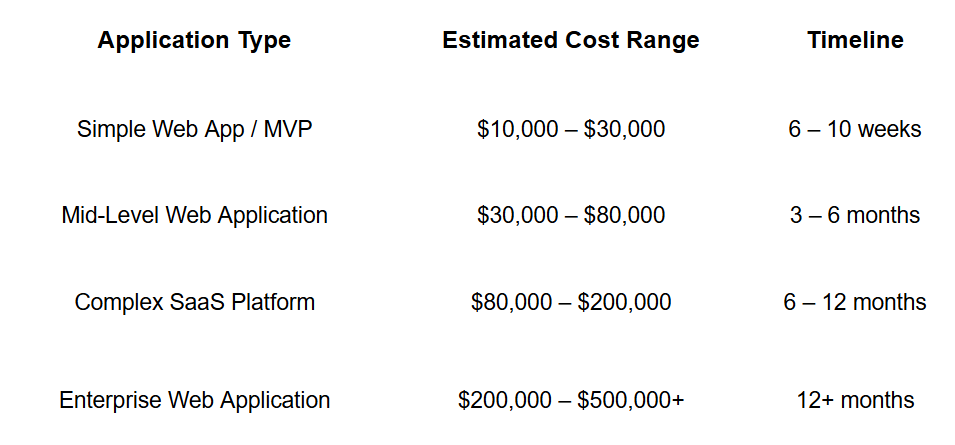
These ranges assume the presence of a professional development team. Freelancers may quote lower, but the tradeoffs in quality, reliability, and timeline often make the savings short-lived.
How you structure your development team is one of the biggest levers you have on cost. Here are the three most common approaches:
Freelancers are the most affordable option on paper. Rates typically range from $25 to $150 per hour, depending on location and skill level. However, managing multiple freelancers across frontend, backend, and design requires significant time and coordination on your end. For simple projects, this can work well. For anything complex, the coordination overhead and reliability risks often outweigh the savings.
A local agency in the US or UK typically charges between $100 and $250 per hour. You get a structured team, clear processes, and easier communication — but costs add up quickly for larger projects. For a mid-level web application, a local agency engagement can easily reach $100,000 or more.
Working with an experienced offshore development team gives you access to senior engineering talent at significantly lower rates, typically $40 to $100 per hour, without sacrificing quality when you choose the right partner. This is why many US and UK startups and scale-ups use offshore teams to build their core products while keeping costs predictable and timelines realistic.
The initial development quote is rarely the final number. Here are the costs that catch most first-time clients off guard:
Hosting and Infrastructure Cloud hosting on AWS, Google Cloud, or Azure isn't free. Depending on your traffic and data requirements, monthly infrastructure costs can range from $50 to several thousand dollars.
Ongoing Maintenance Software needs to be maintained. Bug fixes, security patches, dependency updates, and performance improvements are ongoing. Budget roughly 15–20% of your initial development cost annually for maintenance.
Third-Party Service Subscriptions APIs, payment processors, email services, and monitoring tools all have monthly fees that add up over time.
Post-Launch Iterations: Real users will reveal things your team didn't anticipate. Budget for at least one round of post-launch improvements based on actual user feedback.
QA and Testing: Thorough testing before launch is non-negotiable. If it's not explicitly included in your development quote, make sure you account for it separately.
Reducing cost doesn't have to mean reducing quality. Here's how smart teams do it:
Build only the features that are essential to validate your idea. A well-scoped MVP lets you get to market faster, gather real feedback, and invest in the right features instead of spending six months building things users don't need.
Before writing a single line of code, invest in a structured discovery process. At Codieshub, our Discovery Sprint takes 4–8 weeks and delivers a validated concept, user research, and a high-fidelity prototype. This saves significantly more than it costs by eliminating guesswork and scope creep before development begins.
Over-engineering is expensive. Choose a technology stack that fits your current scale and growth trajectory, not the most complex option available. Your development partner should recommend a stack based on your goals, not their preferences.
Agencies that understand your business goals will push back on unnecessary features, suggest smarter solutions, and help you get more value from your budget. A good development partner saves you money over time; a cheap vendor often costs more.
Here's a simple framework to think about your budget:
If you're validating an idea, budget $15,000 – $40,000 for a focused MVP that proves the concept without over-building.
If you're building a real product, budget $50,000 – $150,000 for a mid-level web application with solid architecture, proper design, and room to scale.
If you're scaling an existing product, budget $150,000+ depending on complexity, integrations, and performance requirements.
In all cases, add 20% to whatever number you arrive at. Unexpected requirements, scope changes, and post-launch iterations are part of every real project.
At Codieshub, we've shipped 50+ products across SaaS, fintech, healthcare, and more on time and on budget. Our clients range from funded startups to enterprise teams in the US and UK.
Here's what makes our approach different:
We start with Discovery, not code. Before any development begins, we validate your concept, map user needs, and deliver a production-ready prototype. This eliminates the biggest source of cost overruns, building the wrong thing.
Design and development work together. Our UI/UX designers and engineers collaborate from day one, so what gets designed is exactly what gets built, no handoff friction, no surprises.
We recommend the right stack for your goals. Whether it's a SaaS platform, a mobile application, or a complex enterprise system, we choose technology based on your needs, not our convenience.
We're a long-term partner. We don't disappear after launch. Our clients stay with us because we're invested in their product's success, not just the initial delivery.
Get a Free Project Estimate. Tell us about your project, and we'll send you a tailored breakdown within 48 hours.
Web application development costs range from $10,000 for a simple MVP to $500,000 or more for a complex enterprise platform. The final cost depends on your feature requirements, design complexity, technology stack, and the team structure you choose.
Starting with a focused MVP is the most cost-effective approach. Build only the core features needed to validate your idea, get real user feedback, and then invest in expanding the product based on what actually matters to your users.
A simple MVP typically takes 6 to 10 weeks. A mid-level web application takes 3 to 6 months. Complex SaaS platforms and enterprise applications can take 6 to 12 months or more, depending on scope and team size.
Freelancers have lower hourly rates but require significant management and coordination. Agencies cost more per hour but deliver structured processes, reliable timelines, and a full team. For most serious projects, an experienced agency delivers better value over the full project lifecycle.
Beyond development, budget for hosting and infrastructure, ongoing maintenance (15–20% of development cost annually), third-party service subscriptions, QA and testing, and post-launch iterations based on real user feedback.
This depends entirely on where your users are. If your audience is primarily on desktop or expects a browser-based experience, start with a web application. If mobile is central to your product experience, explore mobile app development options early in your planning.
Look for an agency with a real portfolio of shipped products, a structured discovery process, and transparent pricing. Check reviews on Clutch or Google, ask for case studies relevant to your industry, and make sure they ask questions about your business goals — not just your feature list.
Share

Raheem
Founder, Codieshub
Building software products for US and UK teams. I write about SaaS, product development, and engineering culture.
Connect on LinkedInStart your project
Ready to build? Let's scope your project.
Get a tailored breakdown in 48 hours no fluff, no commitment.
Discover high-profit AI business ideas for entrepreneurs in 2026. Learn step-by-step how to start, scale, and earn with AI tools.

 Custom Web
Discover 7 common reasons software projects fail and proven strategies to avoid costly mistakes in planning, management, and execution.

 Custom Web
Step-by-step guide to building a dedicated offshore development team in 2026. Save 40-60% on costs and ship faster. Get started with Codieshub today.
Your idea, our brains we’ll send you a tailored game plan in 48h.
Calculate product development costs