



 Custom Web
8 min
Ultimate DevOps Guide 2026: Tools, Practices & Benefits
Master DevOps in 2026 with essential tools, CI/CD practices, and cloud strategies to accelerate software delivery and boost team efficiency.
April 17, 2026
Read
Core Services

AI & ML Solutions
Our clients reduce operational costs by 45% and hit 90%+ prediction accuracy. We build the AI pipelines that make those numbers possible.

Custom Web Development
We've delivered 150+ web platforms for US startups and enterprise teams. Our engineers write in React, Next.js, and Node.js chosen for your project, not our preference.

UI/UX Design
We design interfaces that reduce drop-off and increase sign-ups. Our clients average a 40% conversion lift after a UX redesign.

Mobile App Development
80+ apps published. 4.8/5 average user rating. 99% crash-free sessions across iOS and Android.

MVP & Product Strategy
We shipped PetScreening’s MVP in under 5 months. It reached 21% month-over-month growth within a year. We do the same for founders who need proof before they run out of runway.

SaaS Solutions
We build multi-tenant SaaS platforms that ship on time and hold up under load. Our clients report lower churn and faster revenue growth within the first year of launch.
Recognized By







Industries

Healthcare
Innovative healthcare solutions prioritize patient care. We create applications using React and cloud services to enhance accessibility and efficiency.

Education
Innovative tools for student engagement. We develop advanced platforms using Angular and AI to enhance learning and accessibility.

Real Estate
Explore real estate opportunities focused on client satisfaction. Our team uses technology and market insights to simplify buying and selling.

Blockchain
Revolutionizing with blockchain. Our team creates secure applications to improve patient data management and enhance trust in services.

Fintech
Secure and scalable financial ecosystems for the modern era. We engineer high-performance platforms, from digital banking to payment gateways, using AI and blockchain to ensure transparency, security, and compliant digital transactions.

Logistics
Efficient logistics solutions using AI and blockchain to optimize supply chain management and enhance delivery.
Recognized By
Company

About
Learn who we are, our founding story, and the team behind every product we ship.

Reviews
Read client reviews and testimonials about Codieshub’s software, web, and IT solutions. See how businesses worldwide trust our expertise.

Blogs
Discover expert insights, tutorials, and industry updates on our blog.

FAQs
Explore answers to frequently asked questions about our software, AI solutions, and partnership processes.

Careers
Join our team of engineers and designers building software products for clients around the world.

Contact
You can tell us about your product, your timeline, how you heard about us, and where you’re located.
Recognized By


Learn how to choose the right tech stack for your startup in 2026 to build fast, scalable, and cost-effective web applications.

Choosing the right technology stack is one of the most important decisions for any startup. It directly impacts how your web application performs, scales, and delivers a smooth user experience. A well-planned stack using the right programming language, operating system, and tools helps web developers build fast, secure, and scalable products.
In today’s competitive market, startups need cost-effective and flexible solutions. Using open source technologies, modern frameworks like the MERN Stack, and full-stack development approaches can improve speed and reduce development time. At the same time, selecting the right database, such as SQL Server, and supporting real-time features ensures better performance and reliability.
In this guide, you’ll learn how to choose the best technology stack for your startup, improve development decisions, and build a strong foundation for long-term growth.
A tech stack (or technology stack) is a combination of tools, programming languages, frameworks, and technologies used to build and run a web application. It includes everything from frontend to backend, database, and operating system.
In simple words, it is the complete setup used by web developers to create software.
Frontend Development is a key part of the tech stack, focusing on the user interface and user experience, ensuring that users interact smoothly with the application.
A typical stack includes:
Frontend (React, Angular)
Backend (Node.js, Python)
Database (SQL Server, MongoDB)
Hosting (Cloud platforms)
Choosing the right tech stack is critical for startup success. It impacts speed, scalability, and cost.
A strong stack helps you:
Build faster
Scale easily
Improve user experience
Reduce long-term cost
Backend Development plays a major role here, as it handles data, performance, and real-time processing, ensuring your application runs smoothly and efficiently.
A wrong stack can increase cost, slow development, and create technical issues later.
Choosing the right technology stack is not just about trends; it’s about selecting tools that match your business goals, enhance UI/UX Design, and improve your web application performance. By focusing on the right factors, startups can improve user experience, reduce risk, and build scalable products.
Here are the key factors you should consider:
When selecting a technology stack, always start by understanding your project requirements. Define the core features your web application needs, how complex it will be, and whether it involves AI & Machine Learning components. Consider scalability for future growth, whether vertical or horizontal. Performance is also critical, especially for real-time applications where response time matters. Security should never be ignored, particularly for apps handling sensitive data. A well-chosen stack ensures a smooth user experience and efficient system performance.
Your team’s experience plays a big role in choosing the right technology stack. If your web developers are already familiar with a specific programming language or framework, development becomes faster and more cost-effective. New technologies may slow down progress due to the learning curve. For startups, using familiar tools helps build a stable web application without unnecessary delays.
Startups often need to launch quickly, so development speed is important. Choosing a full-stack framework with ready-made features can reduce development time. Mature frameworks with strong ecosystems and open source libraries allow faster building and testing. This helps businesses deliver a better user interface and improved user experience in less time.
Budget is a key factor when selecting a technology stack. Some tools require licensing fees, while open source solutions are more cost-effective. However, you must also consider maintenance costs, updates, and cloud infrastructure expenses. Choosing the right stack ensures cost efficiency while maintaining performance and scalability for your web application.
A good technology stack should support long-term growth and maintenance. Technologies with strong community support and regular updates are more reliable. This reduces the risk of system failure and ensures your web application continues to perform well. For startups and enterprises, leveraging Top Custom Software Development practices ensures robust, scalable solutions. Long-term planning helps maintain a consistent user experience.
Security is essential for any web application, especially in industries like finance, healthcare, and e-commerce. Your technology stack should support data protection, secure authentication, and compliance standards. Using secure frameworks and trusted programming languages ensures safety and builds user trust.
Strong community support makes development easier. Popular technology stacks often have large communities, detailed documentation, and many open source resources. This helps web developers solve problems quickly and improve development efficiency. Good documentation also reduces errors and speeds up project delivery.
Choosing a stack with widely available talent is important. If your technology stack uses popular programming languages, hiring skilled web developers becomes easier. This ensures smooth project execution and long-term scalability without delays caused by talent shortages. Additionally, selecting the right stack helps startups plan how to integrate voice features efficiently into their applications.
Performance is critical, especially for real-time applications like chat apps or trading platforms. Your technology stack should support high speed, low latency, and efficient data handling. Technologies like optimized databases, such as SQL Server, and scalable backend systems help deliver a fast and responsive user interface.
Modern web applications often rely on third-party integrations such as payment gateways, APIs, and analytics tools. Your technology stack should support easy integration with these services. Flexible backend technologies make it easier to connect external tools and improve the overall user experience.
Choosing the right technology stack requires a clear set of criteria to ensure your web application performs well, scales easily, and delivers a great user experience. The right choices improve development processes, reduce risk, and ensure long-term success. Partnering with the best software development companies can also guide startups in selecting the most effective stack and implementing it efficiently.
Choose the Right Programming Language: Select a reliable programming language that fits your project's needs and supports scalability, performance, and a smooth user interface.
Prefer Open Source Technologies: Using open source tools reduces costs, increases flexibility, and provides strong community support for faster development.
Database Selection: Pick a database like SQL Server or MongoDB based on your data structure and performance needs, especially for real-time applications.
Frontend & Backend Balance: A good mix of frontend and backend technologies ensures a seamless user interface and a high-performing web application.
Full Stack Compatibility: Make sure your stack supports full-stack development for better integration and faster development cycles.
Operating System Support: Ensure your tools and frameworks work efficiently with your chosen operating system to avoid compatibility issues.
Performance & Scalability: The stack should handle growth and increased traffic without affecting performance or user experience.
Custom CRM Considerations: For businesses building a Custom CRM, selecting the right stack is critical for efficient data handling, optimized performance, and a smooth user experience across all features.
Choosing the right tech stack for a web application ensures smooth performance, scalability, and a great user experience. A well-balanced stack combines frontend, backend, and database technologies to deliver a responsive and reliable product.
Frontend tools like React, Angular, or Vue.js help build a strong user interface and improve user experience. These frameworks allow web developers to create interactive and responsive applications.
Backend frameworks such as Node.js, Django, or Ruby on Rails provide robust processing, handle complex logic, and support real-time functionality. They ensure smooth data flow and performance.
Choose a database like SQL Server, MongoDB, or PostgreSQL, depending on your data structure and performance needs. Real-time applications often require fast, scalable databases to manage large amounts of data efficiently.
A full-stack approach allows seamless integration between frontend and backend, reducing development time and improving overall system efficiency.
Using open source tools reduces costs and provides flexibility for customization, while strong community support ensures faster problem-solving and enhanced development processes.
Selecting the right technology stack for mobile apps ensures smooth performance, better user experience, and scalable solutions. A well-chosen stack balances frontend, backend, database, and third-party tools for optimal functionality.
Mobile frameworks like Flutter, React Native, and Swift help build responsive user interfaces and enhance user experience on both Android and iOS devices.
Backend solutions like Node.js, Django, or Firebase handle data processing, server logic, and real-time functionality for mobile apps. A strong backend ensures smooth performance and scalability.
Use databases such as SQL Server, Firebase Realtime Database, or MongoDB to efficiently manage data, especially for apps requiring real-time updates and synchronization.
A full-stack mobile approach integrates frontend and backend seamlessly, improving development efficiency and reducing time to market.
Leveraging open source libraries and frameworks reduces costs, provides flexibility, and allows faster implementation of features while improving development processes.
Choosing the right technology stack is a step-by-step process to build a scalable web application, improve user experience, and ensure long-term success.
Know what you want to build and how your product solves user problems.
Identify features, scalability needs, and whether real-time functionality is required.
Pick a language based on performance, flexibility, and developer availability.
Ensure smooth user interface and strong backend performance.
Use SQL Server or NoSQL, depending on your data needs and performance.
A full-stack approach speeds up development and improves integration.
Open source tools reduce cost and allow flexible customization.
Make sure your stack can handle growth without affecting user experience.
Agencies help startups select the best stack, optimize development processes, and build high-performing applications. Working with a Product Development Agency can simplify this process. They guide startups in choosing the best stack, improving development processes, and building scalable, high-performing applications with better cost-effectiveness.
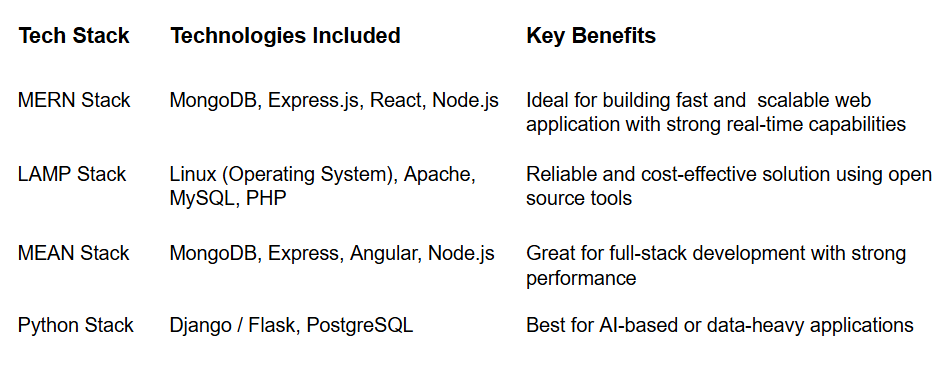
Here are some widely used stacks:
Codieshub helps startups choose the right technology stack based on their needs. Their approach focuses on:
Understanding business goals
Recommending the best tools
Improving development processes
Ensuring scalability and performance
They also work across multiple industries we serve, delivering customized solutions that improve user experience, reduce cost, and ensure effective software development for different business types.
Choosing the right tech stack is not about following trends; it’s about making smart decisions based on your business needs. A well-selected technology stack improves performance, scalability, and user experience, while reducing long-term costs.
Whether you choose open source, full-stack, or modern frameworks like MERN Stack, the goal is to build a strong and scalable web application.
If you want expert guidance, book a call today and let our team help you choose the perfect tech stack for your startup and build a high-performing product.
A tech stack is a combination of programming languages, frameworks, databases, and tools used to build a web or mobile application. Choosing the right stack ensures scalability, smooth UI/UX Design, efficient development processes, and better user experience for startups and enterprises.
Selecting the right technology stack involves evaluating project requirements, team expertise, scalability, and performance. Consider frontend and backend technologies, databases like SQL Server, full-stack compatibility, and open-source tools to reduce costs and improve efficiency in your web or mobile application development.
Popular stacks include MERN Stack, LAMP Stack, MEAN Stack, and Python Stack (Django/Flask). These stacks support full-stack development, real-time applications, AI & Machine Learning integration, and strong UI/UX Design, making them ideal for startups and Top Custom Software Development projects.
Yes, open source tools reduce licensing costs, improve flexibility, and provide strong community support. Using open source technologies in your stack helps development teams implement features faster, maintain high-quality web applications, and optimize development processes for cost-effectiveness.
A full-stack approach integrates frontend, backend, and databases, reducing delays between teams and speeding up development. It improves user experience, simplifies maintenance, and ensures seamless real-time performance, making it a preferred choice for startups and Best Software Development Companies.
AI & Machine Learning can enhance your web or mobile application by providing smart features, predictive analytics, and automation. Choosing a stack that supports Python, Django, or Node.js allows seamless integration, improving performance, scalability, and overall user experience.
Choose technologies with strong community support, regular updates, and compatibility with cloud services. Focus on performance, real-time functionality, and Top Custom Software Development practices. Planning for growth ensures your web application remains scalable, reliable, and cost-effective while maintaining excellent UI/UX Design.
Share

Raheem
Founder, Codieshub
Building software products for US and UK teams. I write about SaaS, product development, and engineering culture.
Connect on LinkedInStart your project
Ready to build? Let's scope your project.
Get a tailored breakdown in 48 hours no fluff, no commitment.
Custom WebMaster DevOps in 2026 with essential tools, CI/CD practices, and cloud strategies to accelerate software delivery and boost team efficiency.


Discover the best AI tools for small businesses in 2026. Learn how to automate tasks, boost productivity, and make smarter decisions with AI.


Learn how to build AI SaaS products in 2026, covering strategy, tech stack, costs, challenges, and how to leverage AI for scalable growth.
Your idea, our brains we’ll send you a tailored game plan in 48h.
Calculate product development costs