


 Custom Web
9 min
Legacy System Modernization: Step-by-Step Guide 2026
Learn how to modernize legacy systems step by step in 2026. Reduce costs, boost performance, and future-proof your business.
April 13, 2026
Read
Core Services

AI & ML Solutions
Our clients reduce operational costs by 45% and hit 90%+ prediction accuracy. We build the AI pipelines that make those numbers possible.

Custom Web Development
We've delivered 150+ web platforms for US startups and enterprise teams. Our engineers write in React, Next.js, and Node.js chosen for your project, not our preference.

UI/UX Design
We design interfaces that reduce drop-off and increase sign-ups. Our clients average a 40% conversion lift after a UX redesign.

Mobile App Development
80+ apps published. 4.8/5 average user rating. 99% crash-free sessions across iOS and Android.

MVP & Product Strategy
We shipped PetScreening’s MVP in under 5 months. It reached 21% month-over-month growth within a year. We do the same for founders who need proof before they run out of runway.

SaaS Solutions
We build multi-tenant SaaS platforms that ship on time and hold up under load. Our clients report lower churn and faster revenue growth within the first year of launch.
Recognized By







Industries

Healthcare
Innovative healthcare solutions prioritize patient care. We create applications using React and cloud services to enhance accessibility and efficiency.

Education
Innovative tools for student engagement. We develop advanced platforms using Angular and AI to enhance learning and accessibility.

Real Estate
Explore real estate opportunities focused on client satisfaction. Our team uses technology and market insights to simplify buying and selling.

Blockchain
Revolutionizing with blockchain. Our team creates secure applications to improve patient data management and enhance trust in services.

Fintech
Secure and scalable financial ecosystems for the modern era. We engineer high-performance platforms, from digital banking to payment gateways, using AI and blockchain to ensure transparency, security, and compliant digital transactions.

Logistics
Efficient logistics solutions using AI and blockchain to optimize supply chain management and enhance delivery.
Recognized By
Company

About
Learn who we are, our founding story, and the team behind every product we ship.

Reviews
Read client reviews and testimonials about Codieshub’s software, web, and IT solutions. See how businesses worldwide trust our expertise.

Blogs
Discover expert insights, tutorials, and industry updates on our blog.

FAQs
Explore answers to frequently asked questions about our software, AI solutions, and partnership processes.

Careers
Join our team of engineers and designers building software products for clients around the world.

Contact
You can tell us about your product, your timeline, how you heard about us, and where you’re located.
Recognized By


Compare Node.js vs Python for web development in 2026. Discover which backend technology suits your project's speed, scalability, and architecture needs.

Choosing the right backend technologies is one of the most important decisions in modern web development. Today, two of the most popular options are Node.js and Python, both of which are widely used for building scalable web applications and powerful web applications.
Node.js serves as a fast runtime environment that enables JavaScript to run on the server side, making it ideal for real-time applications, such as chat applications. On the other hand, Python is a simple and flexible programming language known for clean code and strong community support, making it a top choice for many Python developers.
When it comes to backend development, both technologies offer unique advantages. Node.js uses a single-threaded architecture that improves performance scalability, while Python has features like the global interpreter lock, which can impact performance in certain cases. Unlike many compiled languages, Python focuses on simplicity and ease of use.
Both Node.js and Python are open source, come with powerful package manager tools, and are widely used in building modern web applications.
In this guide, we will compare Node.js vs Python in detail to help you choose the best option for your next project or career as a Node.js developer or Python expert.
What You Will Learn in This Guide
What is Node.js?
What is Python?
Quick Comparison Between Node.js and Python for Web Development
An In-Depth Comparison of Node.js vs Python
NodeJS vs Python: Which One to Choose?
Conclusion & Next Steps
Frequently Asked Questions (FAQs)
Node.js is a runtime environment that allows developers to run JavaScript on the server side.
It is widely used in web development for building fast and scalable web apps.
Uses a single-threaded architecture
Ideal for real-time applications like chat apps
Comes with a powerful package manager (npm)
Built for high-performance scalability
Strong open source ecosystem
Node.js is a great choice if you want to build:
Chat applications
Streaming platforms
Real-time dashboards
A professional working with this technology is called a Node.js developer.
Python is a popular programming language known for its simplicity and readability.
It is widely used in backend development, data science, and automation.
Easy to learn and beginner-friendly
Supports multiple backend technologies
Strong community support
Works well for complex web applications
Not a compiled language (it is interpreted)
Python uses something called the global interpreter lock (GIL), which can affect performance in some cases.
A professional working with Python is called a Python developer.
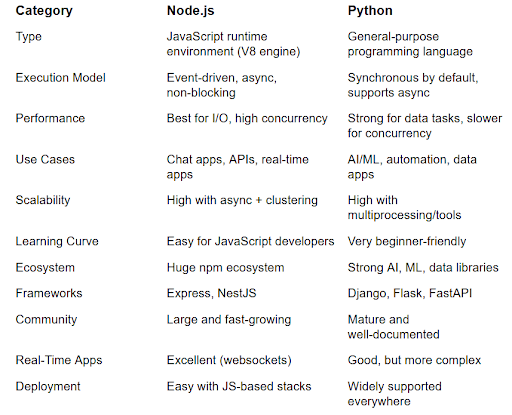
Node.js is built on the high-performance V8 engine and is widely used in modern web development for fast server-side execution. Its single-threaded, event-driven, non-blocking architecture makes it ideal for high-level performance in web applications and real-time applications like chat systems. It handles I/O-heavy tasks efficiently using its runtime environment, giving strong performance and scalability for backend systems.
Python is a popular programming language used in backend development, but it is generally slower because it runs code line by line. It is not a compiled language, which affects execution speed. However, Python is still strong in CPU-heavy tasks and is widely used by every python developer in data-heavy systems and AI Chatbot Development, where it is commonly used to build intelligent conversational systems, automation tools, and machine learning-based applications.
Verdict:
Node.js wins for I/O-heavy web apps, real-time systems, and fast backend technologies, while Python is better for compute-heavy tasks.
Node.js offers excellent performance scalability due to its asynchronous and non-blocking model. It is widely used for building scalable web applications, APIs, and real-time applications. With clustering and event-driven design, it easily handles high traffic workloads.
Python can scale using tools like multiprocessing, containers, and async frameworks. However, the global interpreter lock can limit true parallel execution in some cases.
Verdict:
Node.js is better for scalable web development and high-concurrency systems, while Python requires more setup for similar scalability.
Node.js uses a single-threaded event loop architecture that makes it efficient for server-side development. It is ideal for web apps, APIs, and real-time systems where multiple connections must be handled at once. It is widely preferred in modern backend development, especially for scalable systems and high-performance solutions. It is also commonly used in Custom Software Development Cost optimization because it helps reduce infrastructure overhead and improves development efficiency for large-scale applications.
Python uses a general-purpose architecture and is more flexible. It supports async programming but is still affected by the global interpreter lock in many cases. It is widely used in backend technologies, automation, and scientific computing.
Verdict:
Node.js is more optimized for real-time web applications, while Python is more flexible for general-purpose use.
Node.js has a powerful package manager (npm) that provides thousands of libraries for web development, APIs, and real-time applications. It is highly extensible for modern backend systems.
Python is highly extensible and widely used in multiple domains like AI, automation, and backend systems. It integrates easily with other languages and supports complex systems beyond web applications, which makes it a strong choice for AI projects. Failure scenarios where poorly designed models, weak data pipelines, or incorrect implementation can lead to unsuccessful AI outcomes, highlighting the importance of proper architecture and development practices.
Verdict:
Python is slightly more versatile, but Node.js is highly effective for backend development and web-focused systems.
Node.js has a huge open source ecosystem through npm, making it strong for building scalable web apps and APIs.
Python has a broader ecosystem covering AI, ML, automation, and backend technologies, making it useful beyond web development.
Verdict:
Python has a wider ecosystem, but Node.js is stronger for web-focused development.
Node.js applications depend heavily on third-party npm packages, so security depends on proper management and updates.
Python also uses many external libraries, which may contain vulnerabilities if not properly maintained.
Verdict:
Neither is fully secure by default. Security depends on best practices in backend development and proper code handling.
Node.js has strong community support from the JavaScript ecosystem, making it popular in modern web development.
Python has a mature and global community with strong support across backend technologies, AI, and automation.
Verdict:
Both have strong communities, making them reliable open source technologies.
Node.js is highly popular in web development, APIs, and real-time applications.
Python is one of the most popular programming languages globally, especially in AI, data science, and backend systems.
Verdict:
Python is more popular overall, while Node.js dominates server-side web systems.
Node.js is easy for JavaScript developers, but async programming can be complex in backend development.
Python is simple, readable, and widely preferred by beginners and every Python developer.
Verdict:
Python is easier to learn.
Modern Node.js uses async/await and promises, making error handling easier in web applications, but it can still be complex in large systems.
Python uses simple try/except error handling, making it easier to manage in backend development.
Verdict:
Python has simpler and cleaner error handling.
You are building real-time applications
You need high-performance scalability
You want fast APIs and lightweight apps
You plan to become a Node.js developer
You want simple and clean code
You are building data-heavy systems
You want strong support for AI/ML
You plan to become a Python developer
Both Node.js and Python are powerful backend technologies widely used in modern web development for building scalable web applications, APIs, and real-time applications.
Node.js is the best choice when you need high-performance scalability, fast server-side processing, and efficient handling of I/O-heavy workloads in web apps. It is widely preferred for chat systems, streaming platforms, and real-time products.
On the other hand, Python is a highly flexible programming language known for simplicity, strong community support, and its dominance in AI, automation, and data-driven systems. Many Python developers prefer it for its readability and ease of use in backend development.
In simple words, Node.js is better for speed and real-time systems, while Python is better for simplicity and data-heavy applications.
If you are still confused about choosing between Node.js and Python for your project or want expert help in building scalable web applications, you can book a free consultation call with our team.
Node.js is a powerful runtime environment used in modern web development. It allows JavaScript to run on the server side and is widely used for building fast and scalable web applications, APIs, and real-time systems.
Python is a popular programming language used in backend development, automation, data science, and AI. It is widely preferred by every Python developer due to its simple syntax and strong community support.
Both are strong in web development. Node.js is better for real-time and high-performance web apps, while Python is better for data-heavy and structured backend technologies. The choice depends on your project needs.
Yes, Node.js is generally faster for server-side tasks because of its single-threaded, non-blocking architecture. Python is slower in comparison, but still performs well in many backend development use cases.
Yes, Python can handle real-time applications, but it is less efficient compared to Node.js. Node.js is more optimized for chat systems, live dashboards, and streaming web applications.
The global interpreter lock (GIL) is a mechanism in Python that allows only one thread to execute at a time. It can limit performance in multi-threaded backend development and high-concurrency systems.
Python is easier to learn due to its simple syntax and readability. Node.js is also easy for JavaScript developers, but can be more complex when dealing with asynchronous web development concepts.
Share

Raheem
Founder, Codieshub
Building software products for US and UK teams. I write about SaaS, product development, and engineering culture.
Connect on LinkedInStart your project
Ready to build? Let's scope your project.
Get a tailored breakdown in 48 hours no fluff, no commitment.
Custom WebLearn how to modernize legacy systems step by step in 2026. Reduce costs, boost performance, and future-proof your business.


Discover high-profit AI business ideas for entrepreneurs in 2026. Learn step-by-step how to start, scale, and earn with AI tools.

 Custom Web
Discover what drives web application development costs in 2026, from features and tech stack to team structure, with real price ranges.
Your idea, our brains we’ll send you a tailored game plan in 48h.
Calculate product development costs