
InsightsHealthcare
AI in Dental Practice Management Software Complete Guide 2026
Discover how AI dental practice management software automates scheduling, billing, and documentation—boosting revenue and reducing admin burden in 2026.
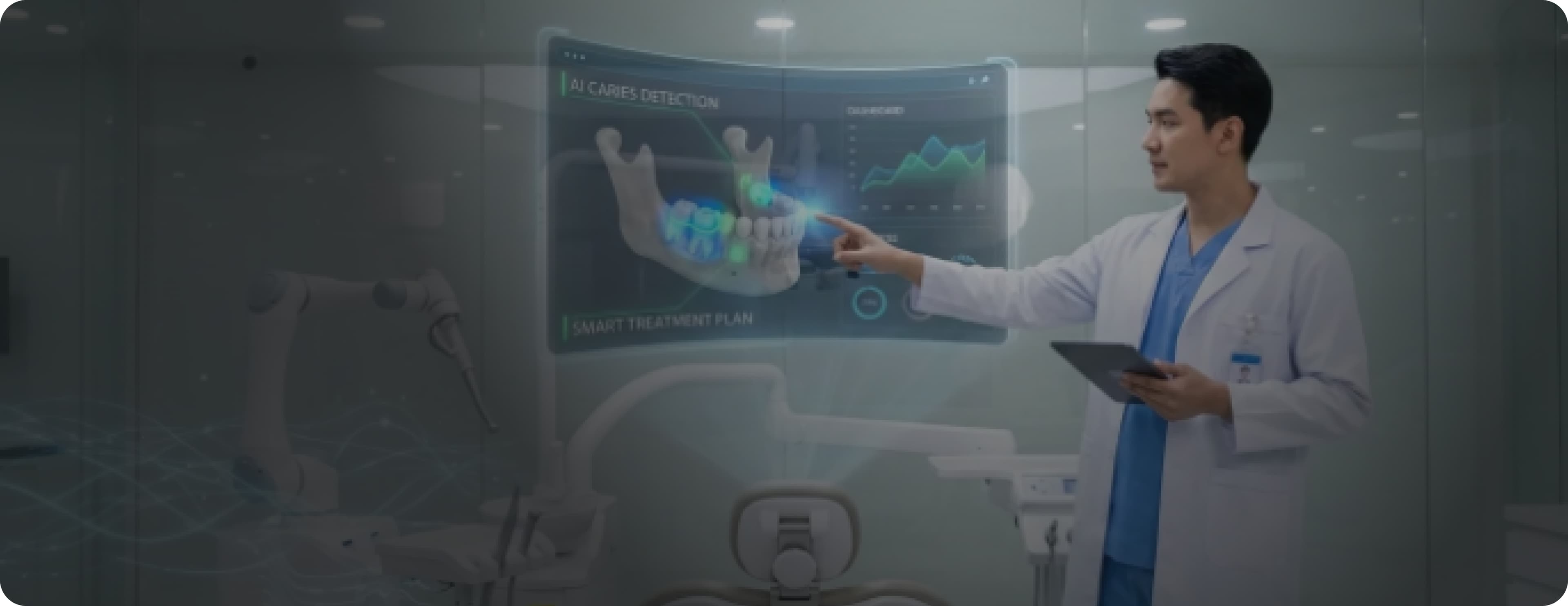
A dental practice schedules 40 to 60 patient appointments every day. Each one involves insurance verification, treatment history review, appointment reminders, chair-side documentation, billing and coding, and follow-up scheduling, all managed by a small administrative and clinical team that is also answering phones, greeting patients, and handling the unexpected situations that arise in any busy healthcare setting.
The administrative burden in dental practices has grown faster than staff capacity to handle it. Insurance requirements have become more complex. Patient expectations for digital communication have increased. And the documentation demands on dentists who spend a meaningful portion of their clinical time on paperwork rather than patient care have not improved despite the widespread adoption of practice management software.
AI dental practice management software is changing this. Not by adding more complexity to existing systems, but by making existing workflows significantly more intelligent, automating insurance verification, reducing no-shows through predictive outreach, generating clinical documentation from encounter data, optimizing scheduling to maximize chair utilization, and catching billing errors before claims are submitted.
In 2026, dental practices and dental service organizations across the United States are deploying AI capabilities into their practice management workflows, and the ones doing it well are seeing measurable improvements in revenue cycle performance, staff efficiency, and patient experience.
This guide covers everything dental startups, DSOs, and health tech companies need to know about AI dental practice management software from the clinical and operational use cases delivering the most value to the technical architecture, compliance requirements, and development process.
Key Takeaways
AI dental practice management software automates scheduling optimization, insurance verification, clinical documentation, billing and coding, and patient communication, reducing administrative burden across the full practice workflow
No-show prediction and intelligent recall outreach are the use cases delivering the fastest measurable ROI for most dental practices, directly improving chair utilization and revenue
HIPAA compliance requires dental patient records, treatment histories, radiograph data, and billing information to be protected health information
Integration with existing dental practice management systems Dentrix, Eaglesoft, Open Dental, and Curve Dental is essential for AI tools to work within the workflows dental teams already use
AI dental billing and coding assistance reduces claim denial rates by 25 to 40% in production deployments, directly improving revenue cycle performance
FDA regulatory classification applies to AI tools that make clinical claims; diagnostic AI for radiograph analysis is regulated differently from administrative automation tools
Total development cost for custom AI dental practice management software ranges from $60,000 for a focused MVP to $400,000 or more for a full DSO-scale platform
What Is AI Dental Practice Management Software?
AI dental practice management software is a technology platform that uses artificial intelligence, machine learning, natural language processing, computer vision, and predictive analytics to automate and enhance the clinical and administrative workflows of dental practice management.
Traditional dental practice management software manages the mechanics of running a dental practice: appointment scheduling, patient records, treatment planning documentation, billing, and insurance claims. These systems are functional but passive; they store and retrieve information without providing intelligent analysis or predictive capability.
AI dental practice management software adds intelligence to these operational foundations. It predicts which patients are at risk of canceling or not showing up and triggers proactive outreach before the appointment is lost. It automatically verifies insurance benefits in real time rather than requiring staff to call payers. It analyzes dental radiographs using computer vision to assist dentists in identifying pathology. It generates clinical documentation from voice notes or structured encounter data. And it identifies billing errors and code selection opportunities before claims are submitted.
The result is a dental practice that runs more efficiently, generates more revenue from the same patient volume, and delivers a better patient experience with measurable improvements at every stage of the practice workflow.
Why AI Is Transforming Dental Practice Management in 2026
The transformation is driven by margin pressure, administrative complexity, and technology that has finally matured enough to deliver practical value in dental workflows.
Dental practice margins are under pressure. Rising supply costs, increasing staff wages, and static or declining insurance reimbursement rates are compressing the margins of dental practices. AI that recovers revenue from billing inefficiencies, reduces no-show losses, and eliminates manual administrative tasks that consume staff time addresses this margin pressure directly.
Administrative complexity is increasing. Insurance verification, prior authorization for high-cost procedures, dental billing code selection, and payer-specific claim requirements have all become more complex. Manual management of this complexity requires experienced staff and consumes time that could be spent on patient care.
DSO scale creates efficiency requirements. Dental service organizations managing dozens or hundreds of practice locations cannot scale administrative functions linearly with location count. AI automation enables DSOs to handle centralized billing, verification, and communications at scale without proportional headcount growth.
Patient expectations have shifted. Patients now expect digital appointment reminders, online scheduling, automated recall communications, and digital treatment plan presentations. Dental practices that cannot deliver these experiences are losing patients to competitors that do.
What Are the Key Use Cases for AI in Dental Practice Management?
Intelligent Appointment Scheduling and No-Show Prediction
No-shows and last-minute cancellations are one of the most expensive operational problems in dental practice management. An unfilled chair represents lost revenue that cannot be recovered once the appointment time has passed. The average dental practice loses 5 to 15% of its available chair time to no-shows and short-notice cancellations.
AI no-show prediction models analyze patient history, previous no-show and cancellation patterns, appointment type, appointment time, days since last appointment, demographic factors, and communication responsiveness to assign a cancellation risk score to each scheduled appointment. High-risk appointments trigger automated outreach, personalized reminders, confirmation requests, and rescheduling prompts targeted at the specific patients most likely to miss their appointments.
AI scheduling optimization goes further, learning which appointment types and patient combinations result in the highest chair utilization and generating scheduling recommendations that maximize productive chair time across the day.
Insurance Verification and Benefits Management
Manual insurance verification calling payer lines, navigating automated phone systems, and manually entering benefit information consumes significant front desk staff time in most dental practices. For practices verifying insurance for dozens of patients daily, this is a substantial operational burden.
AI-powered real-time insurance verification connects to payer databases through electronic verification channels to automatically retrieve and update patient benefit information, coverage amounts, frequency limitations, waiting periods, missing tooth clauses, and orthodontic benefits before the patient arrives. Benefit information is presented to the treatment planning workflow in a format that supports accurate patient cost estimation.
This automation reduces verification time from 10 to 20 minutes per patient to seconds, freeing front desk staff from hours of daily phone calls and reducing the patient billing surprises that occur when manual verification misses coverage limitations.
AI-Assisted Dental Billing and Coding
Dental billing errors are a significant source of revenue leakage. Incorrect CDT code selection, missing narrative requirements, bundling errors, frequency limitation violations, and documentation gaps all result in claim denials that require staff time to resolve and, in some cases, represent permanent revenue loss.
AI billing assistance analyzes treatment documentation and suggests appropriate CDT billing codes, flagging likely coding errors, identifying missing narrative requirements, and catching bundling violations before claims are submitted. AI models trained on payer-specific denial patterns identify claims at elevated denial risk, enabling billing staff to correct issues before submission rather than managing denials after the fact.
Practices deploying AI dental billing assistance consistently report 25 to 40% reductions in first-submission denial rates, delivering both revenue recovery and reduced administrative cost of denial management.
AI-Powered Clinical Documentation
Dentists, like physicians, spend a significant portion of their clinical day on documentation rather than patient care. AI clinical documentation tools capture voice notes during or after the clinical encounter, extract relevant clinical findings and treatment details, and generate structured clinical notes in the appropriate format for the practice management system.
For dental practices, clinical documentation AI must handle the specific vocabulary and structure of dental documentation: periodontal charting, restorative treatment details, radiographic findings, treatment planning notes, and referral documentation with the accuracy that clinical records require.
Dental Radiograph AI Analysis
AI computer vision tools analyze dental radiographs periapical, bitewing, panoramic to assist dentists in identifying pathology. These tools detect caries, bone loss, periapical pathology, calculus deposits, and other radiographic findings, presenting their detections as visual overlays that the dentist reviews and confirms.
Dental radiograph AI is one of the most actively developed areas in dental AI, with several FDA-cleared tools commercially available in 2026. This is the category of dental AI with the clearest FDA regulatory implications, as tools that make diagnostic claims about radiographic pathology are regulated as Software as a Medical Device.
Patient Communication and Recall Automation
Effective recall management reaching patients who are overdue for hygiene appointments, following up on unscheduled treatment recommendations, and re-engaging lapsed patients is essential for dental practice revenue but time-consuming to manage manually.
AI recall and communication tools analyze patient recall status, treatment plan acceptance history, and communication responsiveness to generate personalized outreach text messages, emails, and app notifications at the optimal time and through the optimal channel for each patient. AI personalization of recall messaging consistently improves reactivation rates compared to generic mass recall outreach.
Treatment Plan Presentation AI
AI tools that present treatment plans in visually compelling, easy-to-understand formats with cost breakdowns, insurance coverage estimates, and financing options improve treatment plan acceptance rates. Some AI presentation tools use intraoral camera images to show patients visual evidence of the conditions being treated, improving their understanding and increasing their willingness to accept recommended treatment.
Dental Supply Chain and Inventory Management
For dental practices and DSOs managing supply inventory, AI demand forecasting tools predict supply consumption based on scheduled procedure volume and historical usage patterns, generating automated reorder recommendations that prevent stockouts of critical supplies while reducing excess inventory carrying costs.
What Key Features Does Every AI Dental Practice Management Platform Need?
Real-Time Insurance Verification Engine
Electronic verification connectivity to major dental payers Delta Dental, Cigna, Aetna, MetLife, United Concordia, Guardian, and others with automatic benefit retrieval, coverage limitation identification, and benefit summary presentation in the treatment planning workflow.
CDT Coding Assistance and Claim Scrubbing
AI-powered CDT code suggestion based on treatment documentation, pre-submission claim scrubbing against payer-specific rules, and denial risk scoring for each claim before submission.
No-Show Prediction and Outreach Automation
Machine learning models that score each scheduled appointment for cancellation risk, integrated with automated multi-channel patient outreach SMS, email, app notification that is triggered based on risk score thresholds.
Clinical Documentation Generation
Voice-to-text capture with dental-specific NLP that extracts clinical findings and generates structured clinical notes in the formats required by the connected practice management system.
Radiograph AI Integration
Computer vision analysis of uploaded dental radiographs presented as visual finding overlays for dentist review with appropriate integration into the practice management workflow for finding documentation and treatment planning.
For dental AI tools that analyze radiographs and present pathology detections, FDA regulatory status must be determined and addressed before clinical deployment. Our HIPAA-compliant software development practice navigates these regulatory requirements as a core component of every dental AI engagement.
Patient Communication Hub
Multi-channel patient communication management: appointment reminders, recall outreach, treatment follow-up, unscheduled treatment reminders with AI personalization of message timing, channel, and content based on individual patient response patterns.
Practice Analytics Dashboard
Real-time visibility into practice performance: chair utilization, production per hour, no-show rate, recall effectiveness, collection rate, claim denial rate, and treatment plan acceptance rate presented in a format that practice owners and DSO regional managers can act on.
Our healthcare UI/UX design team designs dental practice analytics dashboards tested with real practice owners and DSO operations managers because dashboards that require expertise to interpret are not being used by the people who most need their insights.
Practice Management System Integration
Integration with the dental practice management systems that dental practices already use Dentrix, Eaglesoft, Open Dental, Curve Dental, Carestream, Carestack is essential for AI tools to work within existing workflows rather than requiring staff to use a separate system.
Our API integration services team builds these integrations with the specific data formats, authentication requirements, and API capabilities of major dental practice management platforms.
HIPAA-Compliant Data Architecture
Dental patient records, clinical notes, radiographs, treatment histories, and billing information are protected health information. Every component of the AI dental practice management system must comply with HIPAA-compliant data transmission and storage, role-based access controls, comprehensive audit logging, and Business Associate Agreements with all third-party services.
How Do You Develop AI Dental Practice Management Software Step by Step?
Step 1: Define the Practice Context and Priority Use Cases
Development begins with a precise understanding of the dental practice context: solo practice, group practice, DSO, or dental health tech startup building a platform for multiple practice types. Different contexts have different operational priorities and different integration requirements.
A solo practice AI tool prioritizes scheduling efficiency, insurance verification automation, and patient communication. A DSO platform prioritizes centralized billing, multi-location analytics, and standardized recall management. A dental radiograph AI startup has fundamentally different requirements: computer vision model development, FDA regulatory strategy, and PACS or intraoral sensor integration.
Defining these priorities before development begins is what ensures the platform delivers maximum value for its specific deployment context.
Step 2: Map Existing Dental Practice Workflows
Map the current dental practice workflow in detail from appointment booking through check-in, clinical encounter, treatment documentation, checkout, billing, claim submission, payment posting, and recall scheduling. This mapping identifies where AI can deliver the most value and which integration points with existing practice management systems are required.
Step 3: Audit Historical Practice Data
AI dental practice management models learn from historical practice data. Audit existing data: appointment volumes and no-show rates, claim submission and denial history, insurance verification times, recall effectiveness rates, and production per chair hour.
This audit establishes the baseline metrics against which AI-driven improvements will be measured and identifies the data gaps that need to be addressed before AI models can be trained effectively.
Step 4: Run a Discovery Sprint
A structured discovery process validates the technical approach, defines the integration architecture, addresses compliance requirements, and produces a validated development plan before engineering resources are committed.
At Codieshub, our MVP and product strategy process is built around this approach. For AI dental software specifically, where practice management system integration, regulatory classification for any radiograph AI components, and HIPAA compliance architecture are all decisions that are expensive to change after development begins, the discovery phase is the highest-leverage investment in the project.
Step 5: Build the Scheduling Intelligence Engine
Develop the no-show prediction models training on historical appointment data with no-show and cancellation outcomes as labels. Implement appointment risk scoring and integrate with the automated outreach system that delivers personalized communications to high-risk patients based on their risk threshold.
Build scheduling optimization logic that learns which appointment configurations maximize chair utilization and generates scheduling recommendations for front desk staff.
Step 6: Develop Insurance Verification Automation
Build electronic insurance verification connectivity using clearinghouse APIs or direct payer connections to retrieve and update patient benefit information automatically. Implement benefit summary presentation in the treatment planning workflow and patient cost estimation tools that use retrieved benefit information.
Step 7: Build the Billing and Coding AI
Develop NLP models that analyze treatment documentation and suggest appropriate CDT billing codes. Build the claims scrubbing engine that checks each claim against payer-specific rules before submission. Train denial prediction models on historical claim outcomes to identify high-denial-risk claims for pre-submission review.
Our AI and ML solutions team builds dental billing AI models trained on dental-specific coding and payer data with model update infrastructure built in from the beginning to maintain accuracy as CDT codes and payer policies change.
Step 8: Develop Clinical Documentation AI
Build voice-to-text capture with dental NLP extracting clinical findings, restorative details, periodontal measurements, and treatment plan documentation from voice notes or structured encounter data. Generate clinical note drafts in the formats required by the connected practice management system.
Step 9: Build Radiograph AI If Applicable
For dental radiograph AI components, develop and train computer vision models for caries pathology detection, bone loss, and periapical pathology. Implement visual overlay presentation for dentist review. Address FDA regulatory classification and develop the validation study protocol required for any regulatory submission.
Step 10: Build Practice Management System Integrations
Build bidirectional integration with the target dental practice management systems reading patient records, appointment data, treatment histories, and insurance information, and writing back clinical documentation, billing data, and scheduling changes.
Step 11: Implement HIPAA Compliance Architecture
Build the full HIPAA compliance architecture: encryption at rest and in transit, role-based access controls, comprehensive audit logging, and Business Associate Agreements with all third-party services before any patient data is processed.
Step 12: Design the Dental Team Interface
Design the interfaces through which dentists, hygienists, front desk staff, and practice managers interact with the AI system; each role with the specific view and functionality appropriate to their workflow.
Step 13: Pilot and Roll Out
Deploy in a structured pilot with specific success metrics: no-show rate change, claim denial rate change, insurance verification time reduction, staff time savings, practice production improvement. Use pilot data to refine models before broad rollout.
Our DevOps and cloud solutions team builds the deployment infrastructure and model monitoring that keeps the dental AI system performing accurately over time.
What Technology Stack Is Used for AI Dental Practice Management Software?
AI and Machine Learning
Python is the standard language for dental AI development. For no-show prediction and scheduling optimization, gradient boosting models XGBoost and LightGBM trained on historical appointment data perform reliably on the tabular appointment features that these models use.
For dental billing CDT code suggestion, NLP models fine-tuned on dental clinical documentation and coding data produce the best code suggestion accuracy. Transformer-based models fine-tuned on dental text including clinical notes, treatment documentation, and CDT code descriptions outperform general-purpose NLP on dental vocabulary.
For dental radiograph AI, convolutional neural networks and transformer-based vision models trained on annotated dental radiograph datasets are the current standard. TorchVision and MONAI provide relevant building blocks, with custom fine-tuning on dental radiograph data required for clinical accuracy.
For voice-to-text clinical documentation, Whisper fine-tuned on dental clinical vocabulary provides strong medical ASR performance. Dental terminology, tooth numbering systems, procedure abbreviations, and periodontal measurement terminology require specific fine-tuning beyond general medical ASR.
For patient communication personalization, sequence models that learn individual patient communication response patterns enable optimization of message timing, channel, and content for each patient.
Backend Infrastructure
Python with FastAPI handles the primary API layer. PostgreSQL serves as the primary database for patient records and practice operational data. Redis provides caching for frequently accessed insurance benefit data and scheduling optimization results. For radiograph AI, GPU compute infrastructure AWS P-series instances, or equivalent provides the image processing performance required for real-time analysis.
Dental Practice Management System Integration
Integration with dental practice management systems uses system-specific APIs where available. Open Dental provides a well-documented API, while Dentrix and Eaglesoft provide integration through their platform developer programs. For systems without comprehensive APIs, integration may require database-level connectivity or middleware solutions.
Electronic insurance verification uses clearinghouse APIs Availity and Change Healthcare, which provide electronic benefit verification connectivity to most major dental payers. Electronic prescribing uses Surescripts for practices that integrate e-prescribing. Dental imaging system integration uses DICOM where imaging systems support it and proprietary APIs for systems that use custom image formats.
Cloud Infrastructure
AWS with a HIPAA Business Associate Agreement is the most common cloud choice. Specific services include Amazon RDS PostgreSQL for HIPAA-eligible database hosting, AWS S3 with encryption for radiograph and clinical document storage, Amazon SageMaker for model training and serving, Amazon Textract for document processing where applicable, and AWS CloudTrail for comprehensive HIPAA audit logging.
How Do You Ensure HIPAA Compliance for AI Dental Practice Management Software?
Dental patient records are protected health information under HIPAA, including clinical records, radiographs, treatment histories, and billing information. All dental patient data handled by an AI dental practice management system must comply with HIPAA.
Technical Safeguards Required
All patient data must be encrypted at rest using AES-256 and in transit using TLS 1.2 or higher. This applies to radiograph images, clinical documentation, insurance benefit data, and billing records, all of which contain or can be linked to patient health information.
Role-based access controls must restrict patient data access to authorized dental practice staff, dentists, hygienists, dental assistants, front desk staff, and billing staff with access scoped to what each role requires for their specific functions. A billing coordinator should not have full access to clinical records. A dental hygienist should not have access to billing data that is not relevant to their clinical role.
Comprehensive audit logging must capture every access to patient records, which staff member accessed which patient's data, when, and what action was taken.
Business Associate Agreements must be in place with every third-party service that processes patient data: cloud providers, insurance verification clearinghouses, NLP API services, radiograph AI services, and patient communication platforms.
State Dental Board Compliance
State dental board regulations add requirements beyond federal HIPAA that vary by state, including requirements for electronic records retention, radiograph storage standards, and specific documentation requirements for certain procedures. AI dental practice management systems deployed across multiple states must address the specific requirements of each operating state.
What Are the FDA Regulatory Considerations for Dental AI?
Most administrative AI capabilities in dental practice management scheduling, insurance verification, billing, and patient communication fall outside FDA jurisdiction because they do not make clinical claims about patient health.
Dental radiograph AI tools that detect pathology, identifying caries, bone loss, periapical lesions, and present their findings to dentists as clinical decision support are regulated by the FDA as Software as a Medical Device. Several FDA-cleared dental radiograph AI tools are commercially available in 2026, including Overjet (FDA-cleared for bone level analysis and caries detection) and Diagnocat.
Building a dental radiograph AI tool for the US market requires determining the appropriate regulatory pathway: 510(k) clearance for tools substantially equivalent to cleared devices before development begins.
Our MVP and product strategy process addresses FDA regulatory classification as a core component of the discovery phase for any dental AI engagement that includes radiograph analysis or clinical decision support components.
Real-World Case Studies: Codieshub Healthcare Projects
Understanding what good healthcare software development looks like in practice is easier with real examples. While Codieshub does not have dental-specific case studies, our two live healthcare platform engagements illustrate the development approach and clinical rigor we bring to healthcare AI projects.
mPATH Health: 70,000+ Patients Served, 70% Workflow Friction Reduced
Dr. David Miller and Dr. Ajay Dharod at Wake Forest School of Medicine built mPATH Health to solve a critical gap in cancer screening outreach: millions of Americans missing critical screenings because legacy systems failed to engage high-risk patients effectively.
After a successful research pilot, they needed a technical partner to turn a localized success into a national automated platform, HIPAA-compliant, requiring no login barriers, and scalable enough to respond to surging demand after their research was published.
Codieshub rebuilt their technical approach from the ground up, a single text message leading directly to a secure web interface with immediate access to risk assessments and educational content. No friction. No app downloads. No login barriers. We also built a DevOps architecture that allows new hospital systems to onboard in days rather than months.
The result: over 70,000 patients have completed cancer screenings through the platform. Workflow friction reduced by 70%. As Cassie Allen, Head of Commercial Development at mPATH, said: "We would not have been able to accelerate at the rate we're accelerating without Codieshub."
Relevance for dental AI: The same principle that made mPATH successful meeting patients exactly where they are with zero friction applies directly to dental patient communication AI. Recall outreach, appointment reminders, and treatment follow-up that reaches patients through the channel they will actually use, without requiring them to download an app or log into a portal, achieves dramatically higher engagement rates.
TeamBuilder: Healthcare Platform MVP in Under 6 Months
TeamBuilder needed a predictive scheduling platform for physician ambulatory care with a hard deadline. A major New York healthcare system was waiting for a live pilot.
Codieshub embedded as a full product and engineering team, delivering role-based authentication, a predictive scheduling engine with demand forecasting, and admin reporting tools in structured two-week sprints. The MVP launched in under six months with 100% of core functionality delivered on time.
Relevance for dental AI: The scheduling intelligence Codieshub built for TeamBuilder, predicting staffing needs and filling scheduling gaps before they create operational problems applies directly to dental practice scheduling optimization. The same predictive modeling approach, applied to dental appointment data, produces the no-show prediction and chair utilization optimization that dental practices need.
AI Dental Practice Management Development Checklist
Strategic Foundation
Practice context and priority use cases defined
Existing dental practice workflow mapped in detail
Historical practice data audited for AI model training
Target practice management system integrations identified
Clinical and Regulatory
FDA regulatory classification determined for all AI components
Radiograph AI validation study designed if applicable
CDT coding accuracy validation protocol defined
State dental board compliance requirements identified
AI and ML Models
No-show prediction models trained on historical appointment data
CDT coding assistance models trained on dental billing data
Insurance verification connectivity built and validated
Clinical documentation NLP validated on dental vocabulary
Model update process defined for CDT code and payer policy changes
Integration
Practice management system integration built and tested
Insurance clearinghouse connectivity implemented
Dental imaging system integration built if applicable
Patient communication platform integration implemented
HIPAA Compliance
Encryption implemented for all PHI, including radiographs
Role-based access controls implemented for dental team roles
Audit logging configured for all PHI access
Business Associate Agreements in place with all third-party services
Deployment and Operations
Pilot defined with specific operational success metrics
Model performance monitoring configured
CDT code and payer rule update process established
Practice team training process designed for AI tool adoption
What Common Mistakes Should You Avoid When Building AI Dental Practice Management Software?
1. Building Without Practice Management System Integration
An AI dental tool that operates outside the dental team's existing workflow, requiring staff to use a separate system, manually transfer data, or context-switch between applications, will not achieve sustained adoption in the high-volume environment of a busy dental practice. Practice management system integration is the feature that determines whether the AI tool gets used or abandoned.
2. Ignoring CDT Code Update Requirements
CDT codes are updated annually by the American Dental Association. AI billing assistance tools that are not updated to reflect current CDT codes will generate incorrect coding suggestions. Building automated CDT code update processes into the platform from the beginning is essential for long-term billing accuracy.
3. Treating Radiograph AI as a Standard Software Feature
Dental radiograph AI tools that detect pathology are regulated medical devices in the United States. Building and deploying these tools without addressing FDA regulatory requirements creates significant legal and liability risk. Regulatory classification must be addressed before development begins for any dental AI component that makes diagnostic claims.
4. Building Without Dental Vocabulary-Specific NLP
General medical NLP models perform poorly on dental-specific vocabulary, tooth numbering systems (Universal, FDI, Palmer), dental procedure abbreviations, periodontal measurement terminology, and restorative material descriptions. Dental documentation AI requires NLP models specifically trained or fine-tuned on dental clinical text.
5. No-Show Prediction Without Outreach Automation
A no-show prediction model that scores appointment risk but does not trigger automated outreach requires staff to manually review risk scores and contact at-risk patients, which defeats much of the operational efficiency benefit. No-show prediction is most valuable when integrated with automated patient communication that acts on the prediction without requiring staff intervention.
6. Neglecting Front Desk Workflow Testing
AI dental tools that are technically capable but add friction to front desk workflows interfaces that are slow to load, require too many clicks, or present information in formats that require interpretation will be bypassed by busy dental front desk staff. Testing with real front desk staff in realistic dental practice conditions is essential before production deployment.
How Codieshub Builds AI Dental Practice Management Software
At Codieshub, we build AI dental practice management software for dental startups and dental service organizations that need platforms designed for the specific workflows, practice management systems, and operational requirements of dental practice not general healthcare AI tools adapted for a dental context.
Every engagement begins with our MVP and product strategy process which addresses practice context definition, priority use case selection, practice management system integration architecture, regulatory classification for clinical AI components, and HIPAA compliance design before production code is written.
Our AI and ML solutions team builds no-show prediction models, CDT coding assistance systems, clinical documentation NLP, and dental radiograph computer vision models trained on dental-specific data with model update infrastructure built in from the beginning to maintain accuracy as CDT codes, payer policies, and clinical guidelines change.
Our healthcare UI/UX design team designs dental team interfaces tested with real dentists, hygienists, and front desk staff in dental practice environments. Our API integration services team builds integrations with major dental practice management systems Dentrix, Eaglesoft, Open Dental, and Curve Dental. Our HIPAA-compliant software development practice ensures full compliance from day one, including radiograph data handling. And our DevOps and cloud solutions team builds the deployment infrastructure and model monitoring that keeps the dental AI platform performing accurately over time.
Get a Free Project Estimate: Tell us about your AI dental practice management project, and we will send you a tailored development and compliance game plan within 48 hours.
Conclusion
The dental practice management software market is at an inflection point. The practices and DSOs that adopt AI capabilities now in scheduling intelligence, insurance verification, billing assistance, and patient communication are building operational advantages that will compound over time as their AI models learn from more data and their competitors continue relying on manual workflows.
The gap between a dental practice running with AI-optimized scheduling, automated insurance verification, and AI billing assistance and one relying entirely on manual workflows is not just operational efficiency. It is revenue from recovered no-show losses, from reduced claim denials, from faster verification that enables accurate patient cost presentation, and from recall outreach that re-engages patients who would otherwise be lost.
At Codieshub, we build AI dental practice management software for dental startups and DSOs that need platforms designed for the specific operational realities of dental practice with HIPAA compliance built in, practice management system integrations that work reliably in production, and AI models trained on dental-specific data that actually delivers the billing and scheduling accuracy that dental workflows require.
Ready to Build Your AI Dental Platform? Turn your dental software idea into a secure, AI-powered solution built for real-world dental workflows. Book a Free Call with our AI healthcare development experts today.
Frequently Asked Questions
1. What is AI dental practice management software?
AI dental practice management software uses machine learning, NLP, and computer vision to automate dental operations. It can predict no-shows, verify insurance, assist with CDT coding, generate clinical documentation, analyze dental radiographs, and personalize patient outreach. These capabilities reduce administrative workload, improve chair utilization, increase revenue, and enhance patient engagement.
2. What AI capabilities deliver the most value for dental practices?
No-show prediction and AI billing assistance often deliver the fastest measurable ROI. No-show prediction improves chair utilization and helps recover lost revenue, while billing assistance reduces claim errors and speeds up revenue collection. Insurance verification automation also provides significant staff-time savings by reducing manual payer calls and repetitive verification tasks.
3. Does AI dental practice management software need to be HIPAA compliant?
Yes. Dental software handling patient records, radiographs, treatment histories, insurance information, or billing data must comply with HIPAA requirements. It should use encryption, role-based access controls, audit logging, and Business Associate Agreements with relevant vendors. Dental radiograph AI may also require additional compliance considerations depending on its clinical use and claims.
4. Does dental radiograph AI need FDA clearance?
Yes, when dental radiograph AI makes clinical claims, such as detecting caries, bone loss, or other pathology. These tools may be regulated by the FDA as Software as a Medical Device and require appropriate authorization. Administrative AI for scheduling, billing, or insurance verification generally does not require FDA clearance.
5. How does AI dental billing assistance reduce claim denials?
AI dental billing software reduces claim denials by checking claims before submission for payer-specific requirements, frequency limitations, bundling restrictions, missing narratives, and documentation issues. Denial prediction models can also identify high-risk claims using historical payer patterns. Staff can then correct potential problems before submission, improving first-pass claim acceptance.
6. How does AI dental software integrate with existing practice management systems?
AI dental software can integrate with systems such as Dentrix, Eaglesoft, Open Dental, and Curve Dental through APIs, database connectivity, or middleware. The best approach depends on each platform’s available integration capabilities. Open Dental offers documented API options, while other systems may require developer partnerships or approved integration programs.
7. How long does it take to build AI dental practice management software?
A focused AI dental MVP typically takes three to six months, while a mid-level platform may require six to twelve months. Enterprise solutions can take twelve to twenty-four months. Adding dental radiograph AI requires additional time for model development, clinical validation, regulatory preparation, and potential FDA review before clinical deployment.
8. How much does AI dental practice management software cost to build?
A focused MVP generally costs $60,000–$120,000, while a mid-level platform may cost $120,000–$250,000. Enterprise platforms can exceed $250,000. Dental radiograph AI may add $80,000–$200,000 or more. Costs depend primarily on AI complexity, integrations, compliance requirements, regulatory needs, and the overall platform scope.