
InsightsHealthcare
AI in Healthcare Cleaning Services: Benefits & Technology Guide 2026
Discover how AI is revolutionizing healthcare cleaning services in 2026—smarter scheduling, infection control, and compliance tracking.
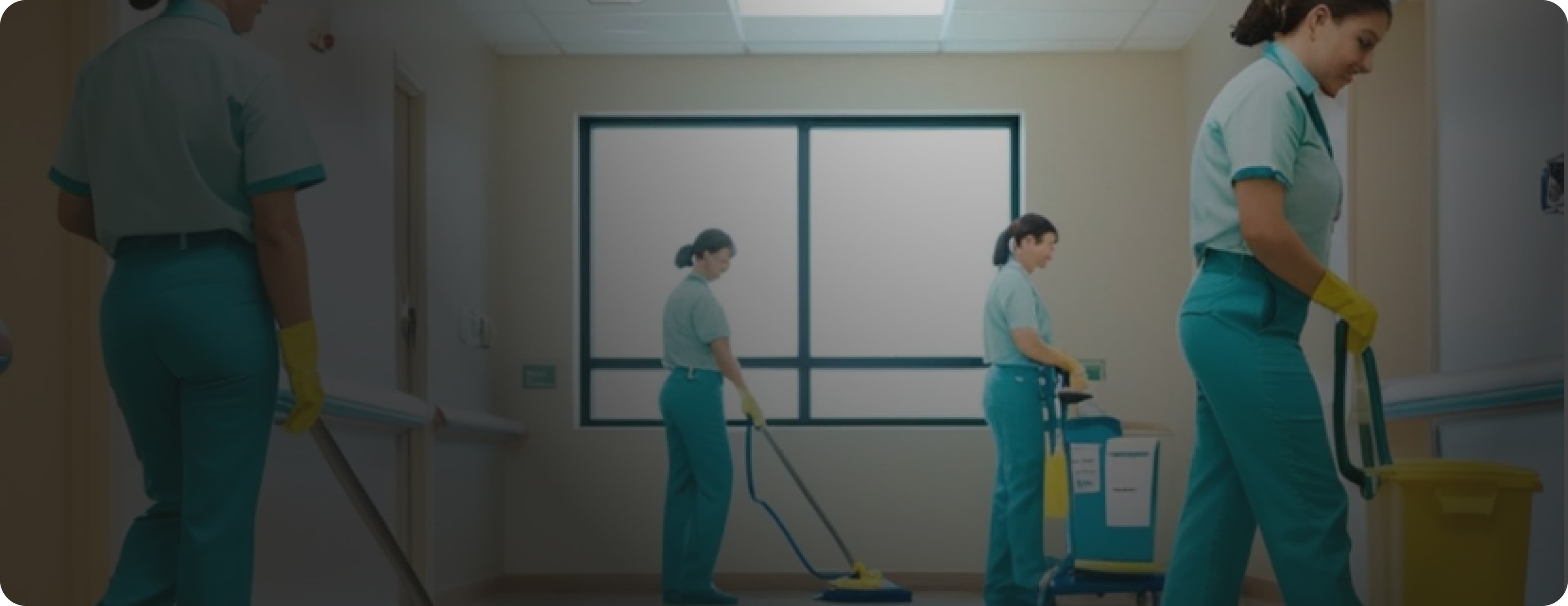
A hospital EVS supervisor starts her 6 am shift with forty-two rooms to clean, two staff out sick, a C. diff room needing terminal cleaning before the next admission, and three OR cases starting at 7 am all coordinated manually with paper checklists and walkie-talkies, with no real-time visibility into room status.
This is the reality of healthcare cleaning services at most US hospitals today: reactive, manually coordinated, and disconnected from the data infrastructure needed to link cleaning operations to patient flow, infection control, and compliance.
The stakes go beyond inconvenience. Healthcare-associated infections affect roughly 1.7 million US patients annually and contribute to 99,000 deaths, with environmental contamination a documented transmission pathway for pathogens like C. difficile, MRSA, VRE, and Candida auris. Manual processes simply aren't adequate for these clinical demands.
AI-powered healthcare cleaning services technology changes this, replacing manual coordination with intelligent scheduling, real-time room visibility, automated compliance documentation, and infection risk monitoring that connects environmental services to clinical operations.
In 2026, AI environmental services platforms are being deployed across hospitals, surgery centers, long-term care facilities, and specialty clinics nationwide, driving measurable gains in room turnover time, compliance completeness, protocol adherence, and staff efficiency.
This guide covers everything facility managers and health tech companies need to know: use cases, technical architecture, compliance requirements, and a step-by-step development process.
Key Takeaways
AI healthcare cleaning services technology uses machine learning, IoT sensors, and real-time data integration to optimize cleaning schedules, track compliance, monitor infection risk, and connect environmental services operations to clinical patient flow
Healthcare-associated infections affect 1.7 million US patients annually. Environmental cleaning quality is a documented determinant of HAI rates, making cleaning operations a clinical quality issue, not just an operational one
The highest-value AI use cases are intelligent room turnover scheduling, real-time cleaning compliance tracking, infection risk zone monitoring, terminal clean protocol management, and predictive staffing optimization
Integration with hospital patient flow systems, ADT feeds, OR scheduling, and bed management is the foundational data connection that makes AI cleaning optimization clinically responsive rather than purely operational
HIPAA compliance applies where cleaning operations data intersects with patient room assignment and occupancy information; patient-linked room data is protected health information
IoT sensor technology UV-C light sensors, ATP monitoring devices, environmental contamination sensors, and RTLS systems provides the objective cleaning verification data that manual checklists cannot deliver
Total development cost ranges from $50,000 for a focused room turnover MVP to $420,000 or more for a full AI-powered environmental services management platform
What Is AI-Powered Healthcare Cleaning Services Technology?
AI-powered healthcare cleaning services technology is a software and hardware platform that uses artificial intelligence, machine learning, predictive analytics, computer vision, and IoT sensor integration to manage, optimize, and verify the environmental cleaning operations of healthcare facilities.
Traditional healthcare environmental services management relies on paper checklists, manual room assignment, walkie-talkie coordination between supervisors and staff, and periodic supervisor inspections for quality verification. These manual processes create significant operational gaps: room-cleaning delays that extend patient waiting times, compliance documentation that is incomplete or inaccurate, and no real-time visibility into where cleaning staff are, which rooms are ready, and which cleaning tasks are overdue.
AI healthcare cleaning services technology replaces these manual processes with intelligent operational infrastructure. It integrates with hospital patient flow systems to know in real time which rooms need cleaning and how urgently. It assigns cleaning tasks to staff based on location, availability, and skill level. It tracks cleaning progress in real time through mobile applications and IoT sensors. It verifies cleaning quality through ATP monitoring and UV-C sensor data. It generates compliance documentation automatically from task completion records. It predicts staffing needs based on patient census, discharge patterns, and cleaning workload forecasts.
The result is an environmental services operation that is more responsive to clinical patient flow, more consistently compliant with infection control protocols, more efficiently staffed, and most importantly, more effective at the primary clinical function of environmental services: preventing the environmental contamination that contributes to healthcare-associated infections.
Why Is AI Transforming Healthcare Cleaning Services in 2026?
HAI Prevention Has Become a Financial and Clinical Imperative
Healthcare-associated infections are both a patient safety crisis and a significant financial burden. CMS does not reimburse for hospital-acquired conditions, and facilities with high HAI rates face value-based purchasing payment adjustments. The connection between environmental cleaning quality and HAI rates for specific pathogens, C. difficile, MRSA, and VRE, is well-established in the infection control literature.
AI cleaning technology that improves the consistency and verifiability of environmental cleaning protocols directly contributes to HAI prevention, which is both a clinical quality improvement and a financial protection for facilities facing CMS HAI-related payment adjustments.
Patient Throughput Depends on Room Turnover Speed
Hospital capacity management the ability to move admitted patients to rooms promptly, turn over ED rooms quickly, and maintain OR throughput is directly constrained by room cleaning speed and coordination. Every minute a cleaned room sits uncommunicated to the bed management team is a minute a patient waits in the ED, a procedure is delayed, or a discharged patient occupies a bed that a new admission needs.
AI cleaning scheduling that integrates with patient flow systems and proactively communicates room readiness to bed management reduces the throughput delays that environmental services coordination currently creates.
Regulatory Compliance Documentation Is Increasingly Demanding
Joint Commission environmental services standards, CMS Conditions of Participation for hospital housekeeping, state health department infection control requirements, and accreditation standards for specific facility types all impose documentation requirements on environmental cleaning operations. Manual documentation, paper checklists signed by cleaning staff and supervisors, is increasingly insufficient for demonstrating compliance to regulators and accreditors who expect digital documentation, audit trails, and data-driven quality improvement programs.
AI compliance documentation that automatically generates cleaning records from task completion data provides the audit trail that regulatory agencies and accreditors increasingly expect.
Environmental Services Staff Shortages Require Efficiency Optimization
Healthcare environmental services is experiencing significant workforce challenges, including high turnover, recruitment difficulties, and wage pressures that are making it harder to maintain adequate staffing levels. AI staffing optimization that predicts cleaning demand, optimizes staff routing, and ensures efficient task assignment maximizes the clinical output of available environmental services staff, which is the most impactful operational improvement available to facilities managing workforce constraints.
What Are the Key Use Cases for AI in Healthcare Cleaning Services?
Intelligent Room Turnover Scheduling
Room turnover cleaning a vacated patient room to prepare it for the next admission is the most time-sensitive cleaning task in acute care facilities. The time between patient discharge and room readiness for the next admission directly affects bed availability, ED throughput, and surgical throughput.
AI room turnover scheduling integrates with the hospital ADT (admission, discharge, transfer) system to receive real-time discharge events, automatically generates cleaning assignments for the vacated room, assigns the task to the nearest available qualified staff member, tracks cleaning progress in real time, and communicates room readiness to the bed management system when cleaning is complete.
This integration, connecting environmental services operations to the patient flow data that determines cleaning urgency, is what makes AI room turnover scheduling clinically meaningful rather than just operationally efficient.
Our EHR and EMR integration practice builds the ADT integration layer that gives AI cleaning platforms real-time patient flow data, the clinical demand signal that makes cleaning scheduling responsive to patient care needs.
Infection Risk Zone Monitoring and Protocol Management
Rooms vacated by patients with contact precaution diagnoses C. difficile, MRSA, VRE, Candida auris, norovirus require enhanced terminal cleaning protocols with specific agent requirements, dwell times, and verification steps that standard cleaning protocols do not include. Managing these enhanced protocols manually, ensuring that every terminal clean is performed correctly, with the right products, for the required contact time, with appropriate verification, is a significant infection control compliance challenge.
AI infection risk monitoring systems integrate with the EHR to identify rooms vacated by patients with contact precaution diagnoses, automatically assign enhanced terminal cleaning protocols to these rooms, guide cleaning staff through the required protocol steps in sequence, verify that required dwell times are achieved, and generate the compliance documentation that infection control programs require.
For facilities managing C. difficile specifically, where spore contamination can persist on surfaces for months and where cleaning failures have direct measurable impact on C. difficile transmission rates, AI-guided terminal cleaning protocol management is a clinical infection control intervention, not just an operational tool.
Real-Time Cleaning Compliance Tracking
Compliance with cleaning frequency requirements for scheduled periodic cleaning of patient rooms, bathrooms, high-touch surfaces, and common areas is a foundational infection control requirement that manual tracking systems consistently fail to document accurately.
AI compliance tracking systems track cleaning task completion in real time through mobile applications used by environmental services staff, generate compliance documentation automatically from task records, identify rooms or areas that are overdue for scheduled cleaning, and alert supervisors to compliance gaps before they accumulate into significant exposure periods.
The difference between manual checklists and AI compliance tracking is verifiability: manual checklists document that a staff member signed off on a cleaning task, while AI tracking with IoT verification documents that the room was actually cleaned, with which products, for how long, and whether the cleaning met the required quality standard.
ATP Monitoring and Objective Cleaning Verification
ATP (adenosine triphosphate) bioluminescence monitoring provides objective, quantitative measurement of surface cleanliness by measuring the biological contamination level on a surface after cleaning to verify that cleaning achieved adequate decontamination rather than just visible cleanliness.
AI platforms that integrate ATP monitoring data recording test results by surface location, room, staff member, and cleaning episode provide the objective cleaning quality data that manual inspection cannot deliver. ATP monitoring results that exceed thresholds trigger immediate re-cleaning of the affected surface and documentation of the quality failure for quality improvement programs.
UV-C Disinfection Integration and Monitoring
UV-C disinfection robots, which use ultraviolet light to decontaminate surfaces after manual cleaning in high-risk rooms, are increasingly used in hospital environments as a supplement to manual cleaning for terminal cleans and for rooms vacated by patients with high-transmission pathogens.
AI platforms that schedule UV-C robot deployment, track cycle completion, verify that required UV-C exposure levels were achieved, and integrate UV-C disinfection records into the complete cleaning documentation for each room provide the operational coordination and compliance documentation that UV-C programs require.
Predictive Staffing Optimization
Environmental services staffing requirements vary significantly across the day, the week, and across seasonal patient census patterns. Overstaffing during low-demand periods wastes budget. Understaffing during peak discharge and admission periods creates room turnover delays that affect patient throughput.
AI staffing optimization models analyze historical patient census patterns, discharge timing distributions, seasonal admission trends, and day-of-week variation to predict environmental services staffing requirements with sufficient lead time for schedule planning. Predicted demand surges trigger schedule adjustments before the surge occurs rather than requiring reactive overtime authorization when the demand arrives.
High-Touch Surface Monitoring and Frequency Optimization
High-touch surfaces bed rails, door handles, call buttons, light switches, IV poles, bedside tables are the primary fomite transmission pathways for contact-spread pathogens. The cleaning frequency required to maintain safe contamination levels on high-touch surfaces varies based on patient census, pathogen risk, and surface contact rates.
IoT-enabled high-touch surface monitoring systems using contact frequency sensors on specific surfaces generate data on actual surface contact rates that inform evidence-based cleaning frequency recommendations rather than fixed-interval protocols that may be over-cleaning low-contact surfaces and under-cleaning high-contact ones.
Cleaning Product and Supply Management
Environmental services supply management, ensuring that cleaning products, PPE, and equipment are available where and when needed, is a logistics challenge that AI inventory systems address with the same demand forecasting and automated reorder approaches that AI healthcare inventory management applies to clinical supplies.
AI supply management integration with cleaning operations data, knowing which rooms are being cleaned, with which protocols, and which products are consumed, generates accurate supply consumption forecasts that prevent stockouts of critical cleaning chemicals and PPE.
Our AI and ML solutions team builds supply consumption forecasting models trained on cleaning operations data, predicting supply needs before shortages disrupt cleaning operations.
What Are the Key Features of AI Healthcare Cleaning Services Software?
Real-Time Room Status Dashboard
A central operations view showing the cleaning status of every room in the facility in real time: clean and available, in-process, pending assignment, or requiring enhanced terminal cleaning, accessible to environmental services supervisors, bed management staff, and clinical charge nurses simultaneously.
Real-time room status visibility is the feature that most immediately improves patient throughput. Bed management staff who can see in real time that room 214 is clean and available can move a patient from the ED to that room without making a call to environmental services to check.
Mobile Staff Application
A mobile application used by environmental services staff that receives cleaning assignments, displays task-specific cleaning protocols, guides staff through required cleaning steps in sequence, captures task completion with timestamps, and integrates with IoT verification devices for objective quality confirmation.
The staff mobile application is the primary data collection interface for AI cleaning operations; every task completion, every ATP test result, every protocol step confirmation is captured through this interface and feeds the compliance documentation and analytics that make AI cleaning technology clinically valuable.
Our healthcare mobile app development team builds environmental services staff mobile apps tested with real EVS workers in realistic cleaning scenarios because apps that are difficult to use while wearing PPE and carrying cleaning equipment will not be used consistently regardless of their technical sophistication.
ADT and Patient Flow Integration
Real-time integration with the hospital ADT system receiving discharge, transfer, and admission events that trigger room cleaning assignments and update room status in the cleaning operations platform. This integration is the clinical data connection that makes AI cleaning scheduling responsive to patient flow rather than operating on fixed cleaning schedules that do not reflect actual room availability.
Infection Control Protocol Library
A complete library of cleaning protocols differentiated by room type, patient population, pathogen risk, and cleaning product requirements that guides staff through the correct protocol for each cleaning task and documents protocol adherence for infection control compliance.
Protocol libraries must be clinically reviewed and maintained by infection control professionals, ensuring that protocols reflect current CDC, APIC, and facility-specific infection control guidelines rather than outdated or generic cleaning procedures.
IoT Sensor Integration
Integration with ATP monitoring devices, UV-C disinfection robots, RTLS (real-time location systems) for staff tracking, environmental contamination sensors, and high-touch surface contact monitors providing objective, sensor-verified cleaning quality data alongside the subjective task completion records that staff mobile applications capture.
Our API integration services team builds IoT device integrations for environmental services platforms, connecting sensor data streams from diverse device manufacturers into a unified cleaning operations data platform.
Compliance Documentation and Reporting
Automated generation of cleaning compliance documentation, room cleaning logs, terminal clean records, protocol adherence reports, and supervisor inspection records from task completion data and IoT sensor readings. Compliance reports formatted for Joint Commission survey preparation, infection control program review, and facility administration reporting.
Supervisor Inspection and Quality Audit Tools
Mobile tools for environmental services supervisors to conduct room inspections, document quality findings, generate corrective action requirements, and track remediation, creating the quality audit documentation trail that regulatory compliance and continuous quality improvement programs require.
HIPAA-Compliant Data Architecture
Where cleaning operations data intersects with patient room assignment and occupancy information, patient-linked room cleaning records that identify which patient occupied the room being cleaned are subject to HIPAA compliance requirements. Room cleaning records linked to identified patient occupants are protected health information.
Our HIPAA-compliant software development practice builds the compliance architecture appropriate for environmental services platforms that integrate patient flow data.
Analytics and Performance Dashboard
Room turnover time analytics, cleaning compliance rates by unit and staff member, HAI-correlated cleaning quality metrics, supply consumption tracking, and staffing efficiency metrics provide environmental services directors and infection control professionals the data needed for systematic quality improvement.
Our healthcare UI/UX design team designs environmental services analytics dashboards tested with real EVS directors and infection control nurses because dashboards that require operational expertise to interpret are not used by the leadership stakeholders who need the insights.
How Can You Build AI Healthcare Cleaning Services Software Step by Step?
Step 1: Define the Facility Context and Priority Use Cases
Building AI healthcare cleaning services software begins with defining the specific facility context acute care hospital, ambulatory surgery center, long-term care facility, or specialty clinic and the priority operational and clinical challenges.
A 400-bed acute care hospital with high C. difficile rates and OR throughput pressure has different priority use cases than a 60-bed long-term care facility managing chronic resident cleaning needs or an ambulatory surgery center focused on OR room turnover between cases. Define the priority use cases based on where cleaning operations failures most directly affect patient safety and operational efficiency.
Step 2: Map the Existing Environmental Services Workflow
Map the current environmental services workflow in detail: how room assignments are made, how staff is deployed, how cleaning completion is documented, how supervisors verify quality, and how cleaning operations currently communicate with bed management and clinical operations.
This mapping identifies where communication failures create throughput delays, where documentation gaps create compliance risk, and which integration points with clinical systems are required to make AI scheduling clinically responsive.
Step 3: Identify IoT Hardware Requirements
Define the IoT hardware components required for the target facility: ATP monitoring devices, UV-C disinfection robots, RTLS infrastructure for staff tracking, and any environmental sensors for contamination monitoring. IoT hardware selection must precede software development planning because hardware capabilities and data formats significantly affect the software architecture.
Step 4: Run a Discovery Sprint
A structured discovery process validates the technical approach, defines the ADT and clinical system integration architecture, addresses compliance requirements, and produces a validated development plan before engineering resources are committed.
At Codieshub, our MVP and product strategy process is built around this approach. For healthcare cleaning services platforms specifically, where ADT integration architecture, infection control protocol clinical review requirements, IoT hardware integration, and HIPAA compliance for patient-linked room data are all decisions with significant downstream implications, the discovery phase is the highest-leverage investment in the project.
Step 5: Build the ADT and Patient Flow Integration
Build the real-time ADT integration receiving discharge, transfer, and admission events from the hospital information system and translating them into room cleaning assignment triggers. This integration is the most critical data connection in the platform the one that makes AI cleaning scheduling clinically responsive rather than operating on fixed schedules.
Step 6: Build the Staff Mobile Application
Build the environmental services staff mobile application displaying cleaning assignments, guiding staff through protocol steps, capturing task completion, and integrating with ATP monitoring and other IoT verification devices. Design for use with PPE and cleaning equipment: large touch targets, simple navigation, offline capability for areas with poor connectivity.
Step 7: Build IoT Device Integrations
Build integrations with the target IoT devices: ATP monitoring device APIs, UV-C robot control and data APIs, and RTLS system APIs for staff location tracking. Implement data normalization for IoT sensor data streams that arrive in device-specific formats.
Step 8: Develop the AI Scheduling and Staffing Models
Develop the AI room assignment optimization model incorporating room priority based on clinical urgency, staff location and availability from RTLS data, and staff skill level and protocol certification. Develop the predictive staffing model trained on historical census and discharge patterns to forecast cleaning demand and generate staffing recommendations.
Step 9: Build the Infection Control Protocol Library
Build the protocol library in collaboration with infection control professionals from the target facility type covering standard room cleaning, enhanced terminal cleaning protocols for specific pathogens, OR cleaning protocols, and isolation room protocols. Build the protocol guidance interface in the staff mobile application.
Step 10: Implement HIPAA Compliance Architecture
Build HIPAA compliance architecture for components that integrate patient-linked room data, encryption of patient-linked cleaning records, role-based access controls, audit logging, and Business Associate Agreements with third-party services.
Step 11: Design the Operations Dashboard and Reporting System
Build the real-time room status dashboard, the supervisor inspection tools, and the compliance documentation and analytics reporting system. Design for the multiple stakeholder roles that need cleaning operations visibility: EVS supervisors, bed management staff, infection control professionals, and facility administrators.
Step 12: Pilot and Measure
Deploy in a structured pilot with specific outcome metrics: room turnover time, terminal clean protocol compliance rate, ATP monitoring pass rates, staff task completion rates, and supervisor inspection scores. Use pilot data to refine AI scheduling models and protocol library before broader rollout.
Our DevOps and cloud solutions team builds the deployment infrastructure, IoT data pipeline monitoring, and AI model performance analytics that keep the cleaning services platform accurate and clinically relevant over time.
What Is the Technology Stack Used for AI Healthcare Cleaning Services Software?
AI and Machine Learning
Python is the standard language for environmental services AI development. For room assignment optimization, matching cleaning tasks to available staff based on location, skill, and task priority, constraint satisfaction optimization frameworks (Google OR-Tools) handle the multi-constraint assignment problem efficiently.
For staffing demand forecasting, predicting cleaning workload from patient census and discharge patterns, time-series forecasting models (Facebook Prophet for seasonal patterns, LSTM for complex temporal dependencies) produce accurate staffing demand predictions at the shift-planning lead time required for schedule management.
For cleaning quality anomaly detection, identifying rooms or staff whose ATP monitoring results consistently fall below quality thresholds, gradient boosting models (XGBoost, LightGBM) trained on cleaning quality outcome data identify the specific factors associated with cleaning quality failures.
Mobile Application
React Native for cross-platform iOS and Android deployment, providing the native device capabilities required for Bluetooth device pairing with ATP monitoring equipment and offline data storage for areas with poor connectivity. Bluetooth Low Energy for ATP monitoring device integration and IoT sensor connectivity.
IoT Integration Infrastructure
AWS IoT Core for managing IoT device connections and data ingestion. MQTT protocol for real-time sensor data streaming from environmental monitoring devices. RESTful APIs for ATP monitoring device integration (Hygiena ATP monitoring API, 3M Clean-Trace ATP monitoring integration). WebSocket connections for real-time RTLS staff location streaming.
Backend Infrastructure
Python with FastAPI for the primary API layer. PostgreSQL for structured cleaning operations and compliance data. TimescaleDB for time-series IoT sensor data from environmental monitors and ATP devices. Redis for real-time room status caching and supervisor dashboard updates. Apache Kafka for high-frequency IoT sensor data streaming in large facility deployments.
Clinical System Integration
HL7 v2 ADT messages for real-time patient admission, discharge, and transfer event processing, the primary clinical data connection for room turnover scheduling. HL7 FHIR for facilities with FHIR-enabled EHR systems. OR scheduling system integrations for surgical suite cleaning coordination.
Cloud Infrastructure
AWS with a HIPAA Business Associate Agreement for components handling patient-linked room data. Amazon IoT Core for IoT device management. Amazon RDS PostgreSQL for structured cleaning operations data. Amazon Timestream for IoT time-series data at scale. Amazon SageMaker for AI scheduling and staffing model training and serving. AWS CloudTrail for audit logging where HIPAA applies.
What Does HIPAA Compliance Require for Healthcare Cleaning Services Software?
HIPAA compliance for healthcare cleaning services software depends on whether the platform integrates patient-linked data specifically, whether room cleaning records are associated with the patient who occupied the room being cleaned.
When HIPAA Applies
HIPAA applies when the cleaning operations platform accesses or stores data that links cleaning events to identified patients: room cleaning records that include patient name, medical record number, or diagnosis information from ADT feeds; terminal cleaning records that document the specific pathogen diagnosis driving the enhanced protocol; or room occupancy data that allows inference of patient identity from room assignment.
For platforms that receive ADT discharge events to trigger room assignments but do not store patient identifiers in cleaning records, using only room numbers and cleaning task data without patient identity, the PHI exposure is significantly reduced.
The specific HIPAA applicability determination depends on the data architecture decisions made in the discovery phase, and building data minimization into the architecture from the beginning (using room identifiers rather than patient identifiers where clinically appropriate) reduces compliance burden without compromising clinical functionality.
Technical Safeguards for Patient-Linked Data
Where patient-linked data is necessary, terminal clean records that document the specific pathogen diagnosis for infection control documentation encrypt all patient-linked records at rest using AES-256 and in transit using TLS 1.2 or higher. Implement role-based access controls that restrict patient-linked room data to infection control staff and authorized clinical leadership rather than all environmental services staff. Maintain comprehensive audit logs of all patient-linked data access.
What Is the AI Healthcare Cleaning Services Development Checklist?
Clinical and Operational Foundation
Facility context and priority use cases defined
Existing environmental services workflow mapped
Infection control protocol library scope defined with infection control professional input
IoT hardware requirements identified and selected
AI and Analytics
Room assignment optimization model developed and validated
Predictive staffing model trained on historical census and discharge data
Cleaning quality anomaly detection model developed
AI model update process defined as cleaning operations data accumulates
Integration
ADT integration built for real-time patient flow data
Staff mobile application built with offline capability
IoT device integrations built for ATP monitoring and UV-C systems
RTLS integration built for staff location tracking where applicable
OR scheduling integration built for surgical suite cleaning coordination
Infection Control Protocol Library
Protocol library developed with licensed infection control professional review
Pathogen-specific terminal cleaning protocols clinically validated
Protocol update process defined for CDC and APIC guideline changes
HIPAA Compliance
Patient-linked data minimization implemented in data architecture
Encryption implemented for all patient-linked room records
Role-based access controls implemented for EVS and infection control roles
Audit logging configured for patient-linked data access
BAAs in place with all cloud and IoT platform services handling patient data
Deployment and Operations
Pilot defined with specific room turnover, compliance, and quality metrics
IoT data pipeline monitoring configured
AI model performance monitoring configured
Clinical protocol update process established for guideline changes
What Common Mistakes Should You Avoid?
1. Building Without ADT Integration
Environmental services software that operates on fixed cleaning schedules rather than real-time patient flow data cannot be clinically responsive to actual room turnover needs. A discharge that triggers an urgent room need at 2 pm does not appear on a fixed schedule. ADT integration is the data connection that makes cleaning scheduling respond to actual patient flow; without it, the platform is a digital version of a paper checklist rather than an intelligent clinical operations tool.
2. Protocol Library Without Infection Control Professional Review
Cleaning protocols that have not been reviewed and approved by certified infection control professionals create clinical liability risk. Incorrect dwell times, inappropriate product selection for specific pathogens, or missing protocol steps in terminal cleaning procedures can result in inadequate decontamination that contributes to pathogen transmission. Every protocol in the library must be clinically reviewed and approved before deployment.
3. IoT Hardware Selection After Software Development
IoT device selection: ATP monitoring manufacturers, UV-C robot vendors, and RTLS system providers significantly affect the software integration architecture, data formats, and API availability. Selecting IoT hardware after software development begins creates expensive integration rework. Hardware selection must precede software architecture design.
4. No Objective Cleaning Verification
Digital checklists that capture staff attestation of cleaning completion are better than paper checklists, but they verify that a staff member reported cleaning the room, not that the room was adequately decontaminated. Objective cleaning verification through ATP monitoring or UV-C sensor confirmation is what provides the evidence of cleaning quality that infection control programs and regulatory agencies increasingly require.
5. Designing Staff Application for Office Users
Environmental services staff use mobile applications while wearing PPE, carrying cleaning equipment, and working in variable lighting conditions. Applications designed for typical office mobile use will fail in these conditions: small touch targets that cannot be activated with gloved hands, interfaces that require multiple navigation steps to record a task completion, screens that are unreadable in brightly lit or dimly lit rooms. Design and test the staff application in realistic EVS working conditions.
6. No Multi-Stakeholder Dashboard Design
Room status visibility is needed by multiple stakeholder groups with different information needs. EVS supervisors need operational detail, bed management staff need room availability status, infection control nurses need protocol compliance data, and facility administrators need quality and efficiency metrics. A single dashboard designed for one stakeholder group will not serve the others effectively. Multi-stakeholder dashboard design from the beginning is essential.
How Does Codieshub Build AI Healthcare Cleaning Services Software?
At Codieshub, we build AI healthcare cleaning services platforms for hospital systems, facility management companies, and health tech companies that need environmental services technology designed for the specific clinical environment, infection control requirements, and patient flow integration demands of healthcare facilities, not general facility management software adapted from non-clinical environments.
Every engagement begins with our MVP and product strategy process, which addresses facility context definition, infection control protocol library scope, IoT hardware selection, ADT integration architecture, HIPAA compliance for patient-linked room data, and multi-stakeholder dashboard design before production code is written.
Our AI and ML solutions team builds room assignment optimization models, predictive staffing systems, and cleaning quality anomaly detection models trained on healthcare-specific environmental services data with model update infrastructure built in from the beginning to maintain accuracy as patient census patterns and cleaning protocols evolve.
Our EHR and EMR integration team builds the ADT and clinical system integrations that connect cleaning operations to real-time patient flow. Our API integration services team builds IoT device integrations for ATP monitoring, UV-C systems, and RTLS platforms.
Our healthcare mobile app development team builds EVS staff mobile applications tested with real environmental services workers in realistic clinical environments. Our healthcare UI/UX design team designs multi-stakeholder dashboards tested with EVS directors, bed management staff, and infection control professionals. Our HIPAA-compliant software development practice ensures appropriate compliance for patient-linked room data. Our DevOps and cloud solutions team builds the IoT data pipeline, AI model serving, and performance monitoring infrastructure that keeps the platform accurate over time.
Conclusion
Environmental cleaning is not a support service in healthcare; it is a clinical function. The quality and consistency of environmental decontamination directly affects HAI rates, patient safety outcomes, and the clinical quality metrics that increasingly determine how healthcare facilities are reimbursed and regulated. Managing this clinical function with paper checklists, walkie-talkie coordination, and manual documentation is not adequate for the infection control demands of 2026 healthcare environments.
AI-powered healthcare cleaning services technology addresses this gap by systematically connecting environmental services operations to real-time patient flow data, ensuring consistent infection control protocol adherence through guided digital workflows, verifying cleaning quality through objective sensor measurement, and generating the compliance documentation that regulatory compliance and infection control quality improvement programs require.
The facilities that deploy AI environmental services technology effectively will have faster room turnovers that improve patient throughput, more consistent infection control protocol adherence that reduces HAI rates, objective cleaning quality documentation that supports regulatory compliance, and more efficient use of environmental services staff in an environment where EVS workforce availability is a growing operational challenge.
At Codieshub, we build AI healthcare cleaning services platforms for hospital systems and health tech companies that understand what environmental services technology needs to be in a clinical environment: clinically connected, infection-control-guided, objectively verified, and built for the specific operational realities of healthcare facility cleaning.
Ready to build AI healthcare cleaning services software that improves infection control and patient throughput? Schedule a Discovery Call. Tell us about your facility context and environmental services challenges, and we will send you a tailored development and integration game plan within 48 hours.
Frequently Asked Questions
1. What is AI-powered healthcare cleaning services software?
AI-powered healthcare cleaning services software uses machine learning, IoT sensors, and real-time clinical system integration to optimize room assignment, track cleaning compliance, guide infection control protocols, verify cleaning quality, predict staffing needs, and connect environmental services to patient flow, replacing manual coordination with intelligent, data-driven management.
2. How does AI improve room turnover time in hospitals?
AI room turnover optimization integrates with the hospital ADT system to receive real-time discharge events, immediately assigns the vacated room to the nearest available qualified staff member, tracks cleaning progress live, and notifies bed management the moment the room is ready, eliminating the communication delays that currently extend turnover times.
3. How does AI help prevent healthcare-associated infections?
AI environmental services platforms prevent HAIs by ensuring infection control protocols are followed consistently, guiding staff through pathogen-specific terminal cleaning steps in sequence, verifying required dwell times, integrating ATP monitoring for objective surface verification, and documenting adherence, reducing pathogen burden for C. difficile, MRSA, VRE, and similar contact-spread pathogens.
4. Does healthcare cleaning services software need to be HIPAA compliant?
It depends on the data architecture. Platforms integrating patient-linked room-cleaning records or terminal clean records documenting specific diagnoses handle protected health information and must comply with HIPAA. Platforms using room identifiers without patient identity may have reduced applicability; data minimization reduces compliance burden without compromising functionality.
5. What IoT technology is used in AI healthcare cleaning services platforms?
Key IoT technologies include ATP bioluminescence monitoring for objective cleanliness verification, UV-C disinfection robots with sensor-verified exposure confirmation, real-time location systems for staff tracking, environmental contamination sensors for continuous monitoring, and high-touch surface contact frequency monitors that inform evidence-based cleaning frequency decisions.
6. How does AI predict environmental services staffing needs?
AI staffing prediction models analyze historical patient census patterns, discharge timing, seasonal admission trends, and day-of-week variation to forecast cleaning workload at the lead time required for schedule planning, identifying demand surges before they occur so adjustments happen proactively rather than reactively.
7. How long does it take to build AI healthcare cleaning services software?
A focused MVP with a room status dashboard, ADT integration, and staff mobile app takes three to six months. A mid-level platform with AI scheduling and ATP integration takes six to twelve months. A full enterprise platform with multi-facility deployment and complete IoT integration takes twelve to twenty-four months.
8. How much does AI healthcare cleaning services software cost to build?
A focused MVP costs $50,000 to $100,000. A mid-level platform costs $100,000 to $240,000. A full enterprise platform costs $240,000 to $420,000 or more, with annual maintenance around $30,000 to $85,000, driven by AI model complexity, IoT integration scope, and HIPAA compliance requirements.