
InsightsHealthcare
AI-Powered Virtual Nursing Assistants: Complete Guide 2026
Discover how AI virtual nursing assistants work in 2026—key features, HIPAA compliance, EHR integration, costs, and how to build one for your practice.

Nurses in the United States are leaving the profession faster than healthcare organizations can replace them. The American Nurses Association projects a shortage of more than one million nurses by 2030. And the ones who stay are stretched, managing more patients, handling more administrative tasks, and spending more time on documentation than on the direct patient care that brought them to the profession.
An AI virtual nursing assistant cannot replace a nurse. But it can take over the work that does not require one-on-one patient check-ins, medication reminders, vital sign collection, symptom monitoring, discharge education, and post-visit follow-up, freeing clinical nurses to focus on the complex, judgment-intensive work that only a human can do.
In 2026, AI virtual nursing assistants are in active clinical use in hospitals, home health programs, and outpatient clinics across the United States. They are conducting thousands of patient interactions daily, checking on post-surgical patients, monitoring chronic disease management, answering care questions, and flagging deterioration before it reaches crisis at a scale no nursing team could manage alone.
This guide covers everything healthcare startups, clinics, and health systems need to know about AI virtual nursing assistants, from how they work to what it takes to build one, what compliance requirements govern their use, and what separates the platforms that deliver clinical value from those that do not.
Key Takeaways
An AI virtual nursing assistant automates routine nursing communications and monitoring patient check-ins, medication reminders, symptom collection, and discharge education, freeing clinical nurses for complex care
The most impactful use cases in 2026 are post-discharge monitoring, chronic disease management, pre-surgical preparation, and medication adherence support
HIPAA compliance is non-negotiable; AI virtual nursing assistants handle protected health information and must be built with encryption, access controls, audit logging, and Business Associate Agreements from day one
EHR integration is what makes an AI nursing assistant clinically useful; assistants that cannot read patient context or write collected data back to the record create work rather than reduce it
Escalation logic is the most critical clinical safety requirement the assistant must recognize when a patient needs immediate human attention and route appropriately every time
FDA regulatory classification depends on whether the assistant makes clinical claims; symptom triage that recommends specific levels of care may be regulated as Software as a Medical Device
Building a custom AI virtual nursing assistant costs $80,000 to $400,000 depending on AI complexity, integration requirements, and clinical scope
What Is an AI Virtual Nursing Assistant?
An AI virtual nursing assistant is a conversational software platform that uses artificial intelligence, natural language processing, machine learning, and generative AI to conduct structured patient interactions that would otherwise require nursing staff time.
These assistants interact with patients through text, voice, or chat interfaces, asking questions, collecting responses, delivering education, issuing reminders, and escalating to human clinicians when patient responses indicate a need for immediate attention.
The key distinction between an AI virtual nursing assistant and a general healthcare chatbot is the clinical depth. A virtual nursing assistant is designed to conduct the kind of structured, protocol-driven patient interactions that nurses perform, such as post-discharge check-ins, chronic disease monitoring calls, medication reconciliation, and symptom assessment, rather than handling general patient inquiries.
This clinical specificity is what delivers measurable value. It is also what makes compliance, clinical validation, and EHR integration non-negotiable requirements rather than optional enhancements.
Why AI Virtual Nursing Assistants Are Growing So Fast in 2026
The growth is being driven by three forces that are not going away.
The nursing shortage is acute and worsening. US healthcare is facing a structural nursing shortage driven by an aging workforce, pandemic-accelerated burnout, and a pipeline of new graduates that cannot keep pace with demand. AI virtual nursing assistants address this shortage not by replacing nurses but by handling the routine, protocol-driven interactions that consume nursing capacity without requiring nursing judgment.
Readmission rates and penalties are significant. Medicare's Hospital Readmissions Reduction Program penalizes hospitals for excess readmissions in targeted conditions. Post-discharge monitoring that catches early signs of deterioration before a patient returns to the emergency department directly reduces readmissions and the penalties they carry. AI virtual nursing assistants that conduct structured post-discharge check-ins at scale deliver measurable financial impact.
Patients want continuous access. Patients managing chronic conditions, recovering from surgery, or adjusting to new medications have questions between clinical encounters questions that are not urgent enough to call the on-call line but important enough to warrant a response. An AI nursing assistant that provides consistent, appropriate responses to these questions at any hour improves patient experience and reduces unnecessary clinical escalations.
Chronic disease management requires continuous engagement. Patients with diabetes, heart failure, hypertension, and COPD benefit from regular monitoring and coaching between clinic visits. Delivering this engagement at scale through human nursing staff is economically impractical. AI virtual nursing assistants make it operationally feasible.
Types of AI Virtual Nursing Assistants
Not all AI virtual nursing assistants serve the same clinical purpose. Understanding which type fits your clinical context shapes every subsequent design, technical, and compliance decision.
1. Post-Discharge Monitoring Assistants
The most widely deployed type in US healthcare. These assistants contact recently discharged patients typically at defined intervals in the first 30 days, conducting structured check-ins that assess symptom status, medication adherence, follow-up appointment compliance, and recovery trajectory.
When patient responses indicate potential complications, wound concerns, medication side effects, or worsening symptoms, the assistant escalates to a clinical nurse for follow-up. When responses indicate appropriate recovery, the interaction is documented and scheduled for the next contact.
Best for: Hospital systems managing readmission reduction, home health agencies, post-surgical care programs.
2. Chronic Disease Management Assistants
These assistants support ongoing management of chronic conditions such as diabetes, heart failure, hypertension, COPD, and asthma through regular patient check-ins that collect patient-reported data, device readings, medication adherence information, and symptom status.
The collected data is analyzed against patient-specific alert thresholds. Concerning trends are escalated to the care team. Routine data is documented in the EHR and contributes to longitudinal monitoring.
Best for: Primary care practices, specialty practices managing chronic disease populations, ACOs and value-based care organizations.
3. Pre-Admission and Pre-Surgical Preparation Assistants
These assistants conduct structured pre-admission interactions, collecting patient history, confirming medication lists, delivering pre-procedure instructions, verifying consent understanding, and answering preparation questions before scheduled procedures or admissions.
By handling this preparatory interaction automatically, they reduce day-of-procedure delays caused by incomplete preparation and reduce the administrative burden on nursing staff managing pre-admission workflows.
Best for: Surgical centers, procedural units, hospitals with high scheduled procedure volumes.
4. Medication Adherence Assistants
These assistants deliver medication reminders, collect adherence information, identify barriers to adherence, and escalate non-adherence or side effect concerns to clinical staff.
For patient populations managing complex medication regimens post-transplant, oncology, HIV management, and psychiatric medication, consistent adherence support between clinical encounters significantly improves clinical outcomes.
Best for: Specialty practices, pharmacy-integrated care programs, behavioral health practices.
5. Mental Health Support Assistants
A growing category. These assistants provide structured support between therapy sessions, collecting patient-reported mood and symptom data, delivering evidence-based coping skill exercises, and escalating crisis indicators to clinical staff.
Regulatory note: Mental health AI assistants require particularly careful clinical validation and escalation design given the patient safety implications of missed crisis detection.
Post-Visit Education Assistants
These assistants deliver structured patient education after clinical encounters, reinforcing discharge instructions, explaining diagnosis and treatment plans, answering condition-specific questions, and assessing patient understanding.
By delivering education asynchronously and at a pace the patient controls, these assistants improve comprehension and adherence compared to rushed verbal education at the point of discharge.
Key Features Every AI Virtual Nursing Assistant Needs
Structured Clinical Protocols
The clinical interactions conducted by an AI virtual nursing assistant must be based on validated clinical protocols developed in collaboration with qualified clinicians and validated against the patient population the assistant will serve.
This is not a feature that can be improvised. Unvalidated clinical protocols in a patient-facing nursing assistant create clinical risk. Every interaction script, every question asked, every threshold for escalation, every education message delivered must be reviewed and approved by qualified clinical staff before deployment.
Natural Language Understanding
Patients interacting with a virtual nursing assistant use natural language; they do not respond to structured medical questions in structured medical terms. The assistant must understand what a patient means when they say "I'm having trouble catching my breath" rather than requiring them to respond to a menu option for "dyspnea."
This requires NLP models trained or fine-tuned on patient-reported health language, which is meaningfully different from clinical vocabulary and from general conversational language. Our AI and ML solutions team builds NLP models for healthcare patient communication with the domain-specific training that general-purpose NLP models do not provide.
Escalation Logic
Escalation logic is the most clinically critical feature of any AI virtual nursing assistant. When a patient's responses indicate potential clinical deterioration, the assistant must:
Recognize the escalation trigger accurately without excessive false positives that create nurse fatigue or false negatives that miss genuine deterioration
Escalate to the appropriate level: nursing callback, physician notification, emergency services direction based on the clinical severity indicated
Execute the escalation reliably every time, without delay
Every escalation pathway must be defined, clinically validated, and tested before deployment. Escalation logic failures are patient safety failures.
EHR Integration
EHR integration is what transforms an AI nursing assistant from an engagement tool into a clinical tool. An assistant that can read relevant patient context medication lists, recent labs, upcoming appointments, condition history conducts more contextually appropriate interactions. An assistant that writes collected patient data, symptom reports, medication adherence, vital sign readings, and education acknowledgments back to the EHR creates a complete clinical record of between-encounter monitoring.
Our EHR and EMR integration practice builds HL7 FHIR-based integrations that make AI nursing assistant interactions part of the clinical record, not isolated interactions that require manual follow-up to document.
Multi-Channel Patient Communication
Different patient populations prefer different communication channels. Some patients prefer SMS text messages, particularly older patients who may not use smartphone apps. Some prefer in-app messaging through a patient portal. Some prefer automated phone calls with voice interaction. An effective AI virtual nursing assistant serves patients through the channel they will actually use.
Our healthcare mobile app development team builds mobile-native patient interfaces that extend AI nursing assistant functionality to the devices patients use for health communication.
Remote Device Integration
For AI nursing assistants that support chronic disease management or post-discharge monitoring, integration with connected home health devices blood pressure cuffs, glucose monitors, pulse oximeters, weight scales enables objective data collection alongside patient-reported symptoms.
Device reading integration automatically pulling readings from connected devices rather than asking patients to self-report significantly improves data accuracy and reduces patient burden. Our remote patient monitoring solutions extend this capability seamlessly into AI nursing assistant workflows.
Clinical Dashboard for Nursing Staff
The clinical staff who review escalations, monitor patient populations, and manage AI assistant interactions need a clear, functional dashboard showing which patients have been contacted, what they reported, which have been escalated, and which require follow-up.
Our healthcare UI/UX design team designs clinical dashboards tested with real nursing staff, designed for the workflow of nurses who are already managing demanding patient loads and cannot afford a tool that creates additional cognitive burden.
HIPAA-Compliant Data Handling
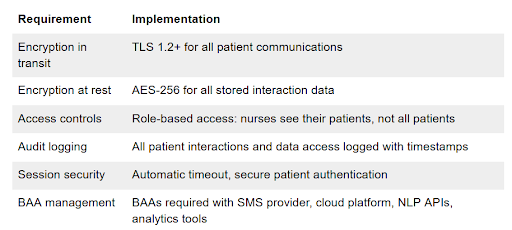
All patient interaction conversation content, collected symptom data, device readings, and escalation records are protected health information. Every component of the AI nursing assistant must comply with HIPAA: encrypted communications, access controls, audit logging, and Business Associate Agreements with all third-party services.
Audit Trail and Documentation
Every patient interaction what the assistant said, what the patient said, and what action was taken must be logged in a format that supports clinical documentation, compliance review, and quality improvement analysis.
AI Virtual Nursing Assistant: Step by Step Development
Step 1: Define the Clinical Use Case and Patient Population
Development begins with a precisely defined clinical use case and patient population. Who will this assistant interact with? What clinical condition or care transition are they managing? What protocol will the assistant follow? What outcomes is the assistant designed to improve?
The precision of this definition determines the quality of every subsequent design and technical decision. A vague use case produces a vague assistant. A specific use case, post-discharge monitoring for heart failure patients in the first 30 days after hospitalization, produces a focused assistant with measurable clinical outcomes.
Step 2: Develop Clinical Protocols With Qualified Input
The interaction protocols question sequences, response thresholds, escalation criteria, and education content must be developed in collaboration with qualified clinical staff from the target specialty. This is not work that can be delegated to a development team.
Clinical protocol development includes:
Defining the structured question sequences for each interaction type
Setting patient-specific and population-level thresholds for escalation
Designing escalation pathways for each severity level
Developing patient education content for relevant conditions
Defining the interaction schedule frequency, timing, and channel
Step 3: Determine Regulatory Classification
An AI virtual nursing assistant that collects symptom information and directs patients to specific levels of care based on their responses may be regulated by the FDA as Software as a Medical Device. An assistant that conducts structured monitoring and escalates based on predefined thresholds without making diagnostic claims may fall outside FDA jurisdiction.
This determination must be made before development begins. Our MVP and product strategy process addresses regulatory classification as a core component of the discovery phase because the intended use statement for an AI nursing assistant significantly affects development requirements and compliance architecture.
Step 4: Build the Conversational AI Engine
The conversational AI engine handles patient input, understanding what the patient said, determining the appropriate response, and advancing through the clinical protocol.
For structured monitoring interactions with defined response options, a combination of intent classification and state machine logic may be appropriate, more predictable and easier to validate than generative AI for safety-critical clinical interactions.
For more open-ended interactions, patient education, symptom discussion, and care navigation, NLP-powered or generative AI approaches provide the conversational flexibility to handle the range of patient inputs these use cases involve.
All patient-facing AI interactions must include clear fallback logic for what the assistant does when it cannot understand or appropriately respond to a patient input and clear escalation triggers for safety-critical situations.
Step 5: Implement EHR Integration
Build HL7 FHIR-based integration with the target EHR enabling the assistant to read relevant patient context before each interaction and write interaction data back to the patient record after each interaction.
Specific FHIR resources for AI nursing assistant integration include:
Patient demographic and identifier information
Condition active problems for context
MedicationRequest for current medications for reconciliation
Observation for writing collected vital signs and patient-reported data
Communication for logging nursing assistant interactions
Appointment for confirming upcoming visits
Our API integration services team builds these integrations with the healthcare interoperability expertise that makes them reliable in production clinical environments.
Step 6: Build the Device Integration Layer
For monitoring use cases, build an integration with the connected medical devices the patient population uses using Bluetooth, cellular, or cloud-API connections to pull device readings automatically.
Device integration significantly reduces patient burden; patients do not need to manually report readings that their device already has and improves data accuracy compared to self-report.
Step 7: Implement HIPAA Compliance Architecture
Build the full HIPAA compliance architecture before any patient interactions are processed:
End-to-end encryption for all patient communications
Encrypted storage for all interaction data and collected PHI
Role-based access controls for nursing dashboard and patient data access
Comprehensive audit logging of all patient interactions and data access
Business Associate Agreements with all third-party services
Our HIPAA-compliant software development practice builds these requirements into the architecture from day one.
Step 8: Design the Patient and Nursing Interfaces
Design the patient interaction interface SMS, app, web, or voice for the specific patient population. Design the nursing dashboard for the clinical staff who will review escalations and monitor patient populations.
Both interfaces require testing with real users from the target population before production deployment. Patient interfaces should be tested with patients representative of the actual user base, including elderly patients and patients managing complex conditions.
Step 9: Validate Clinical Content and Escalation Logic
Before deployment, validate the assistant's clinical content and escalation logic:
Test escalation triggers across the range of patient scenarios the assistant will encounter
Validate that emergency scenarios reliably trigger appropriate escalation
Have qualified clinical reviewers assess the clinical accuracy of education content
Test response handling for unexpected or concerning patient inputs
Step 10: Pilot, Monitor, and Improve
Deploy with a structured clinical pilot. Define specific success metrics: patient engagement rate, escalation appropriateness rate, readmission rate change, nurse time saved, patient satisfaction score.
After deployment, monitor the assistant's performance continuously and use patient interaction data to improve protocol adherence, natural language understanding, and escalation accuracy over time.
Our DevOps and cloud solutions team builds the monitoring and continuous improvement infrastructure that keeps an AI virtual nursing assistant performing reliably in production.
Technology Stack for AI Virtual Nursing Assistant Development
Conversational AI
Component: Intent Classification
Technology: Fine-tuned BERT / DistilBERT
Why: Understanding patient input
Component: Dialogue Management
Technology: Rasa/custom state machine
Why: Protocol-driven conversation flow
Component: Generative Response
Technology: GPT-4o / Claude / fine-tuned LLaMA
Why: Open-ended patient interactions
Component: Medical NLP
Technology: scispaCy / BioBERT
Why: Clinical entity recognition
Component: Sentiment and Urgency Detection
Technology: Custom classifier
Why: Escalation trigger identification
Backend Infrastructure
Component: Backend API
Technology: Python / FastAPI
Why: AI ecosystem, async performance
Component: Database
Technology: PostgreSQL + Redis
Why: Structured clinical data + session state
Component: Message Queue
Technology: AWS SQS
Why: Async patient interaction processing
Component: Notification Service
Technology: Twilio (SMS) / Firebase (push)
Why: Multi-channel patient outreach
Component: Primary Cloud
Technology: AWS / Azure
Why: HIPAA-eligible service catalog
Compliance and Security
Component: Encryption at rest
Technology: AWS KMS / AES-256
Why: PHI protection
Component: Encryption in transit
Technology: TLS 1.2+
Why: Communication security
Component: Audit logging
Technology: AWS CloudTrail
Why: HIPAA audit requirements
Component: Access controls
Technology: AWS IAM + application RBAC
Why: Role-based PHI access
Patient Interface
Channel: SMS
Technology: Twilio API
Patient Population: Broad reach elderly and low-tech users
Channel: Mobile App
Technology: React Native
Patient Population: Engaged patient populations
Channel: Web Portal
Technology: React / Next.js
Patient Population: Portal-integrated interactions
Channel: Voice
Technology: Twilio Voice + custom ASR
Patient Population: Elderly patients, accessibility needs
EHR Integration
HL7 FHIR R4 Patient, Observation, Communication, Appointment, MedicationRequest resources. HL7 v2 for legacy EHR connections. Epic SMART on FHIR for Epic-specific deployments.
HIPAA Compliance for AI Virtual Nursing Assistants
What HIPAA Requires
AI virtual nursing assistants collect, process, and transmit protected health information: patient-reported symptoms, medication adherence data, device readings, and conversation content linked to identifiable patients. Full HIPAA compliance is required.
Key Technical Safeguards
FDA Considerations
An AI virtual nursing assistant that assesses patient-reported symptoms and recommends specific levels of care "your symptoms suggest you should go to urgent care" may be regulated as Software as a Medical Device.
An assistant that collects patient-reported data, delivers protocol-based education, and escalates concerning responses to clinical staff without making diagnostic claims may fall outside FDA jurisdiction.
This determination must be made by regulatory counsel based on the specific intended use before development begins.
AI Virtual Nursing Assistant Development Checklist
Clinical Foundation
Clinical use case and patient population precisely defined
Interaction protocols developed with qualified clinical input
Escalation thresholds and pathways clinically validated
Education content reviewed by qualified clinicians
FDA regulatory classification determined
HIPAA Compliance
Encryption implemented for all patient communications and stored data
Role-based access controls implemented for clinical dashboard
Audit logging configured for all patient interactions and data access
Business Associate Agreements in place with all third-party services
Patient notice and consent process documented
Integration
EHR integration designed using HL7 FHIR
Device integration built for target connected health devices
Multi-channel patient interface implemented
Escalation routing to clinical staff implemented and tested
Clinical Validation
Natural language understanding validated on patient-reported health language
Escalation logic tested across safety-critical patient scenarios
Education content accuracy validated by clinical reviewers
Fallback logic tested for unexpected patient inputs
Deployment and Monitoring
Clinical pilot defined with specific outcome metrics
Patient engagement monitoring configured
Escalation appropriateness monitoring configured
Continuous learning pipeline built for NLP improvement
Common Mistakes to Avoid
1. Building Without Clinical Protocol Validation
AI nursing assistant interaction protocols developed without qualified clinical input create clinical risk by asking wrong questions, missing important symptoms, and setting inappropriate escalation thresholds. Clinical protocol development is not a technical task. It requires qualified clinicians.
2. Inadequate Escalation Logic for Emergency Situations
An AI virtual nursing assistant that misses emergency signals, such as a patient describing chest pain, severe shortness of breath, or suicidal ideation, and fails to escalate appropriately creates patient safety risk that outweighs all operational benefit. Emergency escalation logic must be tested extensively before deployment.
3. No EHR Integration
An AI nursing assistant that operates in isolation, collecting patient data that is not connected to the clinical record, creates documentation burden rather than reducing it. EHR integration is the feature that makes collected patient data clinically useful.
4. Designing for Average Patients
AI virtual nursing assistants serve patients who may be elderly, managing complex conditions, in pain, or anxious. Design for the patients who will find the interface most challenging, not the most tech-savvy users in the population.
5. Treating HIPAA as a Post-Development Concern
Any AI nursing assistant handling patient health information is subject to HIPAA from the first patient interaction. Discovering compliance gaps after deployment creates both regulatory risk and the significant engineering cost of retrofitting compliance.
6. Not Measuring Clinical Outcomes
An AI virtual nursing assistant that cannot demonstrate measurable impact on readmission rates, nurse time savings, patient engagement, or escalation appropriateness cannot justify its ongoing investment. Define specific, measurable outcome metrics before deployment and measure them consistently.
How Codieshub Builds AI Virtual Nursing Assistants
At Codieshub, we build AI virtual nursing assistants for healthcare organizations that need solutions designed for specific clinical use cases, patient populations, and EHR environments, not generic patient engagement tools that require clinical workflows to adapt to the software.
Every engagement begins with our MVP and product strategy process, which addresses clinical use case definition, protocol development requirements, regulatory classification, HIPAA compliance architecture, and EHR integration design before production code is written.
Our AI and ML solutions team builds conversational AI models trained on patient-reported health language with escalation detection, clinical entity recognition, and safety guardrails designed specifically for patient-facing clinical interactions. Our healthcare UI/UX design team designs patient interaction interfaces and nursing clinical dashboards tested with real users from the target populations, including elderly patients and nurses managing demanding patient loads.
Our EHR and EMR integration team builds HL7 FHIR-based integrations that make AI nursing assistant interactions part of the clinical record. Our remote patient monitoring solutions extend device integration capability seamlessly into nursing assistant workflows. Our HIPAA-compliant software development practice ensures full compliance from day one. And our DevOps and cloud solutions team builds the monitoring and continuous improvement infrastructure that keeps the assistant performing reliably and improving over time.
Get a Free Project Estimate: Tell us about your AI virtual nursing assistant project, and we will send you a tailored development and compliance game plan within 48 hours.
Conclusion
The nursing shortage in the United States is structural, and it is not going to be solved by hiring alone. Healthcare organizations that will thrive in this environment are those that find ways to extend the capacity of the nurses they have by deploying AI virtual nursing assistants to handle the routine, protocol-driven interactions that consume nursing time without requiring nursing judgment.
The tools that deliver real clinical value in 2026 are not generic patient engagement platforms adapted for nursing workflows. They are purpose-built AI nursing assistants designed for specific clinical use cases, validated against clinical protocols, integrated with EHR systems, and built with the HIPAA compliance architecture that handling patient health information requires.
Building an AI virtual nursing assistant that works in real clinical environments requires clinical domain knowledge, conversational AI expertise, healthcare compliance architecture, EHR integration experience, and the patient-centered design discipline that determines whether patients actually engage with the tool when they need it most.
At Codieshub, we bring all of these capabilities to AI virtual nursing assistant projects from the initial clinical use case definition and protocol development through conversational AI development, EHR integration, patient interface design, and the long-term monitoring that keeps the assistant performing reliably in production.
Let's talk about your AI virtual nursing assistant project. Share your clinical use case, and our team will get back to you within 48 hours with a tailored development and compliance roadmap. Book a Free Consultation
Frequently Asked Questions
1. What is an AI virtual nursing assistant?
An AI virtual nursing assistant is a conversational platform that conducts structured patient interactions, check-ins, medication reminders, symptom monitoring, education, and discharge follow-up. It uses AI to understand responses, follow clinical protocols, escalate concerning cases to clinicians, and document interactions, letting nurses focus on complex care.
2. What clinical use cases deliver the most value from AI virtual nursing assistants?
In 2026, the highest-value use cases are post-discharge monitoring for readmission reduction, chronic disease management (diabetes, heart failure, hypertension, COPD), pre-admission preparation, medication adherence support, and mental health check-ins between therapy sessions. Each requires frequent, structured interactions impractical to deliver through human nursing staff alone.
3. Does an AI virtual nursing assistant need to be HIPAA compliant?
Yes, without exception. These assistants handle protected health information, including symptoms, medication data, and conversation content. Full compliance requires end-to-end encryption, encrypted storage, role-based access controls, comprehensive audit logging, and Business Associate Agreements with third parties. This architecture must be built in from the start.
4. Does an AI virtual nursing assistant need FDA clearance?
It depends on functionality. Assistants that collect data, deliver education, and escalate concerning responses without making diagnostic or triage recommendations generally fall outside FDA jurisdiction. Assistants that assess symptoms and direct patients to specific care levels may qualify as Software as a Medical Device, requiring regulatory counsel review.
5. What is the most important clinical safety requirement for an AI virtual nursing assistant?
Escalation logic is paramount. An assistant that fails to recognize when a patient needs immediate attention, or delays escalation during an emergency, creates real patient safety risk. Every escalation pathway must be clinically validated, tested across safety-critical scenarios, and confirmed reliable before production deployment begins.
6. How does an AI virtual nursing assistant integrate with an EHR?
Integration relies on HL7 FHIR, the current healthcare data exchange standard. FHIR APIs let the assistant read patient context, medications, conditions, and appointments before interactions, and write collected data like symptom reports and adherence information back afterward. Specific resources used depend on the data being documented.
7. How long does it take to build an AI virtual nursing assistant?
A focused rule-based assistant for one use case, like post-discharge SMS check-ins, takes 8–16 weeks. An NLP-powered assistant with EHR integration takes 4–8 months. A full platform with multiple use cases and device integration takes 8–14 months. Clinical validation and compliance architecture drive the timeline.
8. How much does it cost to build an AI virtual nursing assistant?
A basic rule-based assistant costs $40,000–$80,000. An NLP-powered assistant with EHR integration costs $80,000–$180,000. A full platform with multiple use cases and device integration costs $180,000–$350,000. Enterprise platforms exceed $350,000. Annual maintenance typically runs $30,000–$80,000 depending on ongoing scope.