
InsightsHealthcare
Telemedicine Platform Development in 2026: Features, Cost & Tech Stack
Everything you need to build a telemedicine platform in 2026—features, tech stack, HIPAA compliance, and real development costs explained.
A patient wakes up at 2 AM with a high fever. Under the old model, they wait until morning, call the clinic, sit on hold, and hope for a same-day appointment. Under the new model, they open an app, connect with a doctor in minutes, and have a prescription sent to their local pharmacy before they go back to sleep.
That is what successful telemedicine platform development makes possible, and it is why telehealth has shifted from a pandemic-era workaround to a permanent fixture in how healthcare is delivered.
In 2026, building a telemedicine platform is one of the most in-demand areas across all of healthcare technology. Patients expect digital access to care. Healthcare organizations that cannot offer it are losing patients to those that can. And the technology to build a secure, HIPAA-compliant, genuinely easy-to-use telehealth product has never been more accessible.
This guide is for founders, product leaders, and healthcare entrepreneurs who want to understand what building a telemedicine platform actually involves, from the features users expect to the technology that powers them, the compliance requirements that govern them, and the real costs at every stage.
What Is Telemedicine Platform Development?
Telemedicine platform development is the process of designing, building, and launching software that allows patients and healthcare providers to connect remotely through video, audio, or text so that clinical consultations, diagnosis, treatment, and follow-up care can happen without an in-person visit.
At its core, a telemedicine platform connects three things: a patient-facing interface where patients book appointments, join consultations, and access their health information; a provider interface where doctors and clinical staff manage their schedules, conduct consultations, and document care; and a backend system that handles everything in between appointment scheduling, secure communication, patient data storage, billing, and compliance.
When all three work together well, care delivery becomes faster, more accessible, and more convenient for everyone involved without sacrificing the clinical quality that patients and providers depend on.
What makes this different from standard software development is the combination of real-time communication requirements, strict HIPAA compliance obligations, integration with existing healthcare systems, and the need to serve users who range from tech-savvy clinicians to elderly patients with limited digital experience.
Why the Telemedicine Market Is Still Growing in 2026
Telemedicine had its moment of explosive growth during the pandemic. What changed afterward is that patients discovered they actually prefer it for many types of care, and they are not going back.
The global telemedicine market is projected to exceed $380 billion by 2030, growing at a compound annual rate of over 17%. Several forces are driving that growth, and none of them is going away.
1. Patient expectations have permanently shifted. Patients who experienced the convenience of a video consultation do not want to drive to a clinic and sit in a waiting room for conditions that can be handled remotely. The convenience bar has been raised for good.
2. Healthcare organizations need to extend their reach. Specialist shortages, geographic barriers, and capacity constraints are pushing healthcare organizations to serve more patients without proportionally expanding their physical infrastructure. Telemedicine is the most practical solution available at scale.
3. Reimbursement has stabilized. In the United States, Medicare and most commercial insurers now reimburse telehealth visits at rates comparable to in-person visits for a wide range of conditions. The financial model has become predictable enough for healthcare organizations to build it into their core strategy.
4. Mental health demand is driving significant growth. The demand for mental health services has grown dramatically, and teletherapy platforms have become the primary access point for many patients seeking behavioral health support. Mental health is one of the fastest-growing categories across all of telehealth.
Types of Telemedicine Platforms
Understanding which type of platform you are building shapes every product and technical decision that follows.
1. Synchronous Video Consultation Platforms
Real-time video consultations between patients and providers are the most common form. These require low-latency video conferencing, secure messaging, and tight integration with scheduling and clinical documentation systems.
2. Asynchronous Store-and-Forward Platforms
Patients submit health data, photos, videos, questionnaires, and readings from connected devices, and providers review and respond when available. Common in dermatology, radiology, and specialist referral workflows where real-time interaction is not required.
3. Remote Patient Monitoring Platforms
These combine video consultations with continuous remote patient monitoring, integrating data from wearables and connected medical devices into the consultation workflow. Providers get a richer clinical picture during every telehealth visit.
4. Mental Health and Therapy Platforms
Specialized platforms for teletherapy and telepsychiatry are built for the specific workflows of behavioral health providers and the specific needs of mental health patients. These often include mood tracking, session notes, and care plan management alongside standard video consultation capabilities.
5. Enterprise Telehealth Platforms
Built for large healthcare organizations, hospital systems, large group practices, and accountable care organizations that need to serve thousands of patients across multiple specialties, locations, and provider types from a single platform.
6. Specialty-Specific Platforms
Designed for a specific clinical specialty, dermatology, cardiology, primary care, and urgent care, with features and workflows tailored to that specialty's unique needs. These achieve deeper clinical relevance than general-purpose telehealth solutions.
Key Features Every Telemedicine Platform Needs
Regardless of which type of platform you are building, certain features are non-negotiable in 2026. Their absence will drive churn before your platform has a chance to prove its value.
1. Appointment Scheduling and Calendar Management
Patients need to book, reschedule, and cancel appointments easily from any device, at any time. Providers need to manage their availability, set scheduling rules, and see their upcoming consultations clearly. Friction at this entry point costs you patients before they ever experience the clinical value of your platform.
2. Secure Video Conferencing
The core of any synchronous telehealth application is a reliable, high-quality video connection, low latency, adaptive quality that adjusts to available bandwidth, and security that meets HIPAA requirements. Video quality directly affects clinical outcomes: a blurry or dropping connection makes it harder for a provider to accurately assess a patient's condition.
3. HIPAA-Compliant Secure Messaging
Before, during, and after consultations, patients and providers need a secure communication channel. Standard email and consumer messaging apps cannot be used to transmit patient health information. Your platform needs built-in secure messaging that encrypts communications and maintains appropriate audit logs.
4. Electronic Prescribing
For many consultations, the output is a prescription. Integrating e-prescribing capabilities so providers can send prescriptions directly to a patient's preferred pharmacy without paper or manual steps is now a baseline expectation for most telehealth platforms.
5. Clinical Documentation and EHR Integration
Providers need to document what happened during each consultation, and that documentation needs to flow into the patient's existing record within the healthcare system. Without this integration, documentation requires manual double entry that adds an administrative burden and introduces errors.
6. Patient Portal
A central place where patients can see upcoming appointments, review past consultation notes, access their health data, communicate with their care team, and manage their accounts. A well-designed portal increases engagement and reduces the volume of administrative calls a clinic receives.
7. Payment Processing and Insurance Billing
Collecting payment, whether directly from patients or through insurance, needs to be built into the platform. For US-based platforms, this means supporting major insurance payers, generating appropriate billing codes for telehealth visits, and giving patients clear cost information before their consultation.
8. Notifications and Reminders
Automated appointment reminders via SMS, email, and push notification significantly reduce no-show rates. Patients should receive confirmations when they book, and providers should receive alerts when patients are waiting to join.
Advanced Features That Set Great Platforms Apart
Once the core features are in place, the platforms that win in competitive markets are those that go further using technology to deliver experiences that basic healthcare apps simply cannot replicate.
1. AI-Powered Clinical Support
AI tools embedded in the provider workflow, symptom assessment before the consultation, clinical decision support that surfaces relevant treatment protocols, and documentation automation that generates clinical notes from the conversation reduce provider cognitive load and improve consistency of care.
Integrating AI in ways that genuinely support clinical decision-making, rather than as a surface-level add-on, is one of the clearest ways to differentiate from basic video consultation tools.
2. Integrated Remote Patient Monitoring
For patients with chronic conditions, connecting consultations with continuous remote monitoring creates a clinical experience that in-person care cannot easily replicate. Providers enter a video consultation already knowing a patient's recent blood pressure readings, glucose levels, or heart rate trends giving every visit immediate clinical context.
3. Multi-Provider and Group Consultation Support
Some clinical situations benefit from multiple providers being present simultaneously with a patient, their primary care physician, and a specialist consulting remotely. Platforms that support this open up use cases that basic point-to-point video tools cannot handle.
4. Asynchronous Care Workflows
Not every patient interaction requires a real-time video consultation. Platforms that support asynchronous care, where patients submit information and providers respond when available, allow providers to serve more patients per hour and expand the clinical workflows the platform supports.
5. Integrated Wearable and Device Data
Patients increasingly use connected health devices at home. Platforms that pull health data from wearables and connected devices directly into the consultation workflow give providers a richer clinical picture and reduce the burden on patients to manually report their readings.
Telemedicine Platform Development: Step by Step
Step 1: Define Your Clinical Use Case and Target Users
Before writing any code, be precise about who you are building for and what clinical problem you are solving. A platform for primary care urgent visits looks very different from one designed for ongoing mental health therapy or specialist consultations.
Define your primary patient population, their age range, technology comfort level, and specific healthcare needs. Define your provider workflow. How do providers currently manage their schedule, conduct consultations, and document care? The clearer your answers, the more focused your MVP will be.
Step 2: Run a Discovery Sprint Before Development Begins
A structured discovery process is the most important investment in any telehealth project. It validates your assumptions, maps user workflows, addresses compliance requirements, and produces a prototype that real users can evaluate before development begins.
At Codieshub, our MVP and product strategy process is built around this discovery-first approach. For telemedicine platforms, especially where HIPAA compliance, EHR integration, and clinical workflow fit all need to be addressed before a line of production code is written, the decisions made in discovery determine most of what happens in development.
Step 3: Design the Patient Experience First
The most common reason telemedicine platforms fail to achieve adoption is not clinical capability; it is patient experience. If patients find the booking process confusing, the video connection unreliable, or the interface intimidating, they will not come back.
Design the patient-facing side of your platform with the assumption that your least tech-savvy patient will be using it alone, without help. Every step from "I need to see a doctor" to "consultation complete" should be as simple and clear as possible.
Step 4: Build the Core Consultation Workflow
Build the core of the platform first appointment scheduling through video consultation to post-visit documentation. Get this working reliably before adding advanced features.
Reliability is the foundation on which everything else depends. A telemedicine application that drops connections, fails to load on certain devices, or produces inconsistent documentation will not be trusted by providers or patients, regardless of how impressive the additional features are.
Step 5: Integrate With Existing Healthcare Systems
For most platforms, EHR integration is essential for provider adoption. Providers who have to manually transfer consultation notes into their existing system after every visit will not sustain that workflow.
Build a clean integration layer using healthcare data exchange standards. HL7 FHIR is the current standard for most major EHR platforms. This is specialized work where healthcare integration expertise makes the difference between a system that works reliably in production and one that creates data consistency problems after launch.
Step 6: Implement HIPAA Compliance and Security
Build HIPAA compliance into every layer of your platform, including encrypted video streams, secure messaging, encrypted data storage, role-based access controls, and audit logging before any real patient data enters the system. This is not a step you can defer. Compliance requirements affect your architecture from the ground up.
Step 7: Add Advanced Features Based on Real User Feedback
After your core platform is live with real patients and providers, add advanced features based on what the data tells you users actually need. AI-powered documentation assistance, remote monitoring integration, and asynchronous care workflows are all more valuable when built on top of a proven core product.
Step 8: Launch With a Pilot Group
Before a broad commercial launch, run a structured pilot with a defined group of providers and patients. A pilot surfaces workflow gaps, technical issues, and usability problems that internal testing cannot reliably find and finds them at a scale where they are manageable to fix.
Step 9:Measure Clinical Outcomes and Iterate
After launch, track what matters clinically: patient satisfaction scores, no-show rates, consultation completion rates, and provider documentation time. Use this data to guide post-launch iteration and demonstrate value to new clinical partners.
Technology Stack for Telemedicine Platform
Choosing the right technology stack requires balancing real-time communication requirements, security, compliance, and scalability from the very beginning of the project.
1. Frontend: Patient and Provider Interfaces
React with Next.js is the standard choice for telemedicine web interfaces. React's component architecture makes it possible to build the complex, real-time interfaces that telehealth platforms require. Next.js adds server-side rendering that improves performance and SEO for patient-facing booking pages.
2. Mobile Application
React Native is the best choice for most telehealth mobile apps. A single codebase that runs on both iOS and Android reduces development time and cost significantly important because patients and healthcare organizations increasingly expect care to be accessible on any device.
3. Video Conferencing Infrastructure
Building a video from scratch is not recommended for most telemedicine startups. Purpose-built healthcare video APIs, such as Twilio Video, Daily.co, and Amazon Chime SDK, provide HIPAA-compliant video conferencing infrastructure that would take months to build from scratch. These services handle the complex engineering of real-time video at scale, freeing your team to focus on clinical workflow features.
4. Backend
Node.js or Python with FastAPI or Django are both strong choices. Node.js handles real-time features well. Python is the better choice if your platform includes AI-powered features; its ecosystem for machine learning and data science is unmatched.
5. Database
PostgreSQL for structured patient and appointment data. Redis for session management and real-time features. For platforms that integrate remote patient monitoring data, a time-series database like TimescaleDB handles continuous health data streams efficiently.
6. Cloud Infrastructure
AWS is the most common choice for US-based healthcare platforms because of its extensive catalog of HIPAA-eligible services. Google Cloud and Azure are also strong options. The key is using HIPAA-eligible managed services for all workloads that touch patient data and having a Business Associate Agreement in place with your cloud provider before going live.
Cloud infrastructure for telehealth platforms needs to be architected for global availability and low latency. Using content delivery networks and edge computing to reduce the distance between providers, patients, and servers is an important architectural consideration for platforms serving geographically distributed users.
HIPAA Compliance and Security Requirements
Any platform that handles patient health information in the United States must comply with HIPAA. For telehealth specifically, this means several requirements worth understanding clearly before development begins.
1. Encrypted Video Streams
All video consultations must be encrypted end-to-end. Consumer video tools like standard Zoom, FaceTime, and Google Meet are not HIPAA-compliant without specific enterprise configurations and Business Associate Agreements. Healthcare platforms must use video infrastructure that encrypts streams and provides the audit logging HIPAA requires.
2. Secure Messaging
Messages exchanged through your platform are protected health information. They must be encrypted in transit and at rest, accessible only to authorized users, and logged for audit purposes.
3. Access Controls and Authentication
Role-based access control ensures providers can only access the patient records they are authorized to see, and patients can only access their own information. Multi-factor authentication for all clinical users is a compliance best practice and increasingly a hard requirement for enterprise healthcare organizations.
4. Audit Logging
Every access to patient data, every consultation, every message, every record view must be logged with a timestamp and user identifier. These logs are essential for HIPAA compliance investigations and for identifying security incidents before they become breaches.
5. Business Associate Agreements
Every third-party service that processes or stores patient data, your video infrastructure provider, cloud host, messaging service, and analytics platform must sign a Business Associate Agreement (BAA) before going live with real patient data. Major providers, including AWS, Twilio, and Daily.co, all offer BAAs for healthcare customers.
6. Data Residency and Retention
Many healthcare organizations have specific requirements about where patient data is stored and how long it is retained. Build flexibility into your infrastructure architecture to accommodate these requirements, which come up in every enterprise sales conversation.
How Much Does a Telemedicine Platform Cost?
Development cost depends on platform complexity, the number of specialties and user types it needs to support, AI features included, and whether EHR integration is required.
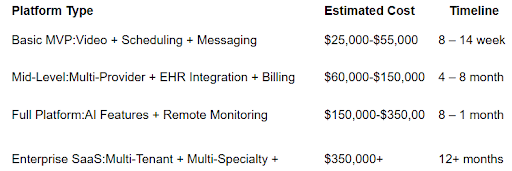
The biggest cost drivers are EHR integration complexity, the number of specialties and user types the platform needs to support, AI-powered feature development, and the sophistication of billing and insurance integration.
For a broader breakdown of what drives healthcare software development costs, see our guide on building a web application.
Common Mistakes to Avoid
Using non-HIPAA-compliant video tools: Consumer tools aren’t secure. Use healthcare-ready video infrastructure with a BAA.
Building advanced features too early: Focus on a stable core consultation experience before adding AI or integrations.
Ignoring provider experience: If doctors find it slow or complex, they won’t use it consistently.
Skipping EHR integration: Manual workflows don’t scale. Integration is essential for real clinical use.
Ignoring bandwidth issues: Ensure adaptive video quality for users with slow internet.
Not testing with real patients: Validate with actual users to catch usability issues before launch.
How Codieshub Approaches Telemedicine Platform
Most agencies talk about discovery, design, and compliance, but at Codieshub, these are executed with real clinical use in mind. We treat discovery as the most critical phase, where we map workflows, define compliance requirements, plan integrations, and validate ideas with real users before development begins. Our design focuses on the least tech-savvy patients to ensure true adoption, not just usability in ideal conditions.
We build compliance into the foundation by making HIPAA-related decisions early, avoiding costly fixes later. Our approach to AI is practical; we only implement features that improve clinician efficiency or patient outcomes. From backend and frontend to video infrastructure, EHR integration, and mobile apps, we handle the entire technical stack to ensure everything works seamlessly.
Most importantly, we stay involved after launch, continuously improving the platform based on real-world usage. For us, building a telemedicine platform is not a one-time project but a long-term partnership.
Get a Free Project Estimate. Tell us about your telemedicine platform, and we’ll send you a tailored game plan within 48 hours.
Frequently Asked Questions
1. What does a telemedicine platform involve?
It involves designing and building software that allows patients and healthcare providers to connect remotely for clinical consultations, diagnosis, treatment, and follow-up care. This includes patient-facing booking interfaces, provider dashboards, secure video infrastructure, HIPAA-compliant messaging, EHR integration, billing systems, and all the backend architecture that ties these components together securely and reliably.
2. Does a telemedicine platform need to be HIPAA-compliant?
Yes, without exception. Any platform that handles patient health information in the United States must comply with HIPAA. For telemedicine specifically, this means encrypted video streams, HIPAA-compliant secure messaging, role-based access controls, audit logging, and Business Associate Agreements with all third-party services that process patient data.
3. How long does it take to build a telemedicine platform?
A basic MVP with video consultation, appointment scheduling, and secure messaging typically takes 8 to 14 weeks. A mid-level platform with EHR integration, multi-provider support, and billing takes 4 to 8 months. A full-featured enterprise telehealth platform with AI-powered features and remote monitoring can take 8 to 14 months or more, depending on complexity.
4. Can I use Zoom or Google Meet for telemedicine?
Not without specific enterprise configurations and HIPAA-eligible plans with Business Associate Agreements in place. Consumer versions of these tools are not HIPAA-compliant. For most telemedicine platforms, purpose-built healthcare video APIs like Twilio Video or Daily.co are better choices, as they provide HIPAA-compliant infrastructure designed specifically for healthcare applications.
5. What does EHR integration involve for a telemedicine platform?
EHR integration allows consultation notes, prescriptions, and other clinical documentation to flow automatically into the patient's record in the provider's existing healthcare system. This is done through healthcare data exchange standards. HL7 FHIR is the current standard. Complexity depends on which EHR systems you need to integrate with and the quality of their API documentation and support.
6. How much does the telemedicine platform cost?
A basic MVP with core features typically costs $25,000 to $55,000. A mid-level platform with EHR integration and billing costs $60,000 to $150,000. A full enterprise telehealth platform with AI features and remote patient monitoring costs $150,000 to $350,000 or more. The biggest cost drivers are EHR integration complexity, AI-powered feature development, and the number of specialties and user types the platform needs to serve.
7. Should I build my telemedicine platform as a SaaS product?
For most founders, yes. A multi-tenant SaaS architecture allows you to serve multiple healthcare organizations from a single platform, with each organization's patient data isolated and secure. This delivers significantly better unit economics at scale than building a separate deployment for each customer. The upfront architectural investment is higher, but the long-term economics are substantially better.
8. What is the most important thing to get right in a telemedicine platform?
Video reliability and patient experience. A platform where video drops, connections are unreliable, or the interface confuses patients will not achieve clinical adoption regardless of its other features. Get the core consultation experience, reliable video conferencing, simple appointment scheduling, clear patient interface working flawlessly before building anything else.