
InsightsHealthcare
Top AI Tools for Healthcare Providers in 2026: Complete Guide
Explore the best AI tools for healthcare providers in 2026—real clinical use cases, compliance insights, and expert guidance to modernize your practice.

Healthcare providers in the United States are facing a problem that technology alone did not create, but technology can meaningfully help solve.
Staffing shortages. Rising patient volumes. Documentation burden that consumes hours of physician time every day. Administrative workflows that have not changed in decades. And a growing expectation from patients that care should be as accessible and responsive as every other service in their lives.
The best AI tools for healthcare providers in 2026 are addressing these problems in ways that are measurable, practical, and increasingly well-evidenced. Not with experimental technology, but with tools that are live in clinics, hospitals, and health systems across the country, delivering quantifiable improvements to clinical efficiency, diagnostic accuracy, and patient experience.
This guide covers the AI tools that are delivering real clinical value in 2026, what they do, how they work, what compliance requirements they carry, and how healthcare providers can evaluate and adopt them responsibly.
Key Takeaways
Seven categories cover almost every clinical AI purchase in 2026: documentation, evidence search, imaging, decision support, scheduling, engagement, and revenue cycle.
Ambient documentation delivers the fastest return, but the return shows up as reduced burnout and after-hours work more reliably than as raw minutes saved.
Ambient scribes are generally not FDA-regulated devices. Diagnostic imaging AI almost always is. Confusing the two creates real compliance risk.
Ambient recording touches state wiretap law. In all-party consent states you need documented patient consent, and that requirement sits with you, not the vendor.
EHR integration predicts sustained adoption better than any accuracy figure on a vendor datasheet.
Free tiers now cover a serious share of the clinical workflow. OpenEvidence in particular is free to verified US clinicians and covers evidence search, ambient notes, and coding suggestions.
Predictive decision support models shipped inside an EHR still need local validation. Several widely deployed ones have failed external validation badly.
Build custom only when a validated tool does not fit your workflow, your data gives you a real model advantage, or long-run cost of ownership favors it.
What Are AI Tools for Healthcare Providers?
AI tools for healthcare providers are software applications that use artificial intelligence, machine learning, deep learning, natural language processing, and generative AI to automate clinical and administrative tasks, improve diagnostic accuracy, enhance patient engagement, and reduce the operational burden on clinical staff.
They span the full arc of an encounter: scheduling, intake, the visit itself, documentation, coding, billing, and post-discharge monitoring.
The defining characteristic of the tools that succeed is that they work inside existing workflows. They integrate with the EHR, the PACS, the practice management system, and the clinical communication platform rather than asking clinicians to adopt a new one. Tools that demand a workflow change consistently fail to sustain adoption no matter how capable they are.
Category 1: AI Clinical Documentation Tools
Clinical documentation is the area where AI is delivering the fastest and most measurable return for most healthcare providers. The average physician spends two hours on documentation for every hour of direct patient care. AI documentation tools are cutting this ratio significantly.
Ambient Clinical Intelligence
Ambient clinical intelligence systems, often called AI scribes, listen to the clinical encounter and automatically generate clinical notes from the conversation. The physician reviews and approves the note rather than dictating or typing it from scratch.
How it works: A microphone-enabled device or smartphone app captures the clinical conversation. The audio is processed by a natural language processing model that identifies clinically relevant content chief complaint, history, physical examination findings, assessment, and plan and formats it into a structured note in the provider's preferred template.
Clinical impact: Physicians using ambient documentation tools consistently report 30 to 70% reductions in documentation time, with corresponding improvements in work-life balance and reductions in after-hours chart completion.
Top tools in this category:
Abridge Epic-integrated ambient documentation with strong hospital system adoption
Nuance DAX Copilot: Microsoft-backed ambient scribe with broad EHR connectivity
Nabla Copilot: Ambient documentation with real-time note preview during the encounter
HIPAA considerations: All ambient documentation tools that process audio from clinical encounters are handling protected health information. Confirm HIPAA compliance, encryption standards, and BAA availability before deployment.
Integration requirement: The clinical value of ambient documentation depends on seamless EHR integration. Notes that require manual transfer between systems defeat the purpose. Our EHR and EMR integration practice builds the integration layer that connects AI documentation tools to EHR systems in HIPAA-compliant, production-reliable ways.
Category 2: AI Diagnostic and Clinical Decision Support Tools
AI diagnostic tools assist clinicians in identifying conditions, interpreting test results, and making treatment decisions, surfacing information that supports better clinical judgment rather than replacing it.
Medical Imaging AI
AI tools for radiology, pathology, and ophthalmology analyze medical images to detect findings, prioritize urgent cases, and measure structures with greater consistency and speed than manual review alone.
High-value clinical applications:
Chest X-ray analysis: pneumonia, pneumothorax, pulmonary nodules
CT triage: intracranial hemorrhage, pulmonary embolism, large vessel occlusion
Mammography screening second-read support and finding prioritization
Retinal image analysis: diabetic retinopathy, glaucoma
Pathology slide analysis: cancer detection and grading
FDA status: Most AI diagnostic imaging tools deployed in clinical settings in the USA have FDA clearance. Verify clearance status before clinical deployment.
Top tools in this category:
Aidoc Emergency radiology triage and worklist prioritization
Viz.ai Stroke detection and care coordination
iCAD Mammography AI for breast cancer detection
IDx-DR FDA-cleared autonomous diabetic retinopathy screening
Clinical Decision Support AI
Beyond imaging, AI clinical decision support tools analyze structured clinical data, lab results, vital signs, medication history, and patient demographics to surface risk scores, treatment recommendations, and clinical alerts.
Applications:
Sepsis early warning: predicting sepsis risk before clinical deterioration
Readmission risk scoring: identifying patients at elevated risk of 30-day readmission
Medication interaction alerts: AI-enhanced pharmacy decision support
Differential diagnosis support: AI-assisted differential generation for complex presentations
Top tools:
Epic Deterioration Index: Early warning integrated into the Epic EHR
Isabel DDx AI differential diagnosis support
Wolters Kluwer UpToDate Clinical decision support with AI-enhanced recommendations
Category 3: AI Scheduling and Patient Flow Tools
Scheduling inefficiency is one of the most operationally expensive problems in healthcare. No-shows, scheduling gaps, inappropriate appointment types, and poor patient flow management all reduce revenue and increase staff frustration.
AI-Powered Appointment Scheduling
AI scheduling tools predict no-show risk, recommend optimal appointment slot allocation, automate patient outreach, and optimize provider schedules based on historical demand patterns.
How it works: Machine learning models analyze historical appointment data, patient demographics, appointment type, time of day, day of week, previous no-show history to assign no-show risk scores to scheduled appointments. High-risk appointments trigger targeted outreach, automated reminders, rescheduling prompts, or waitlist notifications before the appointment is missed.
Clinical impact: Practices deploying AI no-show prediction consistently report 15 to 40% reductions in no-show rates, directly improving revenue and provider utilization.
Top tools in this category:
Kyruus ProviderMatch AI-powered patient-provider matching and scheduling
Relatient Patient engagement and AI scheduling optimization
Notable Health AI-driven patient intake and scheduling automation
AI Patient Flow and Bed Management
For hospital-based providers and health systems, AI patient flow tools predict census, optimize bed utilization, and reduce boarding times in emergency departments.
Applications:
Predictive census management forecasting bed demand 24 to 72 hours ahead
ED boarding reduction: AI-driven bed assignment recommendations
Discharge prediction: identifying patients likely to be discharged within defined windows
Our remote patient monitoring solutions extend this capability to post-discharge monitoring, enabling continuous monitoring of discharged patients at elevated readmission risk.
Category 4: AI Patient Engagement and Communication Tools
Patient engagement between encounters is one of the largest opportunities for AI in healthcare and one of the most underdeveloped in most practices.
AI Chatbots and Virtual Health Assistants
AI chatbots handle routine patient inquiries, appointment scheduling, prescription refill requests, symptom triage, and care instructions without requiring staff involvement. Well-designed healthcare chatbots deflect 30 to 50% of inbound patient communications to automated handling.
HIPAA note: Healthcare chatbots that collect patient health information must be HIPAA compliant. This means encrypted data transmission, access controls, audit logging, and BAAs with platform vendors.
Top tools in this category:
Hyro AI conversational assistant for healthcare call center deflection
Orbita Healthcare virtual assistant platform for patient engagement
Infermedica AI symptom triage and patient routing
AI-Powered Patient Outreach
AI outreach tools personalize patient communication at scale, identifying which patients are due for preventive care, generating personalized outreach messages, and optimizing the timing and channel of outreach based on patient engagement patterns.
Applications:
Preventive care gap closure: automated outreach for overdue screenings and immunizations
Chronic disease management: personalized check-in messages for patients with ongoing conditions
Post-visit follow-up: automated follow-up that captures patient-reported outcomes after encounters
Category 5: AI Revenue Cycle and Medical Billing Tools
Revenue cycle management is one of the highest administrative costs in US healthcare. Coding errors, claim denials, and billing inefficiencies collectively cost US healthcare organizations billions of dollars annually.
AI Medical Coding Assistance
AI coding tools analyze clinical documentation and suggest appropriate ICD-10, CPT, and HCC codes, reducing coding errors, improving code specificity, and capturing revenue that manual coding consistently misses.
How it works: NLP models analyze clinical notes and other encounter documentation, identify clinically relevant content, and map it to the appropriate billing codes. Coders review and approve AI suggestions rather than coding from scratch, significantly reducing coding time and improving accuracy.
Top tools in this category:
Optum Computer-Assisted Coding AI coding support for large health systems
nThrive AI-powered revenue cycle management
3M 360 Encompass Computer-assisted coding with AI enhancement
AI Claim Denial Prevention
AI denial management tools analyze billing claims before submission, identify likely denial risk based on payer-specific patterns, and flag documentation gaps that could trigger denial, allowing billing staff to resolve issues before a claim is rejected.
Clinical impact: Practices deploying AI denial prevention tools consistently report 15 to 30% reductions in initial claim denial rates, directly improving cash flow and reducing the administrative cost of managing denied claims.
Category 6: AI Remote Patient Monitoring and Chronic Disease Management
For healthcare providers managing patients with chronic conditions, AI remote patient monitoring tools extend clinical oversight beyond the clinic walls, enabling continuous monitoring, early intervention, and reduced reliance on in-person visits for routine monitoring.
AI-Enhanced Remote Patient Monitoring
AI algorithms analyze continuous data streams from connected medical devices blood pressure cuffs, glucose monitors, pulse oximeters, wearables to identify patients whose readings are trending toward deterioration before a clinical event occurs.
How it works: Thresholds are set for each patient based on their specific clinical parameters. AI models analyze readings in the context of historical trends, not just current values, to distinguish noise from clinically significant changes. When the AI identifies a concerning pattern, alerts are routed to the appropriate member of the care team.
Top tools in this category:
Biofourmis AI-powered RPM for heart failure and post-surgical monitoring
Current Health: Continuous monitoring with AI-driven deterioration detection
Dario Health AI-enhanced chronic disease management platform
Our remote patient monitoring solutions build custom RPM platforms with AI alerting built in, designed for the specific patient populations and clinical protocols of each client organization.
AI Mental Health Monitoring
AI mental health tools monitor behavioral indicators, sleep patterns, activity levels, social engagement, and smartphone usage patterns to detect early signs of mental health deterioration between clinical encounters.
Applications:
Depression and anxiety monitoring using passive smartphone sensor data
Medication adherence tracking with personalized reminder systems
Patient-reported outcome collection with AI-driven trend analysis
Which AI tools for healthcare providers deliver the fastest ROI?
Ambient clinical documentation delivers the fastest measurable return for most provider organizations, followed by revenue cycle denial prevention and no-show prediction, because all three attack costs the organization already measures.
The reason is not that documentation AI is the most sophisticated technology on this list. It is that the baseline is already instrumented. Your EHR already reports time in notes, pajama time, and note turnaround. Your billing system already reports first-pass denial rate. Your scheduling system already reports no-show rate. You can prove or disprove value in a quarter.
Diagnostic imaging AI and clinical decision support can produce larger clinical value, but the value is harder to attribute and slower to demonstrate, which makes them harder purchases to defend internally.
What are the best AI scheduling and patient flow tools?
The leading tools are Kyruus for patient-provider matching, Notable for intake and scheduling automation, Relatient for engagement plus scheduling optimization, and Qventus for hospital capacity and operating room throughput.
No-show prediction
Machine learning models score scheduled appointments for no-show risk using appointment history, demographics, appointment type, lead time, and day of week. High-risk appointments trigger targeted outreach, reminders, rescheduling prompts, or waitlist backfill before the slot is lost.
This is one of the easiest categories to evaluate because the baseline metric is already in your practice management system and the counterfactual is measurable with a holdout group.
Hospital capacity and flow
For hospital-based organizations, tools in this category forecast census, surface discharge barriers, and fill unused operating room blocks. Qventus is the most visible player, focused on discharge planning, perioperative readiness, and surgical block utilization. Its value is strictly inpatient and perioperative, so it is not a fit for outpatient or community clinics.
What are the best AI patient engagement tools?
The leading options are Hyro for call center deflection, Orbita for virtual assistant workflows, Infermedica for symptom triage and routing, and Ada Health for clinical-grade patient symptom assessment.
Well-designed healthcare chat and voice agents can deflect a meaningful share of inbound patient communication, particularly refill requests, scheduling, directions, and results questions.
Two compliance points that get skipped:
Any assistant that collects patient health information needs encrypted transmission, access controls, audit logging, and a signed BAA.
Symptom triage that directs a patient toward or away from care may carry regulatory implications depending on how the claim is framed. Ask the vendor directly how they characterize their product to regulators.
How to Evaluate AI Tools for Your Healthcare Organization
Not every AI tool delivers value in every clinical context. Choosing the best AI tools for healthcare providers requires a structured evaluation framework, not a decision based on which tool has the most impressive demo.
Step 1: Define the Clinical Problem You Are Solving
Start with a specific operational or clinical problem, not a general interest in "adopting AI." The more specific the problem reducing documentation time for primary care physicians, decreasing no-show rates in a specific specialty, improving diabetic retinopathy screening rates the clearer the evaluation criteria and the more measurable the outcome.
Step 2: Verify HIPAA Compliance Before Everything Else
Any AI tool that will access, process, or store protected health information must be HIPAA compliant. This means:
End-to-end encryption for all patient data
A signed Business Associate Agreement available before deployment
Role-based access controls
Audit logging of all data access
A documented breach notification process
Do not rely on vendor marketing claims. Ask specifically for their BAA, their HIPAA compliance documentation, and their security audit reports. Our HIPAA-compliant software development team evaluates the compliance posture of AI tools as part of every integration engagement.
Step 3: Confirm EHR Integration Capability
The single most important technical requirement for sustained clinical AI adoption is EHR integration. AI tools that surface findings, recommendations, or alerts within the EHR without requiring providers to context-switch to a separate system achieve dramatically higher adoption than those that require separate login and access.
Ask specifically: which EHR systems does the tool integrate with? Is the integration bidirectional? Does it use HL7 FHIR? Who builds and maintains the integration: the vendor or the customer?
Step 4: Verify FDA Regulatory Status for Clinical AI
For any AI tool that makes or supports diagnostic or triage claims, confirm FDA clearance status before deployment. Using an AI diagnostic tool without FDA clearance in a clinical setting creates regulatory and liability risk for the organization.
Step 5: Pilot Before Committing
Run a structured pilot with a defined group of clinical users, agreed-upon success metrics, and a clear timeline before broad deployment. A pilot generates the evidence you need to make an informed adoption decision and identifies workflow issues that are not visible in a demo.
Step 6: Measure Outcomes, Not Activity
Define specific, measurable outcome metrics before the pilot begins: documentation time per encounter, no-show rate, claim denial rate, patient satisfaction score, readmission rate, and measure them consistently. AI tools that cannot demonstrate measurable improvement against your baseline metrics are not delivering value.
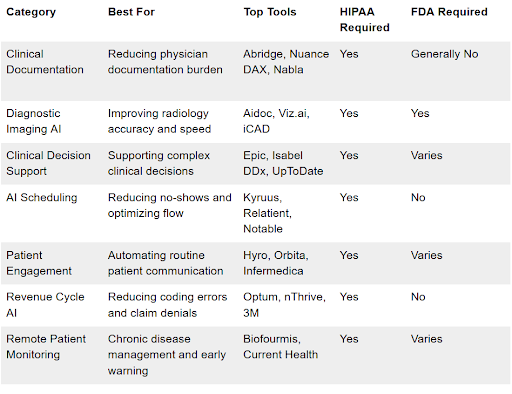
AI Tools for Healthcare Providers Comparison Table
When to Build a Custom AI Tool Instead of Buying One
The best AI tools for healthcare providers are not always off-the-shelf products. For healthcare organizations with specific clinical workflows, unique patient populations, or proprietary clinical data, custom AI development often delivers better outcomes than adapting general-purpose tools.
Build custom when:
Your clinical workflow is sufficiently specialized that no off-the-shelf tool fits without significant compromise
You have proprietary clinical data that would give a custom model a performance advantage over general-purpose tools
Integration requirements with your specific EHR or clinical systems are not supported by available vendors
Long-term total cost of ownership favors custom development over subscription fees at your expected scale
Buy or license when:
A well-validated off-the-shelf tool addresses your specific clinical problem with evidence from similar clinical environments
Your EHR integration requirements are supported by the vendor
Your timeline requires faster deployment than custom development allows
Our MVP and product strategy process helps healthcare organizations make this build-versus-buy decision with clear criteria evaluating off-the-shelf options honestly before recommending custom development when it is the better long-term investment.
Where do AI tools in healthcare fail?
They fail at integration, at alert design, at unvalidated deployment, and at the gap between what a tool measurably does and what the organization was told it would do.
Four failure patterns worth designing against:
The separate login. A tool that lives outside the EHR gets used enthusiastically for six weeks and then quietly abandoned. This is the most common failure mode in clinical AI, full stop.
Alert fatigue. The sepsis model example above generated alerts on 18% of hospitalized patients. Clinicians stop responding to alerts long before anyone formally turns them off.
Deployment without local validation. Vendor performance figures come from the populations and systems the vendor tested on. Yours are different.
Unmeasured value. If you cannot demonstrate the improvement at renewal, the contract is at risk regardless of whether clinicians like the tool. Instrument the outcome from day one.
How Codieshub Helps Healthcare Providers Adopt and Build AI Tools
At Codieshub, we work with healthcare providers in two ways, helping them integrate the best available AI tools into their existing clinical infrastructure, and building custom AI solutions for clinical workflows that off-the-shelf tools cannot adequately address.
For AI tool integration, our EHR and EMR integration team connects AI documentation tools, diagnostic AI platforms, and patient engagement systems to the EHR environments where clinical staff actually work using HL7 FHIR and healthcare interoperability standards that make integrations reliable in production. Our HIPAA-compliant software development practice evaluates the compliance posture of every AI tool we integrate and builds the technical safeguards required for protected health information.
For custom AI development, our AI and ML solutions team builds clinical AI models with the accuracy, explainability, and clinical validation that healthcare environments require. Our healthcare UI/UX design team designs clinical interfaces that are tested with real clinicians from the target specialty. And our DevOps and cloud solutions team deploys and monitors AI systems on HIPAA-eligible cloud infrastructure that is built for the performance and reliability requirements of clinical environments.
Get a Free Project Estimate: Tell us about your clinical AI needs, and we will send you a tailored integration or development game plan within 48 hours.
Conclusion
The best AI tools for healthcare providers in 2026 are not experimental technologies looking for clinical applications. They are proven tools in active clinical use in hospitals and practices across the United States delivering measurable improvements to documentation burden, diagnostic accuracy, scheduling efficiency, patient engagement, and revenue cycle performance.
The challenge for healthcare organizations is not finding AI tools. It is finding the right ones for specific clinical problems, confirming they meet HIPAA and FDA requirements, integrating them into existing workflows in ways that sustain adoption, and measuring their impact against baseline metrics that matter clinically and financially.
At Codieshub, we help healthcare providers navigate this process from evaluating and integrating the best available AI tools to building custom AI solutions for clinical workflows that off-the-shelf products cannot address. We bring HIPAA compliance expertise, EHR integration experience, and clinical AI development capability to every engagement.
Ready to bring the right AI tools into your clinical workflow? Talk to Our Healthcare AI Experts and get a tailored implementation plan no obligation, just clarity.
Frequently Asked Questions
1. What are the best AI tools for healthcare providers in 2026?
Best AI tools depend on your clinical problem. For documentation, Abridge and Nuance DAX lead. For diagnostics, Aidoc and Viz.ai offer FDA-cleared radiology AI. For scheduling, Kyruus and Relatient work well. For remote monitoring, try Biofourmis or Current Health. Choose based on EHR integration and proven clinical results.
2. Do AI tools for healthcare providers need to be HIPAA compliant?
Yes, if they handle protected health information, which applies to nearly all clinical AI tools. Compliance requires encrypted data transmission and storage, role-based access controls, audit logging, and a signed Business Associate Agreement. Always confirm compliance documentation directly with vendors, not just marketing claims.
3. Do AI diagnostic tools need FDA clearance?
AI tools that make diagnostic claims detecting image findings, assessing risk, or supporting triage are regulated as Software as a Medical Device and require FDA clearance before clinical use. Tools offering only general information may fall outside FDA jurisdiction. Always verify clearance status before deployment.
4. What is the most important technical requirement for AI tool adoption in healthcare?
EHR integration matters most. Tools that surface findings and alerts directly within the existing EHR see far higher adoption than those requiring separate systems. Before selecting a tool, confirm which EHR platforms it supports, how integration is maintained, and whether it uses HL7 FHIR for data exchange.
5. How much do AI tools for healthcare providers cost?
Costs vary by category. Ambient documentation tools run $300–$700 per provider monthly. Scheduling tools cost $500–$2,000 monthly for small practices. Radiology AI is typically priced per study volume. Revenue cycle tools often charge a percentage of recovered revenue. Custom development ranges from $50,000 to $300,000+.
6. How do I know if an AI tool will actually work in my clinical environment?
Run a structured pilot with a small provider group, clear success metrics, and a set evaluation timeline. Ask vendors for case studies from similar clinical settings, same specialty, patient population, and EHR system. Real-world evidence from comparable environments beats controlled research claims.
7. Should I buy an off-the-shelf AI tool or build a custom one?
Buy if a validated tool fits your workflow, integrates with your EHR, and has evidence from similar settings. Build custom if your workflow is highly specialized, you hold proprietary data for better model performance, or long-term costs favor ownership. Do a build-vs-buy analysis first.
8. What compliance requirements should I check before deploying an AI tool?
Verify HIPAA compliance and BAA availability, FDA clearance status for diagnostic tools, and state-specific telehealth or digital health regulations if relevant. Also check cybersecurity certifications, recent penetration test results, and data residency requirements based on where your organization needs patient data stored.