
InsightsSaaS
How to Integrate AI with Existing Software (2026 Guide)
Learn how to integrate AI with existing software in 2026 using APIs, automation platforms, and custom solutions to boost efficiency and cut costs.

Most companies don’t need to rebuild their software to leverage AI, yet many struggle to know where and how to connect it effectively. Without a clear integration strategy, businesses risk wasting time on trial-and-error projects, underutilizing powerful AI models, and missing out on predictive insights that could improve decision-making, automate repetitive tasks, and enhance user experiences.
In 2026, integrating AI, machine learning, and predictive analytics into existing software is no longer optional; it’s essential.
This guide walks you through practical, step-by-step ways to connect AI through APIs, automation platforms, and custom solutions so your software becomes smarter, more efficient, and fully competitive in today’s fast-changing digital landscape.
Jump To Section
Understanding AI Integration: What It Actually Means
Business Benefits: The Measurable Impact
Integration Methods: APIs, Platforms & Custom Solutions
Automation Tools with Open API
Custom AI Solutions for Enterprise
Choosing the Right AI Integration Partner
Step-by-Step Implementation Guide
Common Challenges & Proven Solutions
Real-World Use Cases
Conclusion & Next Steps
Frequently Asked Questions
Understanding AI Integration: What It Actually Means
AI integration is the process of embedding artificial intelligence capabilities such as machine learning models, natural language processing (NLP), and predictive analytics into your existing software infrastructure, including mobile app development. Unlike building AI systems from scratch, integration leverages pre-trained models, third-party APIs, and automation platforms to extend what your current applications can do.
The core objective is not to replace your software stack. It is to make your systems smarter, enabling them to analyze data at scale, surface actionable insights automatically, and handle repetitive tasks without human intervention.
Key Distinction: AI Augmentation vs. AI Replacement
AI integration is about augmentation, enhancing your existing systems with intelligent capabilities, not about replacing them wholesale. This distinction is critical when planning your integration roadmap and communicating value to stakeholders.
For example, an e-commerce platform does not need to be rebuilt to offer AI-driven product recommendations. By integrating a recommendation engine API, the platform can begin surfacing personalized suggestions based on real-time behavioral data within weeks, not months.
Business Benefits: The Measurable Impact
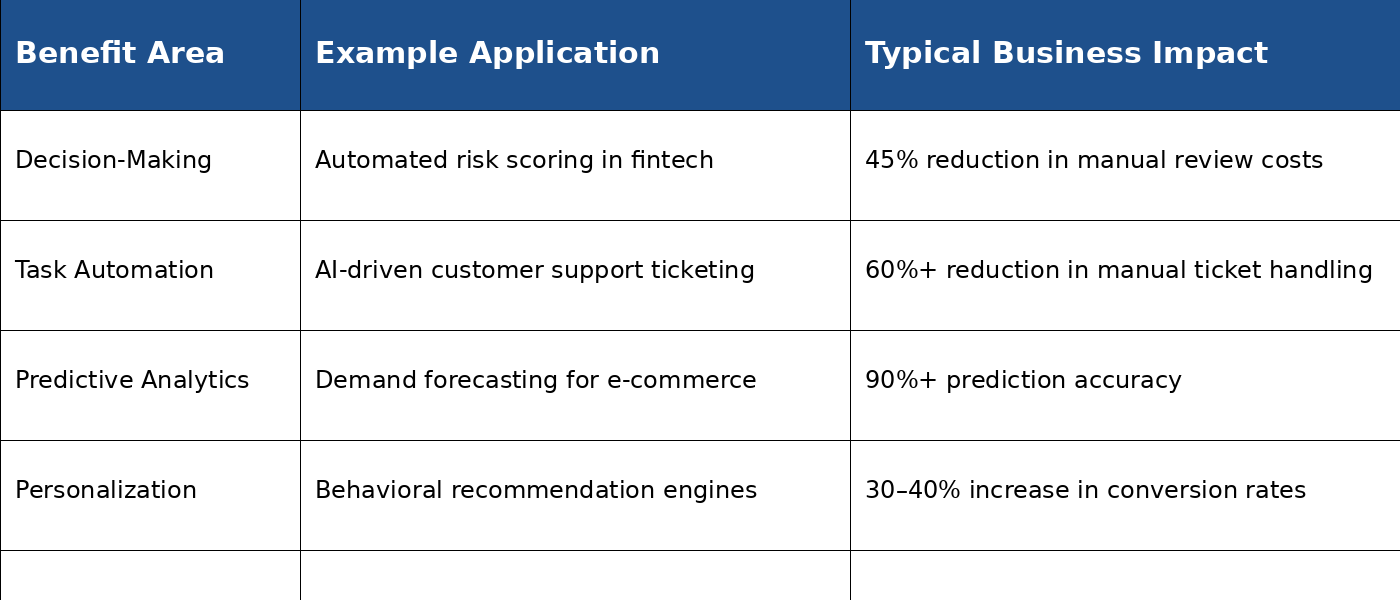
Organizations that integrate AI into their existing software consistently report improvements across four core dimensions:
Enhanced Decision-Making
AI models process and analyze large datasets far faster than human analysts. This enables faster, more accurate business decisions, from dynamic pricing adjustments in retail to risk assessment in financial services. SaaS solutions powered by AI make it easy for businesses to deploy these capabilities without heavy infrastructure investment. Codieshub clients leveraging AI-powered analytics report a 45% reduction in operational costs by eliminating manual data review cycles.
Automation of Repetitive Tasks
Processes such as invoice processing, data entry, customer ticket categorization, and report generation can be fully automated with AI. This frees your human workforce to focus on strategic, high-value work. AI & ML solutions have helped clients automate over 60% of their routine operational tasks, significantly improving ROI in custom software deployments by reducing manual effort and operational costs.
Predictive Analytics
By applying machine learning models trained on historical data, businesses can anticipate outcomes, whether that is predicting customer churn, forecasting inventory demand, or identifying equipment failure before it occurs. Well-designed predictive models routinely achieve 90%+ accuracy, helping organizations make proactive, data-driven decisions.
Personalized User Experience
AI enables software to adapt dynamically to individual users. Recommendation engines, intelligent search, adaptive UI, and personalized content delivery, when integrated with thoughtful UI-UX design, all become achievable, resulting in measurable improvements in user retention and conversion rates.
Integration Methods: APIs, Platforms & Custom Solutions
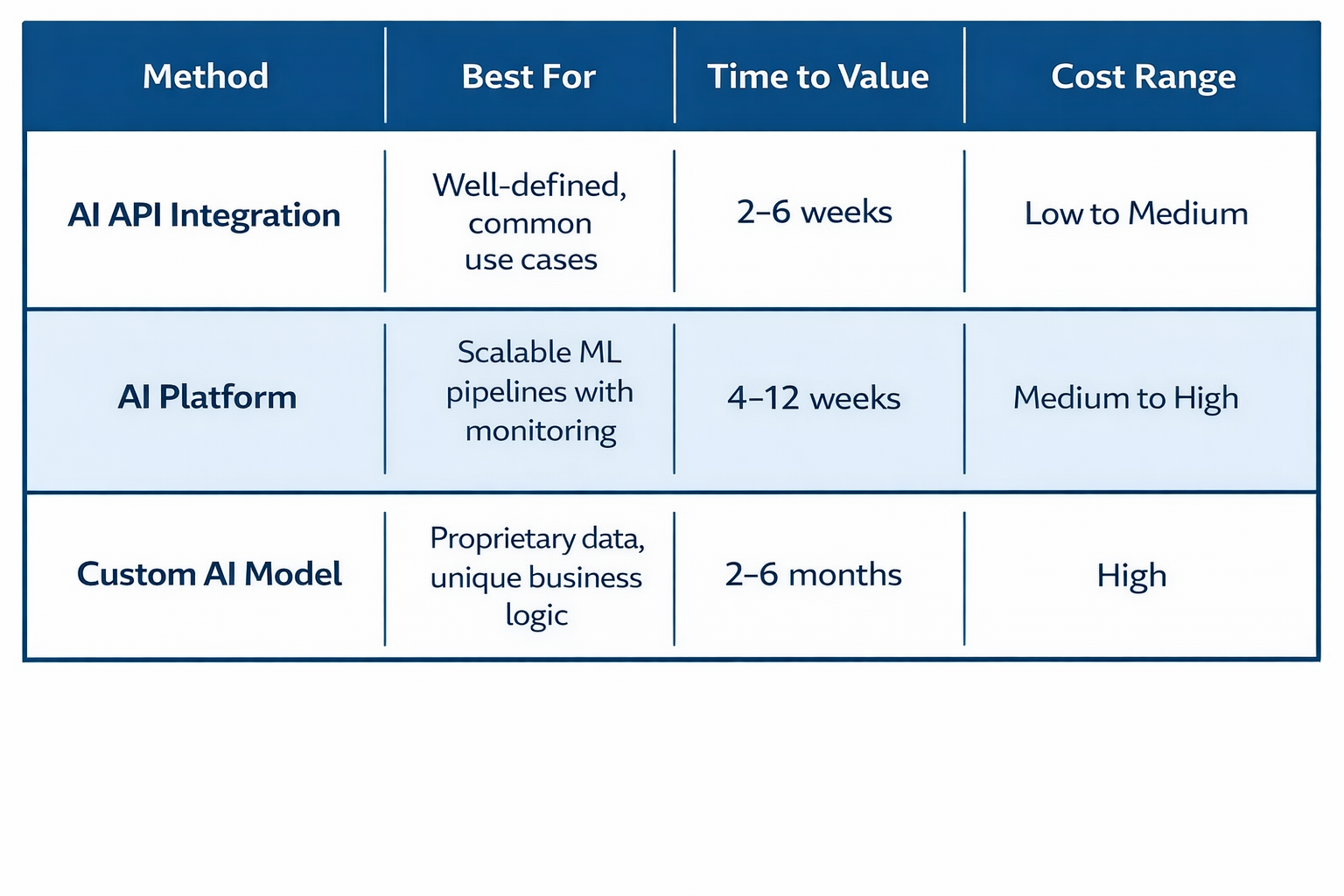
There is no single correct method for AI integration. The right approach depends on your existing infrastructure, technical capacity, budget, and the complexity of the problem you are solving.
Method 1: AI APIs
AI APIs are the fastest route to integration. Platforms such as OpenAI, Google Cloud AI, Microsoft Azure Cognitive Services, and Amazon AWS AI Services expose pre-trained models via RESTful APIs. Developers can embed capabilities such as:
• Natural Language Processing (NLP) for document analysis and chatbots
• Computer Vision for image classification and object detection
• Speech-to-Text and Text-to-Speech for voice interfaces
• Sentiment Analysis for customer feedback processing
API integration is ideal for teams with existing engineering capacity and well-defined use cases. It requires minimal infrastructure overhead but may have limitations around data privacy, customization, and cost at scale.
Method 2: End-to-End AI Platforms
Platforms such as Google Vertex AI, Azure Machine Learning, and DataRobot provide a complete ecosystem including data pipelines, model training, deployment, and monitoring. These platforms reduce the time required to operationalize AI but demand more investment in setup and configuration, making collaboration with an experienced AI development partner a strategic way to accelerate integration and optimize costs.
Method 3: Custom AI Model Development
For organizations with proprietary datasets and specialized requirements, custom model development offers the highest precision and competitive differentiation. Custom models are trained on your specific data, tuned to your business objectives, and deployed within your infrastructure, offering control over performance, privacy, and scalability. Working with AI development experts can accelerate this process while ensuring access to specialized AI
and machine learning talent.
Automation Tools with Open API
For teams that require AI integration without heavy engineering investment, automation platforms with open API support provide an accessible bridge between AI capabilities and business workflows, helping prevent common pitfalls where AI projects fail due to a lack of expertise or inadequate infrastructure.
Tools such as Zapier, Make (formerly Integromat), n8n, and Activepieces allow non-developers to wire AI services into existing software through visual workflow builders. Common use cases include:
• Customer Support Automation: Route incoming emails through an NLP API to classify, prioritize, and auto-respond to common queries.
• Sales Intelligence: Enrich CRM records automatically by triggering AI-powered data lookups when new leads are added.
• Predictive Alerts: Connect predictive analytics outputs to notification systems, triggering alerts when anomalies are detected in operational data.
• Content Workflows: Automate document summarization, translation, or sentiment analysis pipelines for marketing and compliance teams.
When to Use Automation Tools vs. Custom Integration
Use automation tools when: you need rapid deployment, your use case fits standard AI APIs, and workflow complexity is low to medium.
Use custom integration when: you require fine-grained control, handle sensitive data that cannot leave your infrastructure, or need to achieve performance benchmarks that pre-built tools cannot meet.
Custom AI Solutions for Enterprise
Enterprise organizations often face challenges that pre-trained models and automation tools cannot adequately address. In these scenarios, custom AI solutions built on proprietary data and tailored to specific operational contexts deliver the highest return on investment while helping manage technology implementation expenses by focusing resources on solutions that directly impact business outcomes.
Predictive Maintenance (Manufacturing & Logistics)
By training machine learning models on sensor telemetry and maintenance history, manufacturers can predict equipment failures days or weeks in advance. This shifts maintenance from reactive (costly, unplanned downtime) to predictive (scheduled, low-cost interventions), especially when integrated with tailored logistics solutions that help streamline maintenance scheduling and optimize supply chain coordination.
Fraud Detection (Financial Services)
Custom anomaly detection models trained on transaction history can identify fraudulent activity in real time with significantly lower false-positive rates than rule-based systems. These models improve continuously as new transaction data is incorporated.
Intelligent Content Recommendation (Media & E-Commerce)
Recommendation engines trained on user behavior, click patterns, purchase history, and session duration deliver personalized content and product suggestions that increase engagement and revenue per user.
Intelligent Document Processing (Legal, Finance, Healthcare)
Custom NLP models can extract structured data from unstructured documents, contracts, medical records, and financial statements with high accuracy, dramatically reducing manual review time, especially when integrated into specialized healthcare solutions to streamline patient records management and regulatory compliance.
Choosing the Right AI Integration Partner
For organizations without in-house AI expertise, selecting the right technology partner is the single most important decision in the integration process. The right partner brings not only technical capability but domain knowledge, delivery discipline, and a clear methodology.
When evaluating AI integration service providers, assess the following:
• Technical Breadth: Does the partner have proven capability across machine learning, data engineering, API integration, and cloud deployment?
• Domain Experience: Have they delivered AI solutions in your industry? Relevant case studies are non-negotiable.
• Delivery Track Record: What is their on-time delivery rate? Request references.
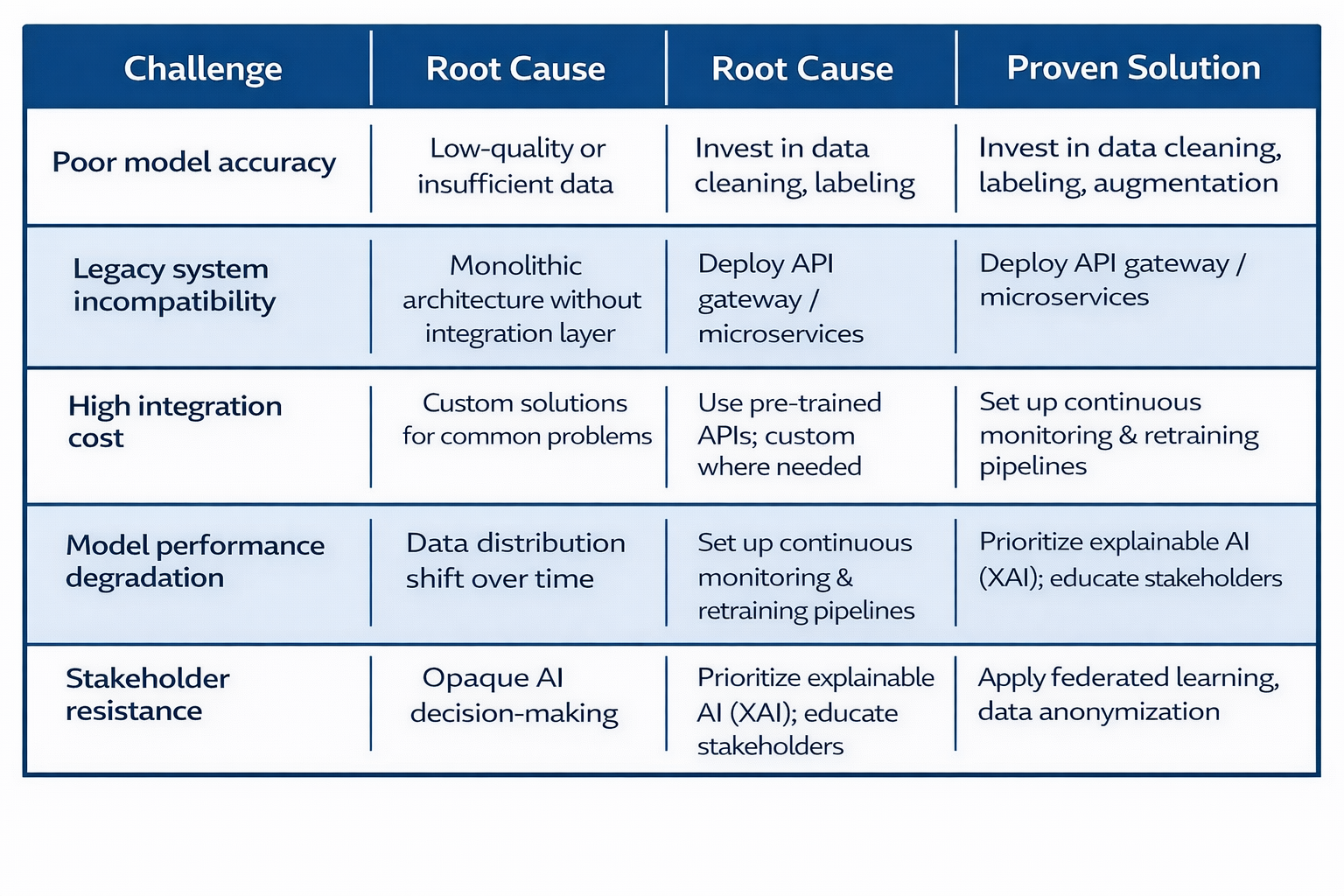
• Post-Deployment Support: AI models degrade over time as data distributions shift. Ensure ongoing monitoring and retraining are included.
• Data Privacy & Security: Confirm they adhere to relevant compliance frameworks (GDPR, HIPAA, SOC 2) and that your data is protected throughout the engagement.
Step-by-Step Implementation Guide
A structured implementation methodology is essential for managing complexity, controlling cost, and ensuring that AI delivers measurable business outcomes. The following framework reflects best practices across enterprise AI integration engagements.
1. Infrastructure Assessment
Audit your existing software stack, data architecture, and integration points. Identify which systems generate the data AI will consume, and assess data quality, volume, and accessibility. Legacy systems may require middleware or microservices layers to expose data to AI components.
2. Objective Definition
Define specific, measurable AI objectives tied to business outcomes. Avoid vague goals such as "use AI to improve efficiency." Instead, target: "Reduce customer support ticket resolution time by 40% using NLP-based auto-classification within 90 days."
3. Data Preparation
AI model performance is directly correlated with data quality. Cleanse, normalize, and label training data. Establish data pipelines that ensure ongoing model freshness. This phase often consumes 40–60% of total project time.
4. Model Selection & Development
Select pre-trained models where applicable (faster, lower cost) or develop custom models for specialized use cases. Evaluate model performance against defined accuracy and latency benchmarks before proceeding to integration.
5. API & Platform Integration
Embed AI capabilities into your software using APIs, SDKs, or direct model deployment. Ensure robust error handling, fallback logic, and monitoring instrumentation are built into the integration layer.
6. Testing & Validation
Conduct rigorous testing across unit, integration, and end-to-end levels. Validate model outputs against real-world data. Run A/B tests where feasible to quantify business impact before full rollout.
7. Deployment & Monitoring
Deploy to production with observability tooling in place, track model accuracy, latency, data drift, and business KPIs. Establish retraining schedules to prevent model degradation over time.
8. Team Enablement
Ensure that end users and operational teams understand how to interact with AI-powered features, interpret model outputs, and escalate edge cases appropriately.
Common Challenges & Proven Solutions
Real-World Use Cases
PetScreening: Intelligent Data Processing at Scale
Codieshub partnered with PetScreening to build a SaaS platform that processes pet screening data for residential property managers. By integrating AI-powered document processing and risk scoring, the platform achieved 21% month-over-month growth within a year of launch, driven by dramatic reductions in manual review time and higher screening throughput.
Fintech: Real-Time Risk Intelligence
A financial services client required a real-time credit risk assessment integrated into their existing loan origination software. Codieshub developed a custom machine learning model trained on historical loan performance data, integrated via an internal REST API. The model reduced manual underwriting time by 55% and decreased default rates by 18% in the first year of deployment.
E-Commerce: Personalization Engine Integration
For a mid-market e-commerce client, Codieshub integrated a behavioral recommendation engine into an existing Shopify Plus storefront. The engine analyzed clickstream data, purchase history, and inventory signals to surface personalized recommendations. Within 90 days of deployment, average order value increased by 23%.
Reference: codieshub.com/services/shopify-plus-agency
Conclusion & Next Steps
AI integration is no longer an advanced capability reserved for technology companies with large engineering teams. In 2026, mature APIs, accessible platforms, and experienced integration partners have made it achievable for organizations of any size and technical maturity.
The organizations that move decisively, defining clear objectives, investing in data quality, and partnering with experienced delivery teams are establishing durable competitive advantages. Those that delay risk being outpaced by competitors who are already operationalizing AI across their software ecosystems.
The path forward is structured, not speculative. Assess your infrastructure. Define your objectives. Select the right integration approach. And partner with a team that has delivered measurable results, not just theoretical frameworks.
At Codieshub, we help organizations move from AI strategy to production with senior engineers who've shipped real AI systems across fintech, healthcare, and commerce. Talk to Our Team and see how we can help you integrate AI the right way.
Frequently Asked Questions
1: Can AI integration work with legacy software?
Yes. Legacy systems can be connected to AI components through API gateways, middleware layers, or microservices architectures. A full software replacement is rarely necessary. The integration layer abstracts the complexity of the legacy system while exposing the data and functionality that AI models require.
2: Do I need an in-house AI team to integrate AI effectively?
Not necessarily. Pre-trained API-based integrations can be implemented by existing engineering teams with limited AI expertise. For custom model development, however, specialized machine learning engineering capability is required either through internal hiring or by engaging an experienced AI integration partner such as Codieshub.
3: How long does AI integration typically take?
Timelines vary significantly by scope and complexity. API-based integrations for well-defined use cases can be completed in 2–6 weeks. Custom AI model development and enterprise-scale platform integrations typically require 2–6 months. Codieshub's Discovery Sprint (4–8 weeks) is designed to reduce uncertainty and establish a clear, cost roadmap before full development begins.
4: Will AI integration replace human employees?
AI integration automates repetitive, rule-based tasks, not strategic judgment, creative problem-solving, or complex human interaction. The net effect is typically a reallocation of human effort toward higher-value work, not a reduction in headcount. Organizations that position AI as a tool for workforce augmentation, not replacement, achieve better adoption outcomes and greater return on investment.
5: Which AI models are best suited for predictive analytics?
The optimal model architecture depends on the specific prediction task. Regression models (linear, logistic) are appropriate for continuous outcome prediction. Time-series models (ARIMA, Prophet, LSTM networks) are used for temporal forecasting. Gradient boosting algorithms (XGBoost, LightGBM) deliver strong performance across a wide range of structured data classification and regression tasks. Codieshub's AI team conducts model selection as part of the technical scoping process for each engagement.
6: How do I ensure data privacy when integrating third-party AI APIs?
Review the data processing terms of any third-party AI API before integration. For sensitive or regulated data (personal health information, financial records), consider on-premise model deployment, federated learning approaches, or data anonymization pipelines. Codieshub ensures all AI integrations are designed with compliance requirements (GDPR, HIPAA, SOC 2) as a primary architectural constraint.
7: How do I measure the ROI of AI integration?
Define baseline metrics before integration begins. Post-deployment, track improvements against those baselines: cost per transaction, processing time, error rate, revenue per user, and customer satisfaction scores. Codieshub builds measurement frameworks into every AI engagement to ensure that business impact is quantified and reported throughout the delivery cycle.