
InsightsHealthcare
Mental Health App Development: Complete 2026 Guide
Build a HIPAA-compliant mental health app in 2026. Discover must-have features, real costs from $20K, and expert guidance from healthcare software engineers.
Mental health app development is the process of designing a HIPAA-compliant mobile or web app, from mood trackers to full teletherapy platforms, for people managing their mental health. In 2026, a basic MVP costs $20K–$45K and takes 6–10 weeks; a full clinical platform costs $100K–$250K+ and takes 6–12 months. The build must include encryption, role-based access, audit logging, and Business Associate Agreements from day one.
If you want to build a mental health app in 2026, the market demand has never been stronger. Roughly one in eight people worldwide live with a mental health disorder (WHO), there are nowhere near enough clinicians to serve them, and more people than ever are willing to use their phones for mental health support.
The opportunity is real. So is the complexity. Building a mental health app is not the same as building a fitness tracker or a productivity tool. You are handling deeply sensitive health data, working with vulnerable users, and entering one of the most regulated spaces in health app development. Getting these things right is what separates apps that achieve real clinical adoption from ones that stall in beta.
This guide gives you a complete, honest picture of the development process from core features and security measures to compliance requirements and real costs. At Codieshub, we build healthcare software for funded startups and enterprise health systems. This guide is built from that experience.
Key takeaways
The mental health apps market is projected to grow from $9.45B in 2026 to $18.81B by 2031 (a 14.76% CAGR), driven by clinician shortages, new U.S. reimbursement codes, and employer-funded care.
A basic MVP costs $20K–$45K; a full clinical platform with EHR integration runs $100K–$250K+ plus 20–30% of build cost per year to maintain.
HIPAA is only the start. The FTC actively regulates non-HIPAA wellness apps, and has fined BetterHelp ($7.8M) and GoodRx ($1.5M) for leaking mental health data to advertisers.
The apps that win are grounded in evidence-based care (CBT, PHQ-9/GAD-7), design for trust and safety first, and iterate on outcome data after launch.
Why Is Demand for Mental Health Apps Growing in 2026?
Demand for mental health apps is growing because roughly one in eight people worldwide live with a mental health disorder, while there are far too few clinicians to treat them, pushing the market from an estimated $9.45B in 2026 toward $18.81B by 2031.
Not enough mental health professionals
The supply of licensed mental health professionals is not growing fast enough to meet rising demand. In many parts of the United States and the UK, waiting times for therapy are measured in months, not weeks. Mental health applications that connect patients with care or help them manage their mental health independently fill a real gap that the traditional system cannot close on its own.
Younger users are driving adoption
Young adults are more likely to open a mental health app than to book a therapy appointment. They are comfortable with mobile technology, more open about mental health, and willing to pay for digital support. Depression and anxiety management remains the largest application segment of the market.
Employers and payers are changing the model
Mental health support is increasingly funded by employers and insurance payers rather than individual users paying out of pocket. Per-employee contracts between organizations and mental health platforms have grown significantly, raising engagement threefold compared to direct-to-consumer models. This opens a B2B sales path that was not available just a few years ago.
WHAT THIS MEANS FOR FOUNDERS: The market demand is there. The technology is accessible. The funding model is improving. But competition is intense; more than 10,000 mental health applications are active in app stores right now. The platforms that win are the ones built around a specific user need with strong data protection, a trustworthy user experience, and clinical credibility that generic wellness apps cannot replicate.
What Types of Mental Health Apps Can You Build?
The main types of mental health apps are anxiety and depression management, meditation and mindfulness, teletherapy and telepsychiatry platforms, employer wellness platforms, AI chat companions, and peer-support communities, each with a different compliance and complexity load.
1. Largest Segment: Anxiety and Depression Management
Apps that help users track symptoms, complete CBT-based exercises, and manage anxiety or depression daily. Common features include mood tracking, journaling, guided exercises, and progress visualization. This category has the highest market demand.
2. Fast Growing: Meditation and Mindfulness
Apps like Calm and Headspace that guide users through breathing exercises, meditation sessions, and sleep support. These require lower compliance than clinical tools but face high competition. User experience is the key differentiator.
3. Clinical: Therapy and Telepsychiatry Platforms
Platforms that connect users with licensed mental health professionals via video sessions or messaging. These apps require strict compliance and offer strong potential for insurance reimbursement.
4. Workplace: Employer Wellness Platforms
B2B mental health solutions offered as employee benefits. Features include therapy booking, wellness check-ins, and organizational health reporting. One of the fastest-growing revenue models in health tech.
5. AI-Powered: AI Chat and Digital Companions
Apps that use conversational AI to provide support between therapy sessions or as standalone tools. Useful for daily engagement and maintaining user retention.
6. Peer Support: Community and Support Apps
Platforms that connect users with peer groups, moderated communities, and recovery programs. Strong engagement potential but requires careful moderation to ensure user safety.
What Core Features Does Every Mental Health App Need?
Every mental health app needs mood tracking, journaling, guided CBT or mindfulness exercises, therapy booking with HIPAA-compliant video, AI chat support, progress insights, crisis support, and encrypted messaging.
Mood Tracking: Users log moods regularly; it helps identify patterns and triggers.
Journaling & Self-Reflection: Private journaling with prompts improves long-term engagement.
Guided Therapy & CBT Exercises: Evidence-based exercises for actionable mental health support.
Therapy Booking & Video Calls: Simple, reliable, and compliant session scheduling and calling.
AI Chat Support: 24/7 conversational support between therapy sessions.
Progress Tracking & Insights: Visual data showing mood, sleep, and improvement trends.
Crisis Support & Emergency Access: Quick access to helplines and urgent support.
Secure Messaging: Encrypted communication between users and therapists.
Which Advanced Features Set the Best Mental Health Apps Apart?
The best mental health apps add AI-personalized care plans, predictive risk alerts, EHR integration, group-therapy sessions, gamified engagement, wearable biometrics, and in-the-moment interventions (EMA/EMI).
AI personalized care plans: tailored plans built from mood, journal, and activity data.
AI predictive risk alerts: early warning signs surfaced before a situation escalates (with human review).
Clinical EHR integration: therapy notes, assessments, and treatment data synced via FHIR / SMART on FHIR.
Group therapy sessions: multi-user video with a licensed clinician.
Engagement gamification & streaks: rewards and milestones that encourage daily use.
Wearable biometric integration: sleep, heart rate, and activity data for deeper insight.
EMA / EMI (in-the-moment support): Ecological Momentary Assessment prompts users to log feelings throughout the day; Ecological Momentary Intervention responds close to the moment of need, e.g., triggering a breathing exercise when the app detects a risk pattern.
How Do You Build a Mental Health App, Step by Step?
You build a mental health app in eight steps: define the clinical use case, run a discovery sprint, design for trust and safety, build core features on a secure foundation, add compliant teletherapy, implement full HIPAA compliance, test with real users, then launch and iterate on outcome data.
Step 1: Define Your Target Users and Clinical Use Case
Start with a specific, well-defined target user and a specific problem. Are you building for people managing anxiety on their own? For users seeking to connect with a licensed therapist? Should employers provide mental health support as a benefit? Each of these requires a different product. The clearer your definition of the target user, the more focused and effective your MVP will be.
Step 2: Run a Discovery Sprint
Before writing any code, validate your assumptions. Talk to real people who match your target users. Map their current mental health support habits. Understand where existing tools fall short. Our MVP and product strategy process is built around this discovery-first approach. For mental health applications, especially, the design decisions made before development begins are the ones that are most expensive to change afterward.
Step 3: Design for Trust and Safety First
Mental health apps serve vulnerable users. The design of the app, its visual tone, the language it uses, and the way it handles distress signals must be built around trust and safety. This is not just a design preference; it directly affects whether users engage honestly with the app. Our UI/UX design team tests mental health interfaces with real users from the target demographic before any production code is written. A user-friendly design is not optional in this category; it is what determines whether people come back.
USER EXPERIENCE IS A CLINICAL OUTCOME: In mental health applications, a confusing or cold user experience does not just reduce engagement. It can make people feel worse about seeking help. The design choices you make about language, color, transitions, and crisis pathways are clinical decisions as much as product ones.
Step 4: Build the Core Features on a Secure Foundation
Build mood tracking, journaling, and the therapy session booking flow first. Get these working reliably and securely before adding advanced features. Establish your data protection architecture, encryption, access controls, and audit logging before any real user health data enters the system.
Step 5: Add Video Calling and Therapist Connectivity
If your app includes therapy sessions with a licensed mental health professional, the video calling infrastructure must be HIPAA-compliant from day one. Purpose-built healthcare video APIs handle this reliably. Consumer video tools do not. Build the booking, matching, and session management workflow carefully. This is the highest-value part of clinical mental health applications and the part that fails most often when not designed thoughtfully.
Step 6: Implement Full Compliance and Security Measures
Any mental health app that handles clinical patient data must meet HIPAA requirements. Build encryption, role-based access controls, audit logging, and Business Associate Agreements with all third-party services into the architecture before launch. Our custom web development team builds compliance into every healthcare product from the first sprint, not as a final step.
Step 7: Test with Real Users from Your Target Demographic
Internal testing misses the problems that real users encounter. In mental health applications specifically, what seems clear and supportive to a developer may feel clinical and cold to a user in distress. Test with real people who match your target users. Watch how they respond to the onboarding flow, the mood tracking interface, and the crisis support pathway. Iterate until these feel genuinely helpful.
Step 8: Launch, Measure, and Iterate
Track daily active users, session completion rates, mood tracking consistency, and therapist booking conversion. The best improvements to mental health apps come from real usage data. A project manager overseeing the post-launch roadmap should treat every metric drop as a user experience signal worth investigating.
What Security and HIPAA Compliance Does a Mental Health App Require?
A HIPAA-compliant mental health app requires AES-256 encryption at rest, TLS 1.2+ in transit, role-based access controls, audit logging, and signed Business Associate Agreements with every third party that touches patient data.
What HIPAA Requires
Encryption at Rest and in Transit: All health data must be encrypted when stored and when transmitted. This is a baseline HIPAA requirement. TLS 1.2+ for in-transit encryption. AES-256 for data at rest. No PHI in unencrypted local storage on devices.
Role-Based Access Controls: Users can only access their own data. Therapists can only access records for their patients. Administrators have access appropriate to their role. Strong authentication and automatic session timeouts are required for clinical users.
Audit Logging: Every access to patient data must be logged with a timestamp and a user identifier. These logs are essential for HIPAA compliance investigations and for identifying security incidents before they become breaches.
Business Associate Agreements: Every third-party service that touches patient data, cloud provider, video calling infrastructure, and email service must sign a Business Associate Agreement. AWS, Twilio, and Daily.co all offer BAAs for healthcare customers.
Compliance beyond HIPAA
Not every mental health app is HIPAA-covered, but that does not mean it's unregulated. The Federal Trade Commission (FTC) is the active regulator for consumer health apps outside HIPAA, and it has been aggressive:
BetterHelp paid $7.8M (2023) after the FTC found it shared users' email addresses, IP addresses, and mental-health questionnaire answers with Facebook, Snapchat, Criteo, and Pinterest for advertising, despite promising privacy (FTC).
GoodRx paid $1.5M (2023) in the FTC's first enforcement of the Health Breach Notification Rule, for sharing user health data with Facebook and Google.
Other regulations that may apply, depending on your app:
42 CFR Part 2, stricter-than-HIPAA consent rules for substance-use-disorder records.
GDPR, for EU users' personal data.
State privacy laws, e.g., Washington's My Health My Data Act, which specifically covers consumer health data.
App Store / Google Play health-data policies.
The lesson for founders: the mere disclosure of an email or IP address to an advertiser can count as disclosing health information when it's obvious the data relates to mental health services. Build data protection into the architecture from the start, adding security at the end typically costs 3–5x more and multiplies breach risk.
How Much Does It Cost to Build a Mental Health App?
The cost of mental health app development depends on the features you need, the compliance requirements your platform must meet, and whether you are connecting users with a licensed mental health professional or building a self-guided wellness tool. Here is a realistic range based on what we have built for healthcare clients.
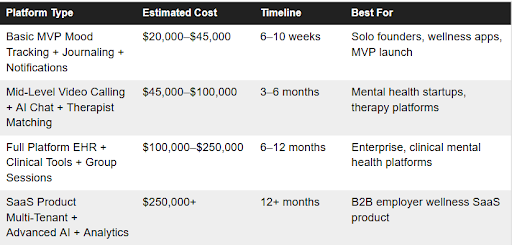
The biggest cost drivers are whether video calling for therapy sessions is required, the sophistication of your AI features, the depth of your security measures and HIPAA compliance infrastructure, and whether you need EHR integration for clinical users.
For a more detailed breakdown of what drives healthcare software development costs, see our guide on building a web application.
How Do You Measure a Mental Health App's Success?
You measure a mental health app by outcomes that map to care, completed check-ins, booked sessions, referral conversion, and changes in standardized clinical scores like PHQ-9 and GAD-7, not by vanity metrics like raw daily active users.
Installs are easy to count; outcomes are harder. Retention in mental health apps lies easily, a user can open the app daily and get nothing useful, while another opens it twice a week and gets exactly the support they need.
Track metrics that connect to real care:
Engagement that maps to care, check-ins completed, exercises practiced, sessions booked.
Referral conversion, for platforms that route users to clinicians (a core BetterHelp-style metric).
Change in standardized scores, PHQ-9 (depression) and GAD-7 (anxiety) trends over time. This is measurement-based care, and it's what gives a product genuine clinical credibility with payers and providers.
Qualitative context, interviews, and surveys to explain why users abandon a flow, not just that they did.
How Do Mental Health Apps Make Money?
Mental health apps make money through D2C subscriptions, B2B2C employer per-employee contracts, insurance reimbursement for validated digital therapeutics, and freemium upgrades.
Direct-to-consumer subscription, recurring revenue, but high acquisition cost and churn.
B2B2C employer contracts, per-employee pricing ($2–$6/employee) removes payment friction and raises engagement ~3x; longer sales cycles but more predictable revenue.
Insurance reimbursement: newly activated U.S. reimbursement codes make app-based CBT billable in some cases; strong for clinically validated products.
Freemium: free core features with paid teletherapy, coaching, or premium content.
For many founders, B2B employer wellness is the more sustainable model if you have the budget and time horizon for an enterprise sales motion.
How Do You Make a Mental Health App Accessible?
You make a mental health app accessible by following WCAG 2.2 and WAI-ARIA standards, screen-reader and magnification support, high-contrast modes, speech input, and calming palettes tuned to the user's emotional state.
Accessibility is both an ethical obligation and a UX advantage. Severe anxiety or depression can cause blurred vision or difficulty concentrating, so support assistive technologies (screen readers, magnification, speech input, single-switch entry) and design for low cognitive load: short flows, plain prompts, and calming color schemes. Some teams go further and adjust the interface subtly based on the user's reported state.
What Are the Most Common Mental Health App Development Mistakes?
The most common mistakes are skipping clinical validation, bolting on security last, building a generic wellness app, neglecting UX, hiding crisis pathways, over-promising on AI, and launching without compliance oversight.
Skipping clinical validation. Apps not grounded in evidence-based practice (CBT, DBT, mindfulness) may feel helpful but won't drive retention or clinical adoption. Involve a mental health professional from the start.
Treating data protection as a final step. Building security after the product is 3–5x more expensive, and in mental health, a breach is catastrophic for trust.
Building a generic wellness app. The winners solve a specific problem for a specific user (anxiety for college students, therapy access for working parents) rather than trying to serve everyone.
Underestimating UX. A user-friendly design determines whether people engage honestly. Cold, clinical interfaces make people feel worse about seeking help.
Unclear crisis pathways. Every app needs a prominent, one-tap path to crisis support (e.g., 988 in the U.S.). Hiding it is both a safety failure and a legal risk.
Over-promising on AI. Build AI that's honest about its limits and escalates to a real professional when needed.
Launching without compliance oversight. Clinical compliance needs dedicated attention throughout, a project manager tracking compliance deliverables is risk management, not overhead.
How Does Codieshub Build Mental Health Applications?
Codieshub builds mental health apps discovery-first, designing for emotional safety, engineering HIPAA compliance from day one, shipping clinically focused AI, owning the full stack in-house, and supporting the product after launch.
We design for safety, trust, and emotional sensitivity. Our UX is built for all users, especially non-technical ones, ensuring the app feels simple, supportive, and easy to use. We carefully design onboarding, mood-tracking, and crisis flows so that users feel safe and guided.
We build HIPAA compliance and security from day one. Encryption, access control, audit logs, and secure data handling are part of the core architecture, not added later.
Our AI features are practical and clinically focused. We build mood analysis, personalized plans, predictive alerts, and AI chat support that provide real value to both users and clinicians.
We handle the full technology stack in-house, including backend, mobile apps, cloud infrastructure, AI models, and integrations. This ensures consistency, security, and performance across the platform.
After launch, we continue to support and improve the product. Mental health apps evolve with user behavior, clinical updates, and regulations, so we continuously refine and scale them.
Ready to build a mental health app? Tell us about your idea, and we’ll send you a tailored development plan within 48 hours.
Frequently Asked Questions
1. What are the core features of a mental health app?
The essential core features are mood tracking, journaling, guided CBT or mindfulness exercises, progress visualization, and crisis support resources. For apps that connect users with a mental health professional, therapy session booking and HIPAA-compliant video calling are also required. Advanced apps add AI chat, biometric integration, and group therapy sessions.
2. Does a mental health app need to be HIPAA compliant?
If your app handles clinical patient data in the United States, such as therapy session notes, diagnosis information, or health records, HIPAA applies. This means encryption at rest and in transit, role-based access controls, audit logging, and Business Associate Agreements with all third-party services that process patient data. Even apps that fall outside strict HIPAA scope should treat data protection as a core requirement because users share deeply sensitive information.
3. How long does it take to build a mental health app?
A basic MVP with mood tracking, journaling, and notifications typically takes 6 to 10 weeks. A mid-level platform with video calling for therapy sessions and AI chat features takes 3 to 6 months. A full clinical platform with EHR integration, group sessions, and advanced analytics can take 6 to 12 months or more, depending on complexity.
4. How much does mental health app development cost?
A basic MVP typically costs $20,000 to $45,000. A mid-level platform with video calling and AI features costs $45,000 to $100,000. A full clinical platform with EHR integration and advanced security measures costs $100,000 to $250,000. The biggest cost drivers are video calling infrastructure, AI feature complexity, and the depth of your compliance and data protection architecture.
5. What security measures does a mental health app need?
At minimum: end-to-end encryption for all communications, AES-256 encryption for stored health data, role-based access controls, multi-factor authentication for clinical users, comprehensive audit logging, and Business Associate Agreements with all third-party services that access patient data. Mozilla’s 2024 audit found that 37% of mental health apps were sending user data to advertisers. Data protection must be treated as a core product requirement, not a compliance checkbox.
6. How do I ensure the app connects users with the right mental health professional?
Build a matching system that filters by specialty, availability, language, insurance acceptance, and user preference. Allow users to review therapist profiles before booking. Make it easy to switch therapists without losing their progress or data. The matching experience is one of the highest-stakes parts of the user experience in clinical mental health platforms. A poor match wastes the user’s time and damages their trust in the platform.
7. Should I build my mental health app as a SaaS product for employers?
For many founders, B2B employer wellness is a more sustainable revenue model than direct-to-consumer. Per-employee contracts remove payment friction, raise engagement threefold compared to consumer models, and provide more predictable revenue. The trade-off is that enterprise sales cycles are longer and the product requirements are more complex. If you have the budget and time horizon for an enterprise sales motion, B2B employer wellness is one of the strongest positions in the mental health app market right now.